FTMO Review: 1-Step vs 2-Step, Rules and Realistic Pass Rates
An honest look at FTMO: the 1-Step and 2-Step challenges compared, the Best Day Rule and trailing drawdown most reviews skip, real pricing and what actually fails most traders.
FTMO has been funding traders since 2015 — longer than almost anyone else in the industry — and has paid out more than $500 million along the way. That track record is real. It's also not the same as saying every FTMO program is equally easy, or that the two evaluation formats are interchangeable. Here's what the marketing page tends to skip.
Quick verdict
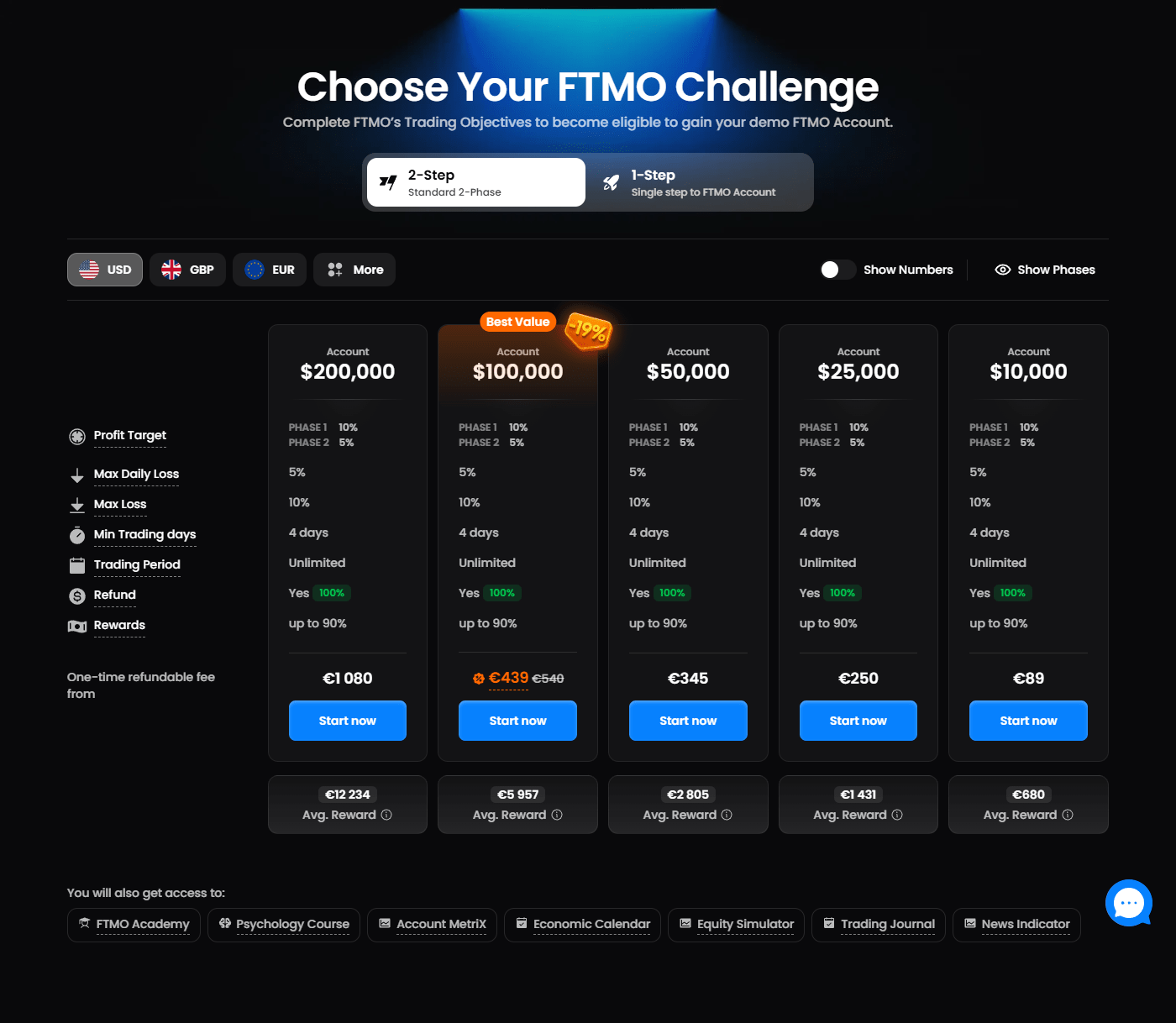
FTMO now runs two evaluation formats side by side: the classic 2-Step (two phases, 10% then 5% profit targets, a looser 5% daily loss limit, starts at an 80% profit split) and the newer 1-Step (one phase, 10% target, a tighter 3% daily loss limit, starts at a 90% split — but adds the "Best Day Rule," which disqualifies you if one lucky day makes up more than half your total profit). Neither format has a time limit, so there's no deadline pressure — but the 1-Step's trailing drawdown and Best Day Rule catch traders who assume "1-Step" just means "faster."
Start an FTMO Challenge only after you've picked the format that actually fits how you trade — not the one that sounds quicker.
2-Step vs 1-Step: the difference that isn't in the headline comparison
| 2-Step (Classic) | 1-Step | |
|---|---|---|
| Phases | 2 (10% target, then 5%) | 1 (10% target) |
| Daily loss limit | 5% | 3% |
| Max drawdown | 10%, static | 10%, trailing |
| Starting profit split | 80% | 90% |
| Best Day Rule | Not applied | Applied — your single best day can't exceed 50% of total positive-day profit |
| Minimum trading days | 4 per phase | 4 |
The static-vs-trailing drawdown distinction matters more than it sounds. On the 2-Step, the 10% loss ceiling is calculated once, from your starting balance — it doesn't move. On the 1-Step, the trailing drawdown threshold rises as your account grows in profit, which means the safety buffer you think you're building up doesn't grow the way a static limit would. Combined with the Best Day Rule, the 1-Step's higher starting split comes with real extra constraints, not just a shorter path to funding.
What actually fails people: the daily loss limit, not the profit target
Public pass-rate data across the industry sits around 5-10% overall, and most of that failure isn't from missing the profit target — it's from breaching the daily loss limit on a single bad session. A 5% (2-Step) or 3% (1-Step) daily limit is tighter than it sounds once normal volatility and a couple of open positions are factored in. Size positions for the daily limit first, the profit target second.
Free Trial and FTMO Swing
If you want to test FTMO's platform before committing to a full evaluation, the Free Trial runs the 2-Step format with a reduced 5% profit target and only 2 minimum trading days (down from 4) — a genuinely lower-stakes way to see the environment. Separately, FTMO Swing is built for traders who hold positions over the weekend or trade around news, both restricted on the standard account — worth checking specifically if your strategy depends on either.
Pricing and scaling
Challenge fees run roughly from the $150s for a $10,000 account up to around $1,080 for the $200,000 account (fees vary slightly between the 1-Step and 2-Step format at the same size). Once funded, FTMO's Scaling Plan can grow an account by 25% every 4 months — up to $2,000,000 — if you post at least 10% net profit across 4 cycles and have withdrawn twice, with the profit split rising toward 90% along the way through the Scaling Plan or Premium Program.
Country restrictions worth knowing
FTMO doesn't restrict Ukraine as a whole — only the specific occupied or contested regions (Crimea, Sevastopol, Donetsk, Kherson, Luhansk, Zaporizhzhia) are affected, due to international sanctions on payment processing to those areas. If you're elsewhere in Ukraine, or in most other countries, account creation itself isn't the issue — but confirm current payout processing status for your specific region before paying for a challenge, since sanctions lists change.
FAQ
Should I pick the 1-Step or 2-Step challenge? If you trade consistently without relying on one outsized day, the 1-Step's higher starting split (90% vs 80%) and single phase are a real advantage. If your results include occasional large wins, the Best Day Rule can disqualify you even while profitable overall — the 2-Step's lack of that rule may suit that trading style better.
Is there a time limit to pass the challenge? No, neither format has a deadline. You do need to meet the 4-minimum-trading-days requirement per phase.
What's the real difference between static and trailing drawdown? Static drawdown is calculated once from your starting balance and never moves. Trailing drawdown rises as your equity grows, so the dollar buffer between your equity and the drawdown line doesn't increase as fast as a static limit would.
Can I hold trades over the weekend or trade the news? Not on the standard FTMO account — that's what FTMO Swing is specifically built for.
Bottom line
FTMO's longevity and payout track record are genuinely the strongest in the category. The choice that actually matters is 1-Step vs 2-Step, and it comes down to whether the Best Day Rule and trailing drawdown fit your trading style — not which one sounds easier. For the full comparison against other funded-account providers, see our FTMO Challenge options directly, or browse the prop trading firm ranking for alternatives.