
How to Withdraw USDT to a Card, and What Each Route Really Costs
Most guides answer this by naming a card, which is the part that ages worst — three of them stopped working while this was being updated. The three routes, what each really costs, and which one fits the way you get paid.
You have USDT sitting on an exchange and you want to buy groceries with it. That is the whole question, and most guides answer it by naming a card and stopping there.
Naming a card is the part that ages worst. The route matters more than the product, because routes stay open for years and individual cards close without warning — three of them did while this guide was being updated.
So this is how to withdraw USDT to a card by route: what each one costs, what it needs from you, and which one fits the way you actually get paid.
The three routes, and what separates them
There are only three, whatever the marketing suggests.
| Route | What it looks like | Typical total cost | Fits |
|---|---|---|---|
| Sell on the exchange, withdraw to your own bank card | One platform, one payout | Trading fee + fiat withdrawal fee | Large, occasional cash-outs where you already have a supported bank |
| Send to an independent exchanger, receive on a card | Two steps, dozens of competing providers | The spread between their rate and the market, plus the network fee | Amounts and destinations exchanges do not serve |
| Move to a multi-currency wallet and spend its own card | Wallet holds the balance, card spends it | Load fee + card issuance + whatever conversion the wallet charges | Recurring income you spend rather than bank |
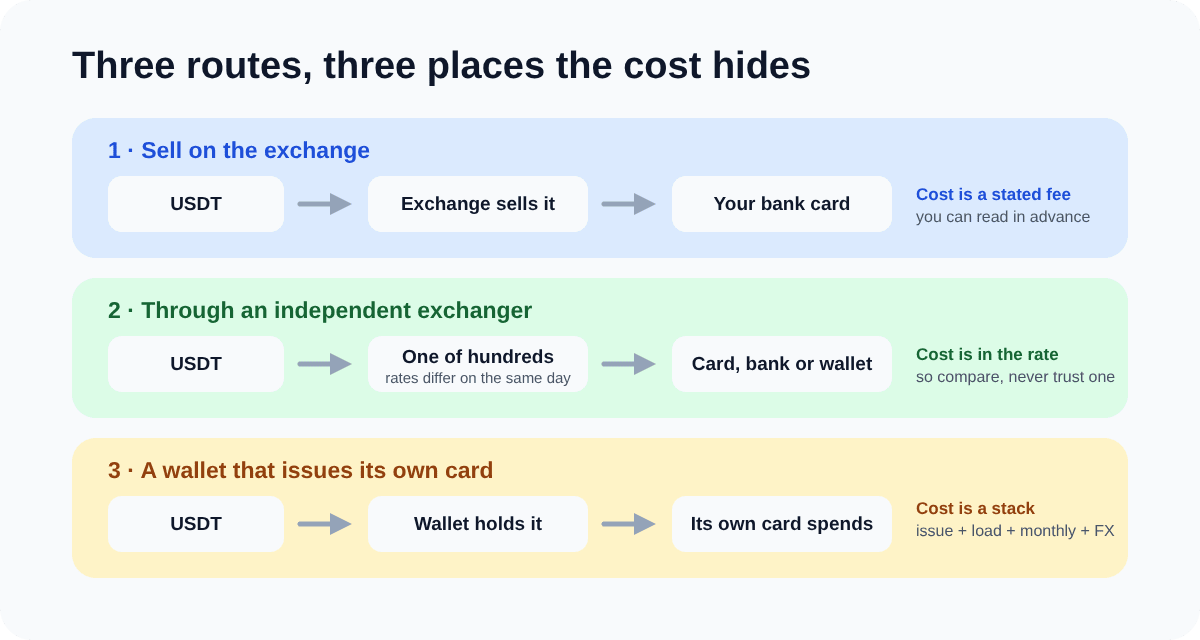
Read that middle column carefully, because it is where the honest comparison lives. Route one hides its cost in a withdrawal fee you can read in advance. Route two hides it in the exchange rate, which is why comparing providers matters more there than anywhere else. Route three spreads it across three smaller charges that each look trivial and add up.
Route one: sell on the exchange, withdraw to your bank card
The simplest path when it works. You sell USDT for your local currency on the exchange, then withdraw that fiat balance to a card or bank account the exchange supports.
Two things decide whether it works for you, and neither is the fee.
The first is whether the exchange serves your country with fiat at all. Crypto trading and fiat withdrawal are separate permissions, and plenty of exchanges offer the first without the second wherever you live.
The second is whether your bank accepts the payment. Banks decline card payouts originating from crypto platforms more often than the exchanges admit, and the money usually returns to your balance after a delay rather than vanishing — but a payout that bounces twice is a route that does not work for you, however cheap it looked.
Test with the minimum before you move an amount you care about. That advice costs a dollar and is the only thing on this page that reliably prevents an expensive week.
Route two: through an independent exchanger
This is the route most guides skip, and it is the one that covers the destinations the exchanges will not.
An independent exchanger takes your USDT and pays out to a card, a bank account or a payment wallet, at a rate they set themselves. There are hundreds of them, their rates differ by more than most people expect for the same direction on the same day, and the good ones publish reserves so you can see whether they can actually fill your order.
The cost here is almost never a stated fee. It is the gap between their rate and the market rate, which is why the only sensible way to use this route is to compare several at once rather than to trust one you found first. That comparison is what our own live exchange monitor does for the USDT-to-euro direction — each provider's rate, reserve and limits side by side, plus a quality score for the provider itself, because the best rate from an exchanger that cannot fill your order is not a rate at all.
The same applies if the destination is a payment wallet rather than a bank: USDT into a Volet dollar balance is a different set of providers with a different spread, and the minimums differ enough to decide which one you can even use.
What this route asks of you is judgement. There is no brand safety net. Check how long a provider has operated, whether anyone reports non-payment, and whether the reserve covers your amount before you send anything.
Route three: a wallet that issues its own card
Here the balance lives in a multi-currency wallet, and the card spends directly from it. No conversion at the moment of purchase, no waiting on a bank payout — the money is already where the card can reach it.
The cost is a stack rather than a single fee: something to issue the card, something to load it, sometimes something monthly, and a conversion charge when you spend in a currency the card does not hold.
As one worked example, Volet publishes 1 USD or EUR for a virtual card and 5 for a plastic one, with loading from the wallet at 1% plus 1 USD or EUR on its European cards. Those are its own published figures and they are the shape to expect rather than a universal rate — every wallet in this category prices differently, and several charge a monthly fee that the headline page does not mention. The full comparison of what these accounts cost to run sits in our payment systems rating.
This route suits money you intend to spend. If you intend to bank it, you are paying a card's costs for a bank's job.
Getting cash out: the four charges nobody adds up
ATM withdrawal is where the advertised cost and the real cost diverge most, because four separate charges stack and only one of them is on the card's fee page.
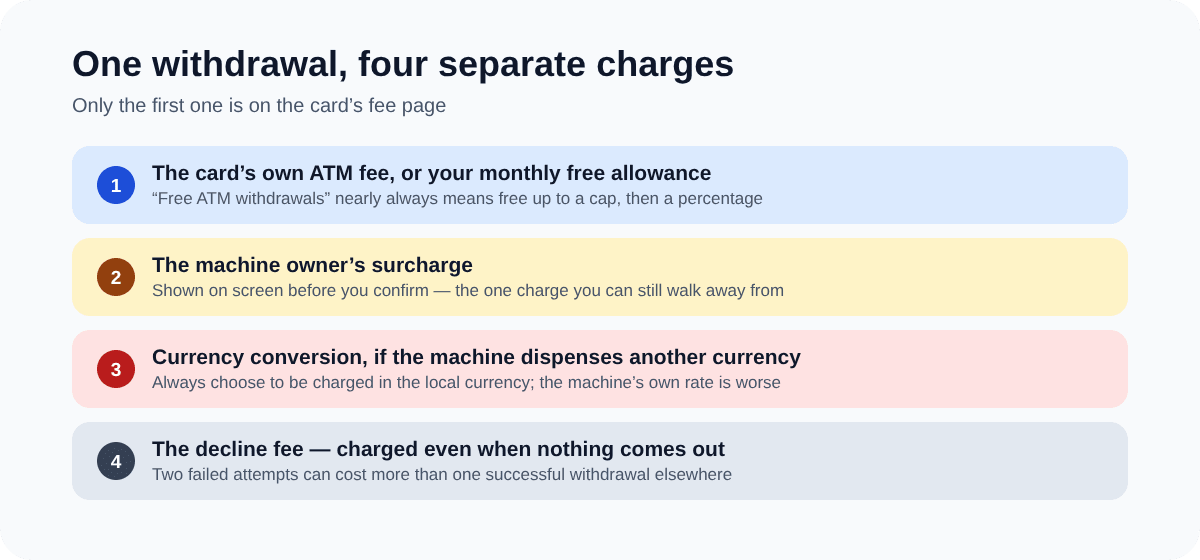
- The card's own ATM fee, or the portion of your monthly free allowance you are using up. Cards that advertise free ATM withdrawals almost always mean free up to a monthly cap, after which a percentage applies.
- The ATM operator's surcharge, which belongs to whoever owns the machine and appears on screen before you confirm. It is the one charge you can decline by walking away.
- The currency conversion, if the machine dispenses a currency your card does not hold. Always choose to be charged in the local currency rather than your card's — the machine's own conversion is reliably worse.
- The decline fee, which several issuers charge even when the withdrawal fails. Two failed attempts at an unsupported machine can cost more than a successful withdrawal elsewhere.
The allowance reset date matters too. A monthly free allowance that resets on the calendar month is not the same as one resetting thirty days from your last withdrawal, and cards do both.
Cards die, and the lists recommending them do not update
This is the part that argues for thinking in routes.
Binance's card is not what most articles still describe. Visa ended its partnership and the Binance Visa debit card was discontinued for European users on 20 December 2023. What Binance offers today is a different product on a different network — a prepaid Mastercard, in a different and smaller set of markets. Articles published this year still list the old Visa card with European availability and cashback tiers attached to it, complete with euro-denominated ATM allowances for a card no European can hold.
Trastra is gone entirely. The London-based crypto card provider ceased operations in March 2025 and filed for insolvency in May. Customers were still reporting no access to their balances months afterwards. It appears on comparison pages to this day.
RedotPay and KAST block account creation in a long list of countries, which no listicle mentions because the writer could open an account from wherever they were sitting. A card you cannot register for is not a card you can use, whatever its fee schedule says.
None of those three earns us anything, which is exactly why they are named here. The lesson is not which card to avoid this month — it is that a card is a product with an owner, a licence and a business model, and any of the three can end. A route does not.
Why every card that actually works asks for your ID
There is real demand for a card that skips verification, and it deserves a straight answer rather than a wink.
Cards that spend at ordinary shops run on Visa or Mastercard. Those networks require the issuer to be a regulated institution, and regulated institutions are required to identify their customers. That is not a policy any individual provider can opt out of while remaining on the network.
So the products that genuinely skip verification are either not real cards, or they are unlicensed and one enforcement action away from freezing with your balance inside. Trastra's customers found out what a card provider's insolvency feels like from the wrong side.
If verification is the obstacle, the honest alternative is route two — an exchanger paying out to a card you already hold, where the identity check already happened at your bank.
Which route fits your withdrawal
- A large, one-off cash-out, and your exchange serves your country with fiat. Route one. The fee is legible and the counterparty is the platform you already trust with the balance.
- A destination your exchange does not support, or an amount below its minimum. Route two, comparing several providers at once rather than accepting the first rate.
- Money arriving regularly that you intend to spend rather than bank. Route three, and price the whole stack — issuance, loading, monthly, conversion — not the headline.
- Money you intend to leave sitting. None of these. A card account is not a savings account, and a balance parked with a payment company is exposed to that company. The reasons an account gets frozen are worth reading before it happens rather than after.
Bottom line
The cheapest route on any given day depends on your amount, your country and your destination, and it changes. What does not change is the shape of the decision: sell where you hold it, use a competitive market of exchangers, or keep a spendable balance in a wallet with a card.
Pick the route first. The product is the easy part, and it is the part most likely to be different in a year.
Card fees, allowances and country availability move constantly. Every figure here was read on the provider's own published pages on the date of this update — check the current ones before you commit an amount that matters.
Related
View category
Getting Money Out of Volet: Every Route and What It Really Costs
All six withdrawal routes from a Volet account priced side by side, the amount where a SWIFT wire stops being the expensive option, and why the same USDT withdrawal has two different prices.
Read article →
Payoneer Review: The Receiving Account, What It Costs, and Where Revolut Isn't Available
Payoneer is a receiving account before it is a wallet: bank details in your own name, in thirteen currencies, that companies and marketplaces pay into as if you banked in their country. What it costs on the way in and out, what the card does, why payments sit under review, and why the Payoneer-or-Revolut question is settled by geography.
Read article →
Volet vs Wise, Revolut and Skrill: Which Account Fits Money You Earn Online
Wise can close an account for receiving money from an unlicensed crypto platform. Revolut takes USDT on Tron but charges to convert it. Where your income arrives from decides the account long before the fee table does.
Read article →