
AI Trading in 2026: How to Use Artificial Intelligence for Forex, Copy Trading and Risk Control
A practical guide to AI trading: what it is, where it helps, how to connect it with forex research, copy trading, broker selection and realistic risk management.
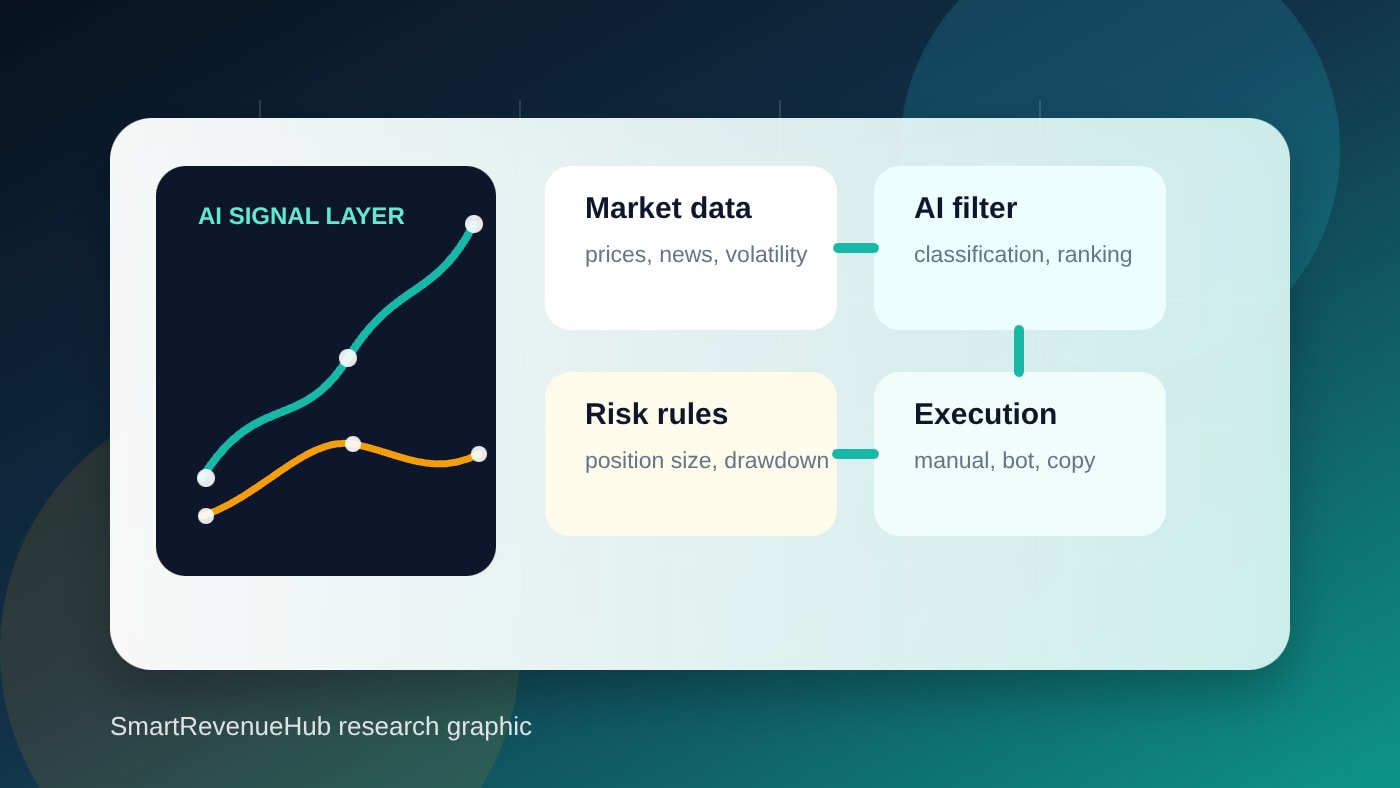
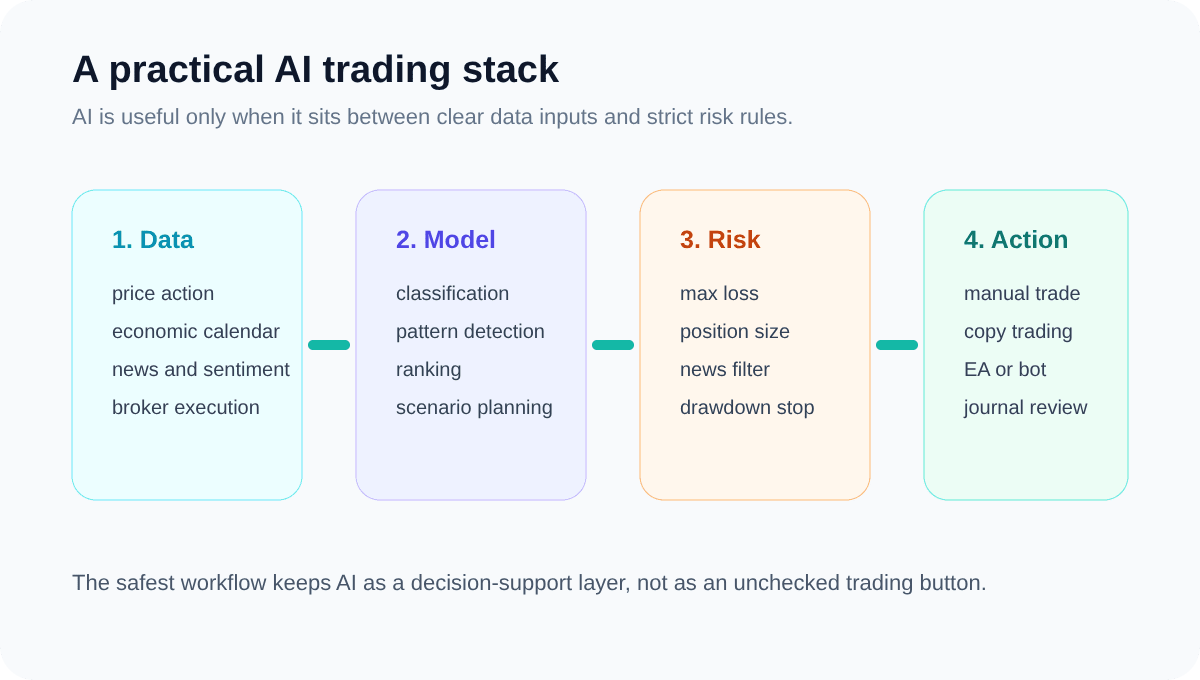
AI trading is one of those phrases that sounds futuristic enough to sell dreams, but the useful version is much more practical. In real trading, artificial intelligence is not a magic button that predicts every candle. It is a decision-support layer that can help collect information, classify market conditions, compare strategies, organize risk rules, and sometimes automate parts of execution after serious testing.
The important word is support. A trader can use AI to process more information than a human can comfortably read in one session, but the final trading plan still needs strict risk limits, broker checks, and a realistic understanding of drawdown. This is especially true in forex, where leverage can turn a small mistake into a large account problem quickly.
Quick verdict
AI trading is most useful when it improves a workflow that already makes sense: research, strategy filtering, journaling, risk control, or semi-automated alerts. It becomes dangerous when a beginner treats a model, bot, signal, or copy-trading profile as a guaranteed income system. The safest approach is to start with a broker and platform setup you understand, then add AI only where it reduces noise or helps you make more disciplined decisions.
If you are still choosing where to trade, start with our forex broker ranking. Broker quality matters because even the best-looking AI model can fail in practice if spreads, slippage, platform stability, withdrawals, or legal entity details are wrong for your country.
AI can help you find patterns faster. It cannot remove market risk, broker risk, leverage risk, or the need to control position size.
Where AI connects to real trading
The first layer is research. AI tools can summarize central-bank commentary, extract key points from earnings reports, compare macro scenarios, and turn a messy watchlist into a structured checklist. This is useful because many traders do not lose only from bad entries; they lose because they trade without context, repeat the same emotional mistake, or jump between systems without a review process.
The second layer is signal filtering. A model can help classify whether the market is trending, ranging, volatile, news-driven, or illiquid. That does not mean the model should open trades by itself. A more sensible use case is to make the trader ask better questions: "Is this setup still valid?", "Is volatility too high for this position size?", "Does this strategy usually survive this kind of market?"
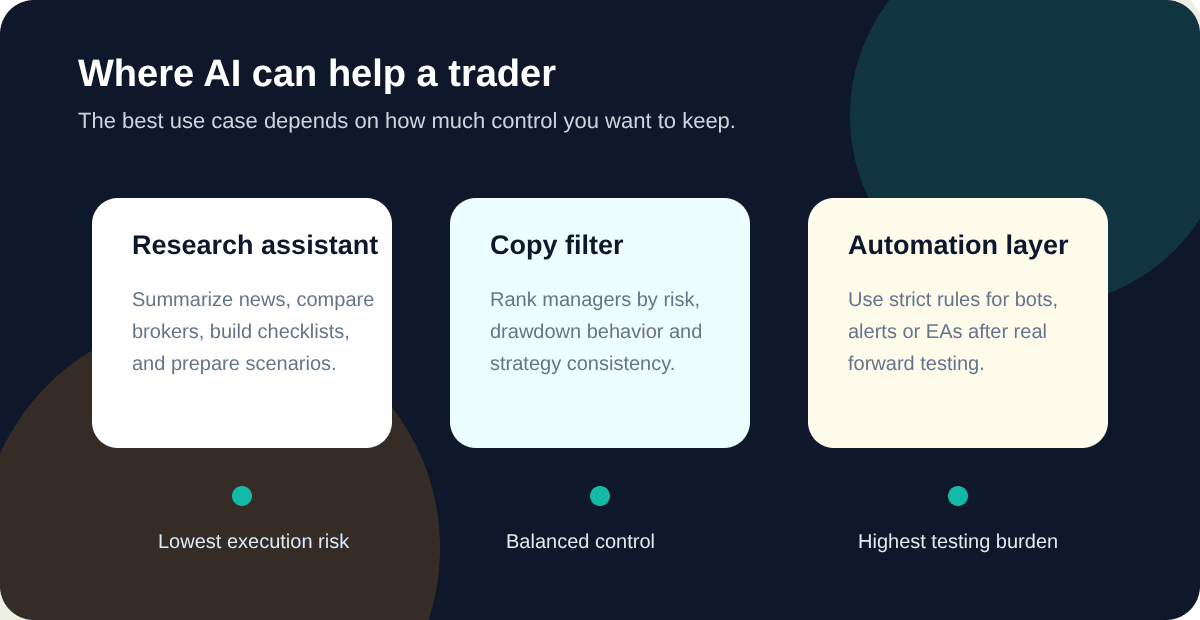
The third layer is execution and monitoring. Advanced traders may connect alerts, bots, Expert Advisors, or API-based automation. Beginners should be slower here. Before automation touches real money, the rules need backtesting, forward testing, demo testing, and a hard stop for abnormal drawdown. AI can help write code or generate trading ideas, but it can also generate confident nonsense, so every rule still needs verification.
| AI trading layer | Practical use | Main risk |
|---|---|---|
| Research | Summarize news, compare brokers, prepare scenarios | Acting on outdated or shallow information |
| Strategy filter | Rank setups, classify volatility, review signals | Overfitting and false confidence |
| Copy selection | Compare managers by drawdown and consistency | Chasing recent profit without reading risk |
| Automation | Alerts, bots, EAs, execution rules | Running live money before forward testing |
| Journal review | Find repeated mistakes and weak conditions | Ignoring the review when it contradicts the trader |
A practical route: use AI to choose better copy-trading strategies
For many investors, the most realistic first step is not building a fully autonomous trading robot. It is using AI as a filter for copy-trading and managed strategy selection. You can ask the tool to summarize a trader's history, compare drawdown patterns, create a checklist, and highlight what still needs manual verification before you allocate money.
RoboForex Copy Trading / CopyFX strategy ranking is a practical place to study this workflow because it gives you a wider marketplace of strategies to compare by period, platform, profitability and risk profile. Our own CopyFX watchlist stays intentionally short, but the full RoboForex ranking gives you more strategies to filter when you want to search for a manager that matches your allocation size and risk tolerance.
This is where AI can help without pretending to be a trader. Instead of asking "which strategy will make the most money?", ask AI to build a comparison table: account age, drawdown, recent performance, recovery behavior, trade frequency, average holding time, open floating risk, and whether the strategy looks stable across different market phases. The final decision is still yours, but the workflow becomes much less random.
IC Markets, social trading and the AI angle
IC Markets is interesting from another angle. It is not only a low-spread broker candidate; it also has several social or copy-trading routes around its platform ecosystem, including ZuluTrade, cTrader Copy, IC Social and Signal Start depending on region and account setup. That gives an AI-assisted investor more than one way to approach the same problem: compare brokers first, then compare strategy marketplaces, then decide where the execution environment looks most suitable.
For example, ZuluTrade and cTrader Copy are more about following strategy providers, while cTrader Algo and MetaTrader Expert Advisors move closer to rule-based automation. AI can help document the differences, create due-diligence questions, and build a personal scoring model. It should not replace checking the actual account conditions, supported country, fees, spreads, leverage, and platform availability.
The due-diligence checklist before using AI signals
Before you follow any AI-generated idea, bot, signal provider, or copy-trading manager, slow down and write the investment case in plain English. If you cannot explain why the strategy should work, when it usually fails, what maximum loss you can tolerate, and why the broker setup is acceptable, the idea is not ready for real capital.
Use this checklist as a starting point:
- Does the strategy have enough live history, not only a perfect-looking backtest?
- Is drawdown measured on closed trades only, or is there dangerous floating loss?
- Does the position size stay stable, or does the manager increase risk after losses?
- Are spreads, commissions and swaps realistic for the broker account you will use?
- Can you stop copying, withdraw funds, or reduce allocation without complicated steps?
- Is the strategy still understandable after you remove marketing language from the description?
A simple AI trading workflow for beginners
Start with manual research. Pick one market, one broker shortlist, and one trading approach. Use AI to summarize learning material, compare broker conditions, and turn your notes into a checklist. At this stage, the goal is not profit; the goal is clarity.
Then move to observation. Watch several strategies or setups without allocating meaningful money. AI can help keep a journal: why the trade was opened, what market condition existed, how the trade behaved, and whether the original idea remained valid. Over a few weeks, this journal becomes more valuable than a random indicator recommendation.
Only after that should you test small allocation. If you copy a manager, start small and limit exposure. If you use an EA or bot, run it on demo first, then on very small size. If you use an AI-generated signal, treat it like a research note, not a command. The goal is to survive enough market conditions to learn whether the process is actually useful.
What AI cannot solve
AI does not solve weak discipline. It does not know your personal financial situation, tax position, withdrawal needs, or emotional reaction to drawdown. It can also hallucinate facts, misunderstand broker conditions, or overvalue recent performance because the input data looks impressive. In trading, a wrong answer delivered confidently can be worse than no answer at all.
AI also cannot remove the basic conflict between return and risk. A strategy that looks smooth may be hiding exposure. A copy-trading manager with high recent profit may be using leverage that is unacceptable for your account size. A bot that worked in a trending market may fail in a sideways market. That is why every AI-assisted decision should end with a human risk check.
Bottom line
AI trading is not a shortcut around learning the market. It is a toolkit for traders and investors who want better research, cleaner checklists, faster comparison, and more disciplined reviews. The most realistic path is to use AI first as an analyst, then as a filter, and only much later as part of automation.
For SmartRevenueHub, the practical direction is clear: combine broker research, copy-trading watchlists, and risk-focused education. Start with the forex broker ranking, compare available copy-trading routes on the CopyFX watchlist, and only then decide whether AI should help you research, filter or automate part of the process.
