
Copy Trading Portfolio Diversification: Why One Account Isn't a Portfolio
The biggest risk in copy trading is putting your entire allocation into one strategy, however good it looks. Here's how to actually diversify across risk profiles, not just across accounts.

The single biggest risk-management mistake in copy trading isn't picking a bad strategy — it's putting your entire allocation into one account, no matter how good that account looks. A portfolio built from several strategies with different risk profiles survives a single account's bad month. A portfolio that is really just one account, however well-chosen, does not.
Quick verdict
Treat copy trading the same way you'd treat any other investment: no single position should be large enough to hurt you badly if it goes wrong. That means splitting an allocation across strategies with genuinely different risk profiles and instruments — not several accounts that all happen to trade the same pair with a similar style, which isn't real diversification, just the same risk copied three times.
Why "one great account" isn't a portfolio
It's tempting to find one high-performing strategy — like a martingale-style gold strategy with a steep yield curve — and allocate everything to it. The problem is straightforward: every strategy has a worst-case scenario, and no amount of past performance tells you when that scenario arrives. If 100% of your copy-trading allocation sits in one account and that account has its worst month, you have no other position to offset the loss.
This is the same logic that applies to stocks, crypto, or any other investment: concentration increases both the best-case and worst-case outcome. Diversification doesn't increase your expected return — if anything, it slightly lowers your best-case number — but it dramatically reduces the odds of a single event doing serious damage to your capital.
What "different risk profiles" actually means
Real diversification means the strategies you combine don't tend to lose money at the same time, for the same reason. A few practical categories to mix instead of stacking similar accounts:
| Risk category | Typical behavior | Example |
|---|---|---|
| Martingale / grid | Smooth curve, rare but severe drawdowns | High-yield gold or FX grid strategies |
| Trend-following | Slower, choppier equity, smaller max drawdown | Multi-week directional systems |
| Lower-leverage / conservative | Modest returns, small drawdowns, longer track record | Conservative multi-pair accounts |
| Rule-based / AI-assisted filtering | Depends on the underlying model's risk controls | See our AI trading guide for how to evaluate these |
Combining even two or three categories above, instead of one, means a bad month in a high-yield martingale strategy doesn't have to be a bad month for your whole allocation.
A simple way to size a copy-trading portfolio
Start by deciding what you can genuinely afford to lose completely, and treat that as your total copy-trading budget — not your whole trading capital. From there:
- Cap any single strategy at a percentage you'd be comfortable losing entirely (many experienced copiers use somewhere around 10-25% per strategy, never 100%).
- Mix at least one lower-volatility, longer-track-record strategy with any higher-yield, higher-drawdown one.
- Re-check each strategy's drawdown history periodically — a strategy that looked conservative a year ago can change its risk profile over time.
- Don't confuse "different account" with "different risk" — three martingale-style gold strategies from three different providers still move together if gold makes the same sharp move against all of them.
FAQ
How many accounts should a copy-trading portfolio have? There's no fixed number — what matters is that the strategies behave differently from each other, not the count. Two genuinely different strategies beat five similar ones.
Does diversification lower my returns? It can lower your best-case return, since you're no longer "all in" on the single best performer. In exchange, it removes the scenario where one account's worst month becomes your worst month.
Is it enough to diversify across different brokers? No — the broker doesn't determine the risk profile, the strategy does. The same high-drawdown strategy style carries the same risk regardless of which broker or platform it runs on.
Bottom line
A copy-trading "portfolio" only earns that name if the strategies inside it actually behave differently from each other. Before adding a new strategy, ask what specifically makes it different from what you already hold — instrument, style, typical drawdown, and how it behaves in a losing month. If the honest answer is "not much," it's not diversification, it's just more of the same risk. Browse strategies with clearly stated risk profiles on our Forex Copy watchlist.
Related
View category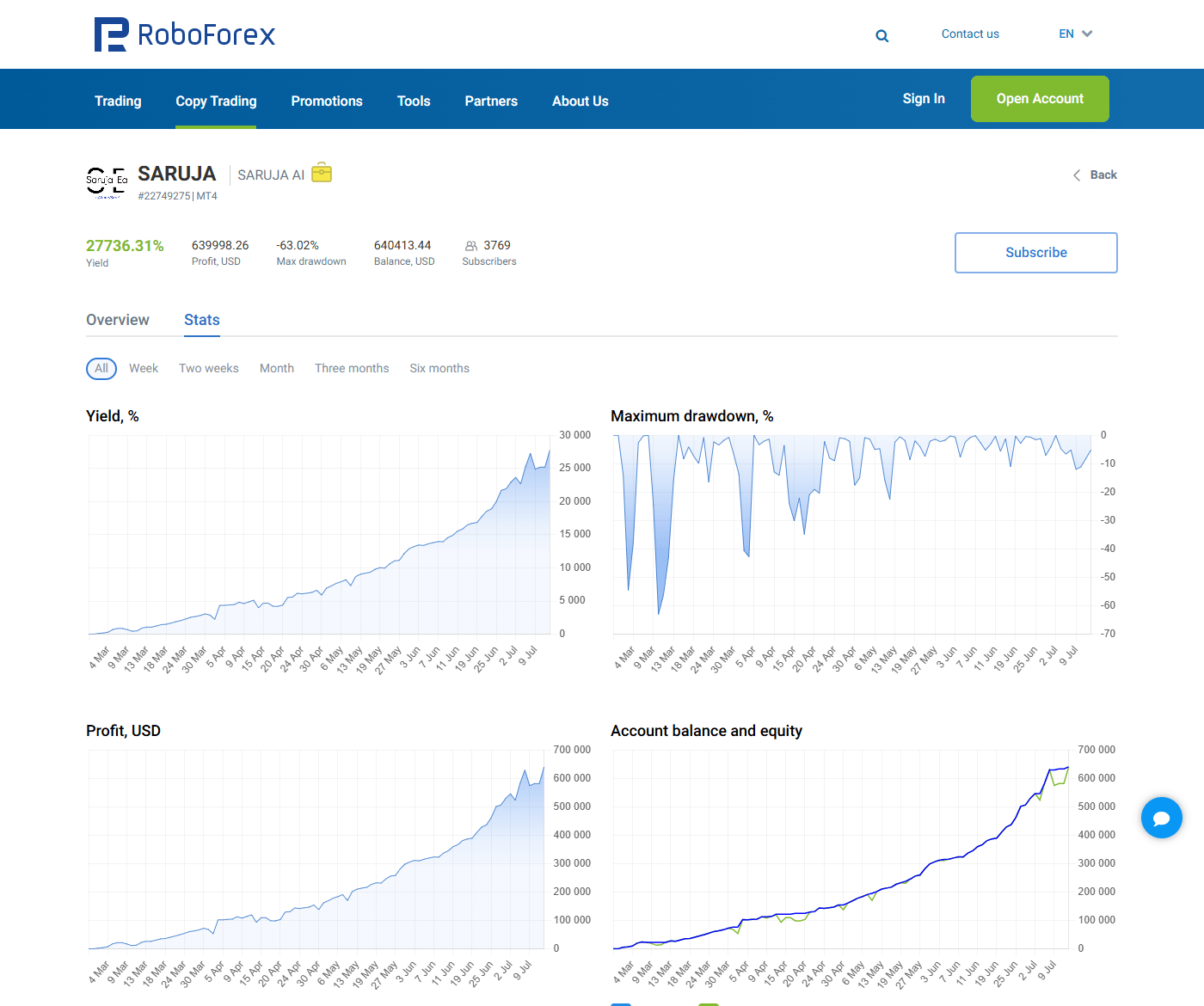
RoboForex Copy Trading Leaders: Who Is on Top Right Now
A periodically refreshed look at the top of RoboForex's public Copy Trading rating — real yield, real drawdown numbers, and the risk pattern behind the best-looking chart.
Read article →What Is a Martingale Strategy in Copy Trading? (Why the Chart Looks Smooth Until It Doesn't)
Martingale and grid-style money management can produce a smooth, steadily rising equity curve in copy trading — right up until a single move against the position wipes out months of gains. Here is how it works and how to spot it from public stats alone.
Read article →