
Payoneer Review: The Receiving Account, What It Costs, and Where Revolut Isn't Available
Payoneer is a receiving account before it is a wallet: bank details in your own name, in thirteen currencies, that companies and marketplaces pay into as if you banked in their country. What it costs on the way in and out, what the card does, why payments sit under review, and why the Payoneer-or-Revolut question is settled by geography.
Quick verdict
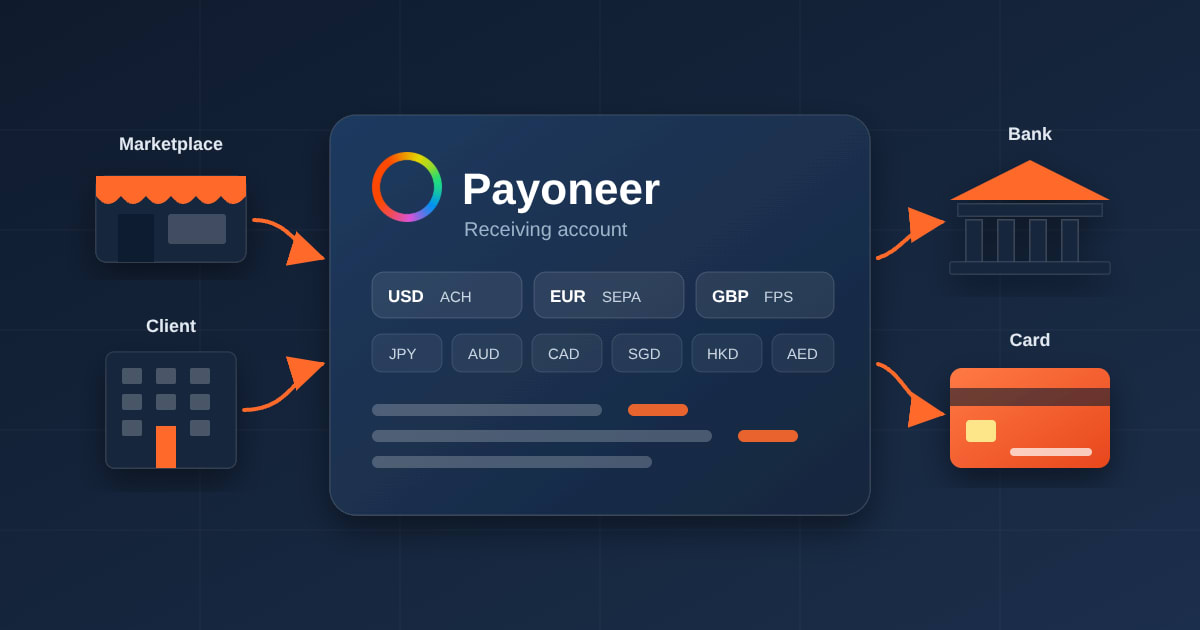
Payoneer is a receiving account first and a wallet second. Its product is a set of bank details in your own name, in thirteen currencies, that companies and marketplaces pay into by ordinary local transfer as if you had a bank account in their country. Everything else, the balances, the card and the withdrawals, exists to move that money on.
We score it 3.75 out of 5 in our payment systems rating. It scores well on where it can be opened and on who regulates it, and it loses points on the things a reader paid in crypto cares about: it holds no coin at all, and its compliance reviews hold money often enough that the complaints have a shape. The score was re-verified on 17 September 2026, and every fee and rule on this page was read from Payoneer's pricing page and help centre that day.
One line settles most decisions about it. If Revolut will open an account for you, Revolut is the better card and the cheaper place to hold money. Payoneer's case starts where Revolut's map ends, and Payoneer's own map runs past a hundred and ninety countries and territories while Revolut's has about forty.
Payoneer at a glance
| Our score | 3.75 / 5 |
| Best for | Getting paid by marketplaces and foreign business clients, then moving the money to a local bank |
| Weakest at | Holding money, crypto of any kind, and the speed of its compliance reviews |
| Strongest at | Local receiving details in thirteen currencies, and opening where neobanks will not |
| Holds | USD, EUR, GBP, JPY, AUD, CAD and other fiat balances; no cryptocurrency |
| Card | Business Mastercard, physical and virtual, 29.95 USD a year |
| Regulated by | FinCEN and state licences in the US, the Central Bank of Ireland in the EEA, the FCA in the UK, and five more regulators |
| Listed | Nasdaq, as PAYO; agreed in June 2026 to be bought by Nuvei, expected to close in mid-2027 |
What a Payoneer receiving account actually is
Open the account, go to Get paid, and request receiving accounts. What comes back, from a few minutes to three business days later depending on your business type and country, is a set of bank account details in your own name or your company's: an account and routing number for US dollars, an IBAN and BIC for euros, an account number and sort code for pounds. Payoneer's help centre lists local details in USD, EUR, GBP, JPY, AUD, CAD, HKD, SGD, AED and MXN, its product page adds BRL, KRW and IDR, and on top of that there are SWIFT details for dollars, euros and pounds from anywhere else.
A payer uses them like any other bank account. A US client sends an ACH transfer, a German client sends a SEPA transfer, and Upwork, Fiverr, Amazon or Airbnb pay out through their own Payoneer integration. Nothing about the transfer tells the payer's bank that the destination is not a bank. The money arrives in the matching currency balance inside Payoneer, and from there you withdraw it, spend it on the card, or pay another Payoneer user.

That is the whole product, and the rules around it are the part most reviews skip.
Only business payers. The help centre is blunt: "Only payments for business transactions from business accounts are supported. Payments from personal bank accounts will be declined." A transfer from a bank account in your own name is declined too, unless your account has been cleared to add its own funds, and so is a payment from a company you own. A friend cannot pay you through it and neither can your own savings account. The details are for clients, customers and marketplaces, and Payoneer treats every payment as one it may review before releasing.
Reviewed, not instant. Payoneer's own guide to payment statuses says every payment to your balance is reviewed before it becomes available, that a payment can take up to five business days to arrive, and that a payment from an unapproved sender is returned to that sender within seven to ten business days. Payments that clear do so without you noticing. The ones that stall are the reason "receiving account under review" and "payment on hold" are among the phrases people search most often about the service, and the section on holds below is about them.
Issued on paper. Getting the details means a receiving-account questionnaire, identity documents, a verified bank account, and for a company the names of its beneficial owners. The SWIFT account asks the business questionnaire again. There is a cap on how many receiving accounts you can hold in one currency, and the beneficiary name a payer types has to match the one on your details, or the payment may be declined.
Whether this is a strength or an irritation depends on what you are. For a sole trader paid by three foreign companies it is the closest thing to a local bank account in each of their countries that a person outside those countries can get. For someone hoping to be paid by people rather than businesses, it is the wrong product.
What it costs on the way in
Payoneer's pricing page, which has no country selector and describes itself as the standard schedule, prices receiving by how the money arrives.
| How the money arrives | Fee |
|---|---|
| From another Payoneer customer's balance | Free |
| Through a receiving account, in your local currency | Free |
| Through a receiving account, in a currency that is not your local currency | 1%, minimum 1.00 USD |
| From a marketplace or integrated platform | Set by the marketplace |
| The payer pays from an EU or UK bank account, or by US ACH debit | 1% |
| The payer pays by credit card, or by PayPal in the US | Up to 3.99% + 0.49 USD |
The row that matters is the third one, and it matters most for exactly the people Payoneer serves best. "Your local currency" is the currency of the country you registered from. A freelancer in Germany receiving euros through the EUR details pays nothing; the same freelancer receiving dollars pays 1%. A freelancer in Pakistan, Nigeria, Ukraine or the Philippines has no local-currency receiving account at all, because none exists in rupees, naira, hryvnia or pesos, so on the published schedule every receiving-account payment is a non-local one. Payoneer's receiving-accounts page says the fee "varies by country and currency" and that the exact figure sits on the Pricing and Fees page inside your account, which is where to check before quoting a client.
Card and PayPal payments are the expensive door, at up to 3.99% plus 0.49 USD, and Payoneer says so plainly. The 1% bank-debit route exists for clients who will not make a transfer but will authorise a pull from their account.
What it costs on the way out
Getting the money to a bank is where the schedule splits the world in two.
In the EU, the UK, the US, Canada, Australia, Japan, Singapore, Mexico, Poland, the Philippines, Vietnam and a dozen or so more countries, a withdrawal to a bank account in that country's own currency is a flat 1.50 USD. Everywhere else, or into any currency that is not the account's own, the withdrawal is priced as a percentage, published as 1.2% to 4%, with a minimum that can reach 20 USD in some countries. The exact rate and the amount that will land are shown on the withdrawal summary before you confirm, and that screen is the only figure to trust for your own case.
When a currency changes on the way out, the conversion margin sits inside the rate rather than on a separate line. Payoneer's own guide for Ukrainian users describes its conversion as up to 2% off the interbank rate and withdrawals to hryvnia accounts as 0.5% to 2% depending on the currency; a Ukrainian accountancy guide updated this week puts the practical figure at around 2% whether the money goes by IBAN in one to three business days or through the direct Monobank and PrivatBank integrations that credit within hours. The minimum withdrawal is 50 USD.
Moving money between your own balances, dollars to euros say, costs 0.50%.

Then there is the fee for doing nothing. Payoneer charges an annual account fee of 29.95 USD, and waives it only if the account has received at least 6,000 USD in any twelve consecutive months. It is charged no earlier than twelve months after registration, an upgrade to the Premium plan for a one-time 39.9 USD waives it for a year, and if the balance cannot cover it Payoneer takes whatever is there until the balance reads zero. The threshold used to be 2,000 USD, and much of what is written about Payoneer, including our own rating note until today, still quotes that figure. For an account that receives one 500 USD payment a month, this fee alone is half a percent on the year.
The Payoneer card
The card is a business Mastercard, issued by Payoneer Europe from Ireland for most of the world and, for eligible US customers, a corporate purchasing card issued by First Century Bank. It comes as a physical card and as virtual cards, in USD, EUR, GBP, CAD or JPY, and it spends the matching balance directly, which is the point: money can go from a client to a purchase without ever being withdrawn.
Its costs are separate from the account's, and the two are easy to confuse because both are 29.95 USD. The annual card fee is 29.95 USD and is charged whatever you receive; the annual account fee above is the one the 6,000 USD waiver applies to. Additional virtual cards are free, standard delivery is free, and a replacement is 12.95 USD.
The transaction fees are where a card built for a global customer shows its shape. A purchase with no currency conversion costs up to 1.8% unless the merchant is in the same country as the card's issuer, which for a card issued from Ireland means most purchases outside Ireland carry it. A purchase with conversion costs up to 3.5%. An ATM withdrawal is 3.15 USD, 2.50 EUR or 1.95 GBP plus the same 1.8% or 3.5%. Set against Revolut, where spending in the card's own currency is free and exchange on the free plan carries a monthly fee-free allowance, the Payoneer card is a way to spend Payoneer money, not a card to run a household on.
One regional note: Payoneer says it cannot deliver physical cards into Ukraine at present. It will ship to an address outside the country against proof of residence, and virtual cards are issued as normal.
Payoneer vs Revolut: decided by geography
Search "payoneer vs revolut" and the answers compare fee tables. The tables are not what decides it. Revolut opens personal accounts for residents of about forty countries and ten overseas territories: the EEA, the UK, Switzerland, the US, Australia, New Zealand, Japan, Singapore and Brazil. Payoneer registers customers from more than a hundred and ninety countries and territories, the exceptions being sanctioned regions and a handful of markets where it cannot support direct sign-up.
For a reader in one of Revolut's forty, Revolut is usually the better account for everyday money: a licensed bank in the UK, free spending in the card's own currency, crypto deposits into the same app. For a reader in the other hundred and fifty, the comparison does not exist. Ukraine is the sharpest example. Revolut closed the accounts of Ukrainian residents on 22 February 2026 after the National Bank of Ukraine said a local licence was required, and Payoneer, which was withdrawing to hryvnia accounts before that and still is, became the answer by default. The same pattern holds in Pakistan, Nigeria, India, Kenya and Bangladesh, which are also, not by coincidence, the countries people most often ask "is payoneer available in".
Where both are open, the honest split is by what the money is for. Payoneer wins on receiving from marketplaces and on being paid by companies through local details; Revolut wins on holding, spending and converting. Many freelancers inside Europe run both for exactly that reason, receiving on one and living on the other. Wise sits in the same conversation with its own rule about crypto proceeds, and our comparison of Volet, Wise, Revolut and Skrill is the piece for that side of it.
Holds, reviews and what Trustpilot shows
Every payment into a Payoneer balance is reviewed before release, and most reviews take seconds. The ones that take weeks are the platform's real weakness, and they are visible in public. On 17 September 2026 Payoneer's Trustpilot profile carried 63,390 reviews, 69% of them five stars and 15% one star, and no score at all: where the number normally sits, the profile shows the notice "This company's rating is unavailable due to a breach of our guidelines", and does not say which guideline. The one-star reviews repeat one story: a payment marked pending, a request for documents, the documents uploaded, and then silence for weeks with the balance locked.
None of that is unusual for a regulated payment institution, and much of it is triggered by a mismatch between the account and the money: a payer whose name does not match, a personal account paying a business receiving account, a marketplace paying an account registered under a different name. The practical defence is dull. Register under the exact name the marketplace or client will pay, keep the documents Payoneer asked for at sign-up current, and treat the receiving account as a place money passes through rather than a place it lives. Our account-risk score of 3 out of 5 is the honest number for a service whose complaints are consistent rather than rare.
Regulation, and who stands behind it
Payoneer is regulated where it operates rather than in one place. Payoneer Inc. is registered with FinCEN as a money services business and licensed as a money transmitter in every US state that requires it; Payoneer Europe Limited is an e-money institution authorised by the Central Bank of Ireland and passported across the EEA; Payoneer Payment Services (UK) Limited holds the same status with the FCA; and there are licensed entities in Hong Kong, Japan, Australia, Singapore and India. Client money in Europe is held under e-money safeguarding rules, not under deposit insurance. Payoneer is not a bank anywhere, and has applied to become one in a narrow sense: in February 2026 it asked the OCC for a national trust bank charter for a proposed PAYO Digital Bank, N.A., a stablecoin and custody entity that would neither take deposits nor lend.
It is also one of the few payment providers whose accounts you can read. Payoneer Global is listed on Nasdaq as PAYO, and its second-quarter 2026 results, published on 6 August, showed 23.7 billion USD of payment volume in the quarter and 7.7 billion USD of customer funds held at 30 June 2026. That transparency has a date on it: on 15 June 2026 Payoneer agreed to be acquired by Nuvei for 7.40 USD a share, about 2.75 billion USD, in a deal expected to close in mid-2027. If it closes, Payoneer becomes part of a private company and the quarterly filings stop. We score regulation 4.5 of 5 today, on the licences and the filings as they stand.
Crypto: none, and stablecoins on the way
Payoneer holds no cryptocurrency. It does not accept deposits of it, it does not sell it, and there is no crypto balance to convert. In February 2026 it announced stablecoin capabilities built on Bridge, the Stripe-owned infrastructure company, saying customers would be able to receive, hold and send stablecoins and withdraw them to a local bank account, launching "in select markets in Q2 2026, with broader availability rolling out throughout the year". The announcement did not name which stablecoins or networks, and as of mid-September it is not a feature of the account most readers can open, so we score asset coverage on what exists.
If your income arrives as USDT, this is not your account, and it is not meant to be. Our Volet.com wallet guide covers the one account we rate that holds fiat and crypto side by side, and the comparison linked above explains why Wise and Revolut land in different places on the same question.
How we scored it
| Component | Weight | Score | Why |
|---|---|---|---|
| Getting money out: cost and routes | 20% | 4 | A flat 1.50 USD in the EU, UK, US and about twenty more countries, a percentage elsewhere, the conversion margin inside the rate |
| Where it is actually accepted | 20% | 4 | Marketplaces pay into it directly and any business can pay it by local transfer; nothing pays a private person into it |
| Currency and asset coverage | 15% | 3 | Thirteen receiving currencies and no crypto; stablecoins announced, not scored |
| Account risk and fund-source rules | 15% | 3 | A review on every payment, holds that run for weeks in the complaints, a Trustpilot score currently withheld |
| Country availability and onboarding | 10% | 4.5 | Registers from more than 190 countries and territories; sign-up is a form, receiving details are paperwork |
| Regulation and licensing | 10% | 4.5 | Licensed in eight jurisdictions and listed on Nasdaq; not a bank, and the listing ends if the Nuvei deal closes |
| Cards and spending | 10% | 3.5 | A working Mastercard with a 29.95 USD fee and up to 1.8% on most purchases abroad |
The weighted result is 3.75. The weights are the same for every payment system we rate and are explained on the methodology page. Partner links never move a score on this site, and this entry was scored a month before Payoneer's link existed.
Who Payoneer suits
A good fit if: you are paid by marketplaces or foreign business clients and live somewhere Revolut and Wise do not serve; you need a local bank-transfer destination in dollars, euros or pounds without a bank account in those countries; you receive enough that the 6,000 USD waiver takes care of the annual fee.
A poor fit if: the people paying you are individuals rather than businesses; your income arrives in crypto; you want somewhere to keep money rather than pass it through; or you live in one of the forty countries where Revolut will open an account, unless marketplace payouts are the point.
Bottom line
Payoneer does one thing most of its rivals cannot: it gives a person almost anywhere a set of real, local bank details that businesses in the US, Europe, the UK, Japan and Australia can pay into. Around that it charges for nearly every step, holds payments it does not like the look of, and offers no crypto. For the reader it was built for, someone outside the neobank map being paid by companies abroad, that trade is worth making, and the 3.75 says so. For everyone else, the receiving account is the reason to open it, and the reason to move the money out again quickly.
Related
View category
Volet vs Wise, Revolut and Skrill: Which Account Fits Money You Earn Online
Wise can close an account for receiving money from an unlicensed crypto platform. Revolut takes USDT on Tron but charges to convert it. Where your income arrives from decides the account long before the fee table does.
Read article →
Getting Money Out of Volet: Every Route and What It Really Costs
All six withdrawal routes from a Volet account priced side by side, the amount where a SWIFT wire stops being the expensive option, and why the same USDT withdrawal has two different prices.
Read article →
Which Forex Brokers Actually Accept Volet? We Checked Each One
Third-party lists all repeat the same unsourced claims about which forex brokers accept Volet. We checked all 17 brokers on our own rating against their own official sites instead: one confirmed, seven confirmed no, nine could not be verified publicly — and why that gap matters.
Read article →