
Short Stop Is Law Review: A Gold Breakout EA on Six Accounts
Short Stop Is Law sits high in our CopyFX rating on a record with no double-digit fall. The same trader runs the same gold breakout EA on five other accounts, and three of them have already been through falls the listed one has not. What the whole family shows, what the fee history says, and how to size it.
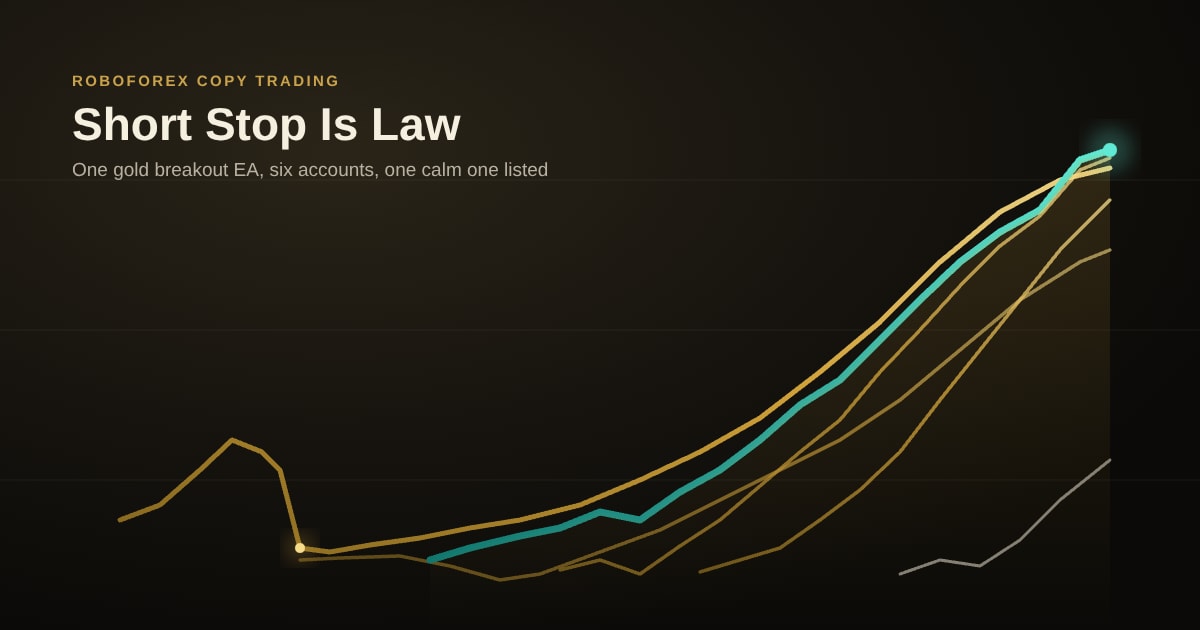
All figures in this review were read from RoboForex's public data on 10 September 2026; the curves run to 8 September. It is a snapshot of that day.
Short Stop Is Law sits high in our CopyFX rating on a record that has never contained a double-digit fall. That record is real, and this review does not take it away. It does put it in context, because the account is one of six the same trader runs on the same gold breakout EA, and three of the six have been through the kind of double-digit fall the listed one has not. The listed account opened on 8 May 2025, three months after its oldest sibling lost 23.8% in twelve days, and that sibling did not get back above its January peak until December.
That is the finding this page is built around. The rest is what the account is, what the software claims, what the fee history shows, and how a follower should read a family of accounts rather than a single card.
What the account is
| Strategy | Short Stop Is Law (trader Kuropatkin, account 72170379) |
| Software | Gold Spike, a breakout expert advisor, by the trader's own description |
| Instruments traded | XAUUSD 79%, GBPUSD 18%, USDJPY 3% of closed trades |
| Running since | 8 May 2025 |
| Account type | Standard USD account, leverage 1:200 (not a cent account) |
| Minimum to follow | $300 |
| Trader's fee | 20% of your profit, settled weekly |
| People copying it | 22 |
| Trades | 738 |
| Trader's own balance | $2,608 |
RoboForex publishes the account's live figures; the copy page is Short Stop Is Law on RoboForex Copy Trading.
738 trades in sixteen months is about eleven a week. The account has closed results on 203 of the roughly 350 trading days since it opened, so it does not trade every day, and when it does the positions are short: the trader's description promises a stop and a target on every one, and the record of small, quickly recovered dips is consistent with that.
A gold breakout EA, in the trader's words
The description on the card is a product sheet for the software rather than a note about this account. It names the program, Gold Spike, calls it "a powerful EA for gold", and describes the method as "breakouts of key support/resistance levels", with "multiple confirmation algorithms", a stop-loss and take-profit on every trade, a trailing stop, and "adaptive lot sizing based on balance/drawdown". It lists the recommended account type for running the EA (ECN), balance ("from $500, optimal $1000+") and leverage ("1:100 or higher"), and closes with "Backtests: stable growth, low drawdowns, stress-tested on max history — no failures."
Three things in that text can be checked against the record.
"Instrument: XAUUSD (gold only)." Not on this account. Of its 703 closed trades with an instrument recorded, 129 are GBPUSD and 20 are USDJPY, a fifth of the book. On two of the trader's other accounts the currency pairs are the majority. The description is near-identical on every account; the trades are not.
"Adaptive lot sizing based on balance/drawdown." This is the phrase to slow down on. Sizing positions to the balance is ordinary money management. Sizing them to the drawdown can mean two opposite things: trading smaller after losses, which is prudent, or trading larger after losses to win them back, which is the mechanism behind every smooth curve that ends in a cliff — the pattern our martingale explainer describes. The record of this account does not show the second pattern: its worst episodes are shallow and recover in days, not through one oversized win. But the wording admits both readings, and a follower should know which is meant before treating "adaptive" as reassurance.
"Stress-tested on max history — no failures." The live record of the trader's oldest account, below, contains a 23.8% fall. Whether that counts as a failure is a matter of definition; that it happened is not.
The record
| Window | Return | Reported drawdown |
|---|---|---|
| All time (since 8 May 2025) | +175.27% | −4.25% |
| Last year | +157.29% | −4.13% |
| Last 2 weeks | +1.37% | −1.07% |
| Last week | −0.15% | −0.23% |
Sliced into four non-overlapping quarters, the last twelve months read +14.2%, +47.4%, +25.6% and +21.7%: no quarter was flat and no quarter carried the whole result. Fourteen of the account's seventeen calendar months have been positive; the worst month was −3.0% (October 2025) and the best +19.3% (March 2026). The curve set its all-time high on 19 August 2026 and closed the reading 0.4% below it.
The drawdown, measured twice
RoboForex prints a maximum drawdown of 4.25% for this account. That figure is the worst single step in its daily series, not the distance from a peak to the trough that followed, which is why our score reads the full curve instead. On the curve, the deepest fall is 7.8%, from 28 November to 9 December 2025, recovered two days later. The next three are 5.7% (May to June 2025, the account's first weeks), 5.4% (October 2025) and 5.1% (13 July to 3 August 2026).
Both numbers are single digits. The account has also never carried much open risk: the widest open loss in its daily history, the gap between balance and equity, was $104, on 10 June 2025, about 3% of the balance that day. For a strategy that trades gold breakouts with stops, that is the shape you would hope to see.
It is also the shape of one account. The same software, run by the same trader, has produced other shapes.
Six accounts, one gold breakout EA
RoboForex links strategies to a trader through its client identifier, the same field that surfaced Vendo DD50's siblings and Filmont's second account. Kuropatkin's identifier returns six: five named Short Stop Is Law and one, opened in May 2026, named Iron Stop. Between them they have 117 copiers and about $12,400 of the trader's own money.
| Account | Opened | All time | Reported drawdown | Deepest fall on the curve | Trades | Copiers | Fee |
|---|---|---|---|---|---|---|---|
| A — 74159872 | 29 Nov 2024 | +183.13% | −16.07% | 23.8% (22 Jan – 3 Feb 2025) | 1,179 | 12 | 15% |
| B — 30272957, cent account | 29 Nov 2024, trading from May 2025 | +102.07% | −13.98% | 14.4% (14 May – 21 Aug 2025) | 1,798 | 0 | 10% |
| C — 72170379, reviewed here | 8 May 2025 | +175.27% | −4.25% | 7.8% (28 Nov – 9 Dec 2025) | 738 | 22 | 20% |
| D — 72171731 | 23 Jul 2025 | +211.30% | −7.29% | 11.1% (6 – 16 Oct 2025) | 958 | 8 | 15% |
| E — 72173285 | 3 Nov 2025 | +225.78% | −4.23% | 7.1% (28 Nov – 9 Dec 2025) | 399 | 72 | 20% |
| F — Iron Stop, 77046719 | 24 May 2026 | +40.81% | −6.49% | 9.0% (13 Jul – 3 Aug 2026) | 222 | 3 | 10% |

Two things are true at once in that table.
The accounts move together. All five Short Stop Is Law accounts set their all-time high on the same day, 19 August 2026. The dip of 28 November to 9 December 2025 shows on every account that existed then: 7.8% on C, 7.1% on E, 5.9% on D, 6.3% on A. The dip of 13 July to 3 August 2026 shows on all six: 5.1% on C, 6.4% on E, 6.9% on D, 8.3% on B, 9.0% on F, 10.4% on A. That is what one system looks like from six angles, and it is genuinely useful: the listed account's result is not one lucky run.
The accounts do not share their worst days. Account A's 23.8% fall, from 22 January to 3 February 2025, happened when A was the only one trading; it took until 22 December 2025 for A to get back above its January peak. Account B's 14.4% fall, from May to August 2025, was B's alone: A lost 2.7% in the same window and C was flat. The three accounts with the deepest falls, A, B and D, are the three where currency pairs make up roughly half or more of the trades: B has more GBPUSD trades than gold, D has 525 GBPUSD against 400 XAUUSD, and on A nearly half the trades are pairs (360 GBPUSD and 148 USDJPY against 621 XAUUSD). The two with the smallest falls, C and E, are the two where gold is roughly four trades in five or all of them. Six accounts are too few to call that proof, but it is the pattern the data shows, and it is the opposite of what the description's "gold only" would lead a follower to expect.
So the honest reading of the listed account's clean record is this: it is the record of the calmest configuration of a system whose other configurations have fallen 24%, 14% and 11%, and it began after the deepest of those falls had already happened.
The same EA in other hands
One more account carries the description word for word, in Russian: Diamondhill, account 72170338, opened on 7 May 2025, the day before the reviewed account, under a different client identifier. Whether that is the same person with a second client profile or a buyer of the software, the public data cannot say. What it can say is what the same EA did on that account over the same sixteen months: +337.89% all time, a reported drawdown of 13.18%, and falls on the curve of 17.4% (May to June 2025), 15.1% (August to September 2025), 11.5% and 10.8%. Its first month lost 9.3% while the reviewed account's first month lost 1.1%.
Same software, same start week: about twice the deepest fall and three times the reported drawdown, for about twice the return. The description says the EA "adjusts frequency from conservative to volatile". Which setting an account runs is the decision that actually determines a follower's experience, and it is not printed anywhere on the card.
What you actually pay
The fee on the reviewed account has changed twice: 5% from launch in May 2025, 15% from 5 April 2026 and 20% from 14 June 2026. Account E, the most-copied of the six, followed the same path to 20%. The older accounts with the deeper falls charge less: A 15%, D 15%, B and F 10%. In other words, the trader charges the most for the two configurations with the cleanest records, and the price of those records went from 5% to 20% in ten weeks this spring.
The settlement mechanic is the platform's standard one: 20% of each week's profit, taken weekly; a losing week generates no fee and refunds nothing.
The trader's money
The reviewed account holds $2,608 of the trader's own money against 22 copiers. It has not been a fixed sum. The account opened with $3,328 on the same day account A's balance dropped by about $2,800. Since then the balance history shows withdrawals of roughly $1,400 and $1,000 in November 2025, a deposit of about $3,850 in March 2026, a deposit of $1,250 and a withdrawal of $3,100 in July, and a withdrawal of about $2,550 on 8 September 2026, two days before this reading.
Several of those dates repeat across the family. On 3 November 2025 accounts A, C and D were all brought to about $2,200; on 19 March 2026 accounts A, D and E were all cut to $1,600 while C received the money. The trader treats the six accounts as one pool of capital and moves it between them. None of this touches the return figures, which are computed on closed results and exclude deposits and withdrawals, but it does mean the balance printed on the card on any given day says little about the trader's commitment to that particular account.
What being in the rating does not mean
RoboForex removes an account from its rating only when its equity is under $50 for three consecutive days or its yield reaches −90% for ten. Everything above that bar stays listed. The platform's rating is a filter for near-total destruction, not for quality, and the account's presence on it is not the broker's endorsement.
What would tell you this has changed
- A fall past 7.8% on this account. Its worst episode so far lasted eleven days. A deeper one, or a longer one, would mean the calm configuration has started to behave like its siblings.
- The family diverging. If the six accounts stop setting highs and lows together, the results have stopped coming from one method.
- A fee change. Two rises in ten weeks is already a pattern.
- The trade mix drifting toward currency pairs. On this family, that is where the deeper falls have lived.
Where it stands
Short Stop Is Law earns its place on things that check out: a gold breakout EA that has closed 738 trades with a stop on each, a worst fall of 7.8% measured the strict way, seventeen calendar months of results with fourteen of them positive, and five sibling accounts that move with it closely enough to show the result comes from the method rather than from one fortunate stretch. That is more evidence than most strategy cards offer.
What holds it back is the rest of the same evidence. The method has fallen 23.8% on the trader's oldest account, 11.1% on a sibling opened two months after this one, and 17.4% on the same EA under another name; the first of those happened before this account existed. The description promises gold only and delivers a fifth in currency pairs, and its "adaptive lot sizing" can mean two opposite things. The fee has quadrupled since launch, and the trader moves capital in and out at will. A follower sizing an allocation should size it against the family's worst fall, not the listed account's, and our position-sizing guide is built for exactly that arithmetic. Copy trading carries real risk, and nothing here predicts what the next twelve days will do.
Related
View category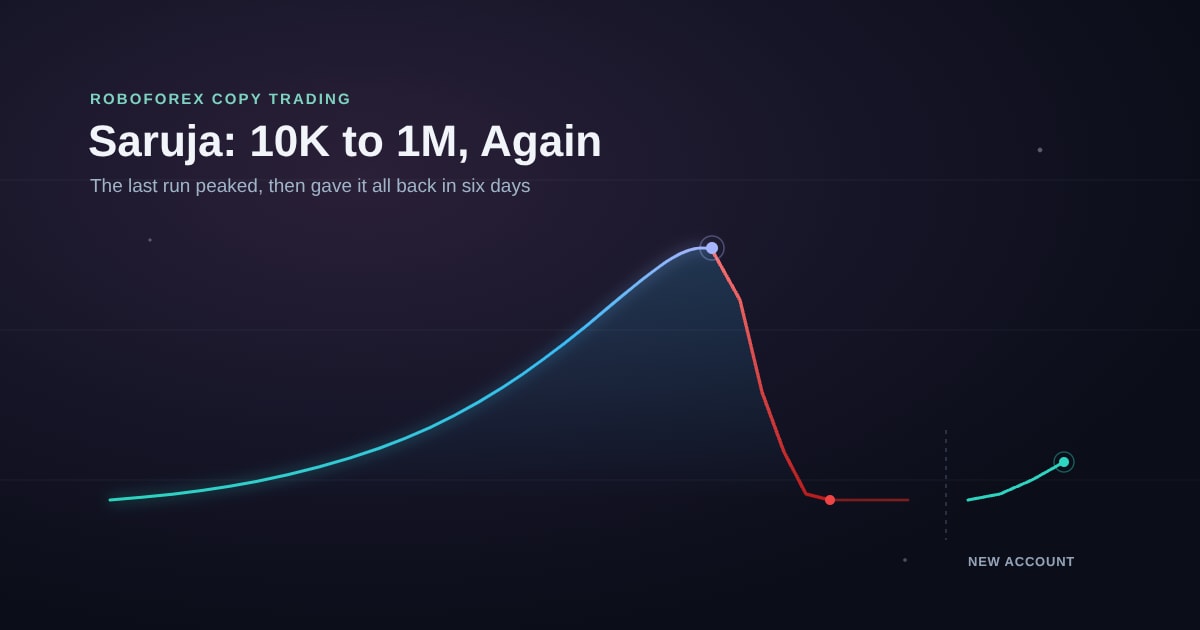
Saruja 10K to 1M Journey: The New Account, and What the Last One Did
Trading has started on the account behind the Saruja 10K to 1M journey. The same operator’s last account made a very large return and then gave all of it back in under a week — which is both the case for copying this one and the reason to keep it small.
Read article →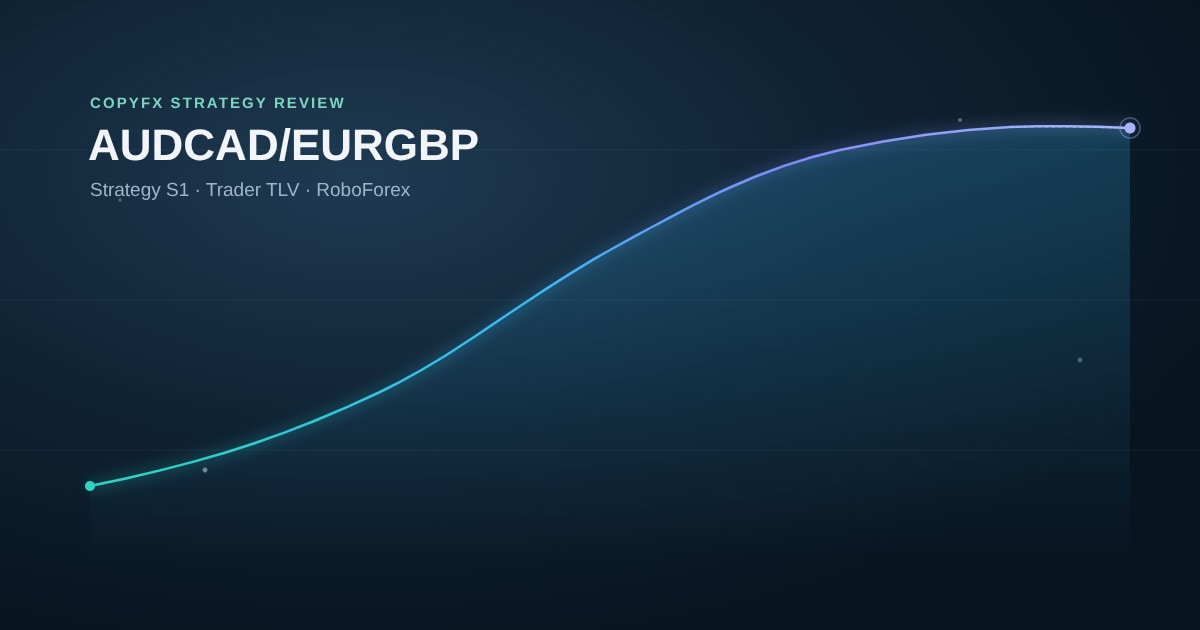
S1 AUDCAD/EURGBP Copy Trading Strategy Review: A Long Record, a Recent Slowdown
S1 AUDCAD/EURGBP has been running on RoboForex's CopyFX platform since 2023 and trades ordinary currency pairs, unlike most of the rating — but its growth has clearly slowed over the past year. Here's what the record, the fees, and the cent-account mechanics actually show.
Read article →
Vendo DD50 Review: The Calmest of Four XAUUSD Copy Trading Strategies
Vendo DD50 has a 9.05% maximum drawdown across 26 months. The same trader also runs an account named DD30 that has lost 54.87%. What the four records show, what the drawdown figure really measures, and why no follower earned the headline 463.89%.
Read article →