
Saruja 10K to 1M Journey: The New Account, and What the Last One Did
Trading has started on the account behind the Saruja 10K to 1M journey. The same operator’s last account made a very large return and then gave all of it back in under a week — which is both the case for copying this one and the reason to keep it small.
Every figure below was read from RoboForex's live copy-trading data on 2 September 2026. This is a snapshot of that day, not a page that updates itself.
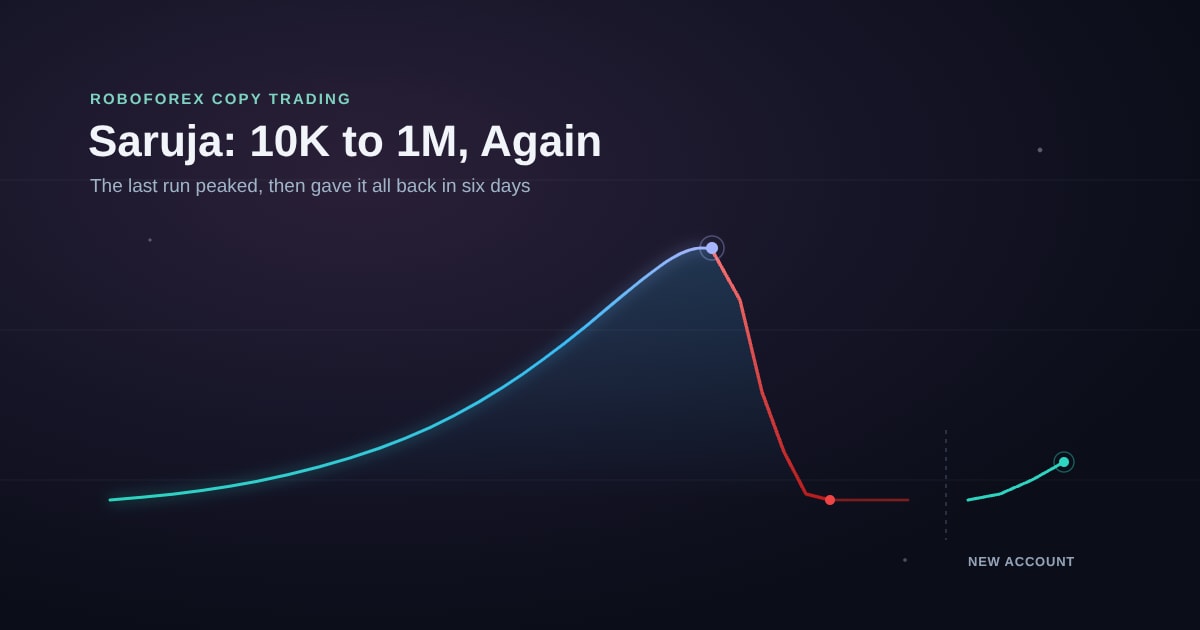
Saruja has started again. A new account under the same name opened for copying on 21 August, its public description says the journey begins on 1 September, and by the time this was written it was already carrying over fourteen hundred followers with only a handful of closed trades behind it. If you want to be on it from the start, the account is here.
The Saruja 10K to 1M journey is not just a slogan attached to it, either: the account holds a little over $11,000 of the trader's own money, and the stated destination is a million. That is the shape of the thing — a real starting balance, a public target, and a follower count in the thousands before the first month is out.
That is the whole of the good news, and the rest of this page is the part that matters more. The last account this operator ran did something genuinely remarkable and then destroyed it in under a week, and it is still sitting in the rating today with more than two and a half thousand people attached to it.
What actually started
The new account is a standard account, not a cent one. Its published instructions ask followers to open an MT4 ProCent account if their own balance is under $10,000, to set copying to proportional at a coefficient of 1.0, and it takes 35% of any profit it makes you, settled weekly. The minimum equity to follow is $100 and the account runs at 1:1000 leverage.
At the time of writing it had been open eleven days, had closed five trades, and showed a small positive return. Eleven days and five trades tell you nothing whatsoever about a strategy. They are worth stating only so nobody mistakes the number on the platform for evidence.
What the last one did — and this is the case for copying
The reason anyone is interested at all is that the previous account was not a modest performer. It opened at the end of February and by mid-July its published all-time yield had passed +29,900%. Its own description still says so in the past tense: "for five incredible months, this account achieved results that exceeded all expectations… We started with just $2,500 and came only a few steps away from reaching our $1 million goal."
Somebody who joined that account early and took their money out anywhere near the peak made a very large return. That is real, it is on the platform's own record, and pretending otherwise would be as dishonest as pretending the crash did not happen.
Then it gave all of it back in six days

The dates are the platform's own. On 4 August the account was still up 24,342%. On the 5th it was at 11,976%. On the 7th, 4,784%. On the 10th, 1,263%. On the 11th it printed −2.91%, and it has not moved since — the same figure was showing on 1 September, three weeks later.
Five months of gains, returned in six days. We wrote up the collapse as it happened with the day-by-day numbers; nothing in the account's record since has changed that account's position.
Why a dead account is still in the rating
This is the part most readers get wrong, and it is not their fault. RoboForex removes an account from its copy-trading rating on exactly two conditions: equity under $50 for three consecutive days, or a yield of −90% or worse for ten consecutive days. That is the entire bar.
An account sitting at −2.91% meets neither. So it stays listed, it keeps its 2,545 followers, and its presence in the rating is not an endorsement of anything. The rating filters for near-total destruction, not for competence.
There is a second account, and it is not the same person
A separate account trading as SARUJA1MLN launched on 27 August with almost identical wording about a journey beginning on 1 September. It is a cent account with a little over $100 in it, it takes 30% rather than 35%, and it had picked up around twenty followers within a week.
It belongs to a different owner. RoboForex's data groups every account by an internal client id, and the collapsed account and the new one above share theirs, while SARUJA1MLN's is different — it is that owner's only account on the platform. Whoever is running it has borrowed the name and the launch date; they are not the operator whose record this article is about.
If that seems far-fetched, it is the normal state of affairs here. Nineteen accounts on RoboForex now carry the Saruja name and they are run by nine different people, which is the subject of a separate piece on what the name actually means. Check the account number before you copy anything, not the nickname.
So should you copy it
Our honest position is that this is worth a small, deliberate allocation and nothing more — and that the size matters more here than the decision.
The strategy behind the previous account demonstrably made money for months before it failed. The failure was not a slow bleed either; it was a single week that took everything. That combination has a specific consequence: the return is real but it is only yours if you take it off the table, because this account's own history says that leaving it on the table indefinitely ends at zero.
Which turns the whole thing into a question of how much, not whether. Our worked example on sizing a copy-trading allocation starts from a strategy's own worst drawdown rather than from a generic percentage, and on a record like this one that calculation lands somewhere very small. The same logic is why one strategy is not a portfolio, however good the last five months looked.
Two things worth deciding before you fund anything, not after:
- The number at which you take profit out. Not a feeling — a figure. The previous account gave people five months to set one and six days to regret not having.
- What proportion of your capital you are prepared to see go to zero. On this record that is the correct way to size it, because the account has already done exactly that once.
If you have both of those, joining the account is a defensible decision. If you do not, no entry price makes it one.
Figures read from RoboForex on 2 September 2026. Copy trading carries risk and past results, including the ones described above, do not predict future performance.
Related
View category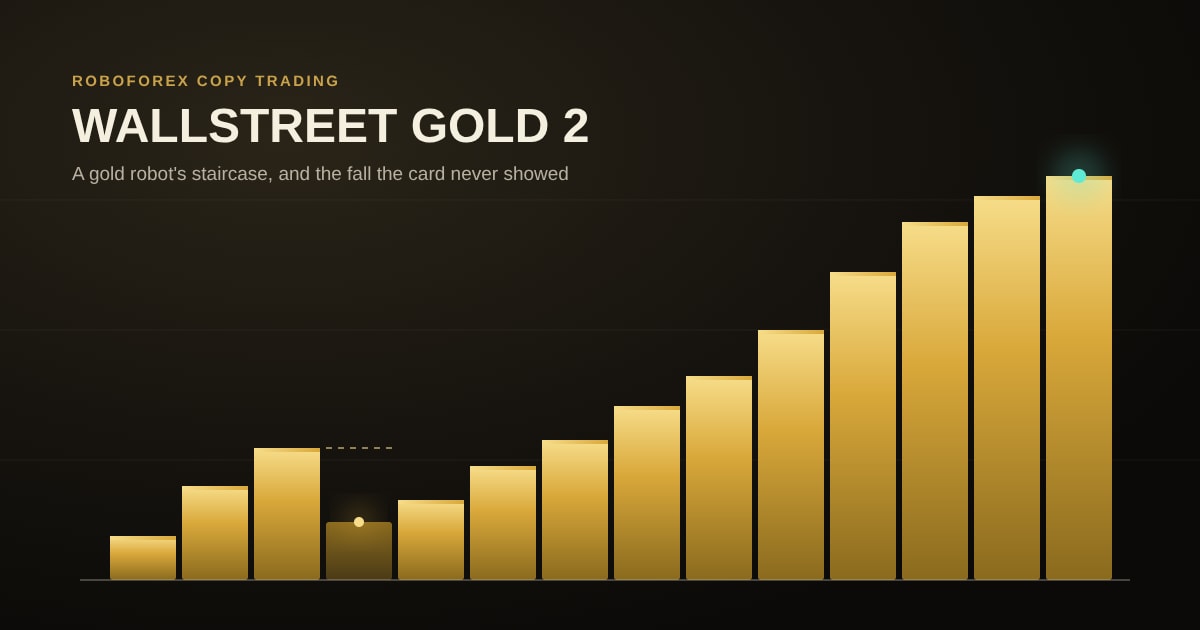
WALLSTREET GOLD 2 Review: XAUUSD Copy Trading as a Staircase, Not a Spike
WALLSTREET GOLD 2 is one of the most-copied accounts in our CopyFX rating: a gold-only robot with a staircase record and a card whose drawdown figure understates its worst fall. The card never showed the account's first-year fall, and the trader's original account on the same robot has taken a fall this one has not. What the full record shows, what the fee really takes, and how to size it.
Read article →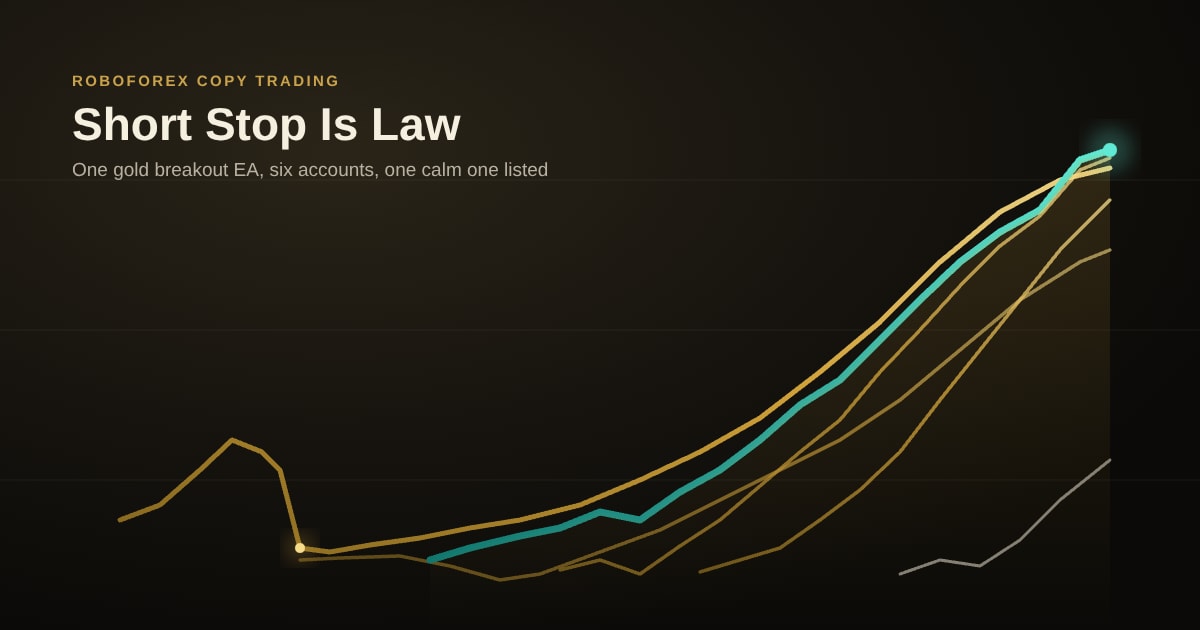
Short Stop Is Law Review: A Gold Breakout EA on Six Accounts
Short Stop Is Law sits high in our CopyFX rating on a record with no double-digit fall. The same trader runs the same gold breakout EA on five other accounts, and three of them have already been through falls the listed one has not. What the whole family shows, what the fee history says, and how to size it.
Read article →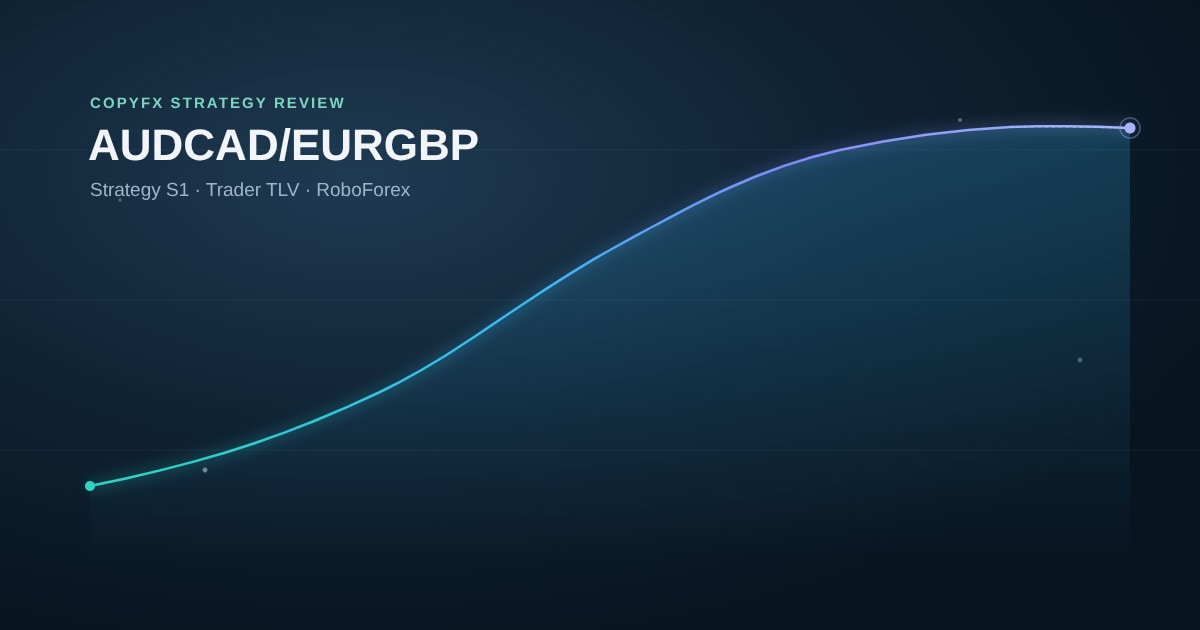
S1 AUDCAD/EURGBP Copy Trading Strategy Review: A Long Record, a Recent Slowdown
S1 AUDCAD/EURGBP has been running on RoboForex's CopyFX platform since 2023 and trades ordinary currency pairs, unlike most of the rating — but its growth has clearly slowed over the past year. Here's what the record, the fees, and the cent-account mechanics actually show.
Read article →