
How Much Should You Put Into One Copy-Trading Strategy? A Worked Example
Generic copy-trading allocation advice gives a different percentage every time because it ignores the one number that actually matters: a strategy’s own maximum drawdown. A worked example using RoboForex’s real top strategy shows the actual method.
Search for advice on this and you get a different number every time: 10-20% per strategy from one source, 20-30% from another, "70% to copy trading, 30% self-directed" from a third. None of them are wrong exactly — they just skip the one question that actually determines the right answer for you: what's the worst month this specific strategy has already had?
Quick verdict
Ignore the generic percentage ranges. Real position sizing in copy trading means sizing a position against the strategy's own maximum drawdown, not its yield and not someone else's rule of thumb. If you can't afford to lose your allocation entirely during that strategy's worst historical stretch, the allocation is too big — regardless of what percentage it works out to.
Why the yield number is the wrong number to size against
Every copy-trading leaderboard sorts by yield first, because yield is the number that sells. It's also the number that tells you the least about how much to risk.
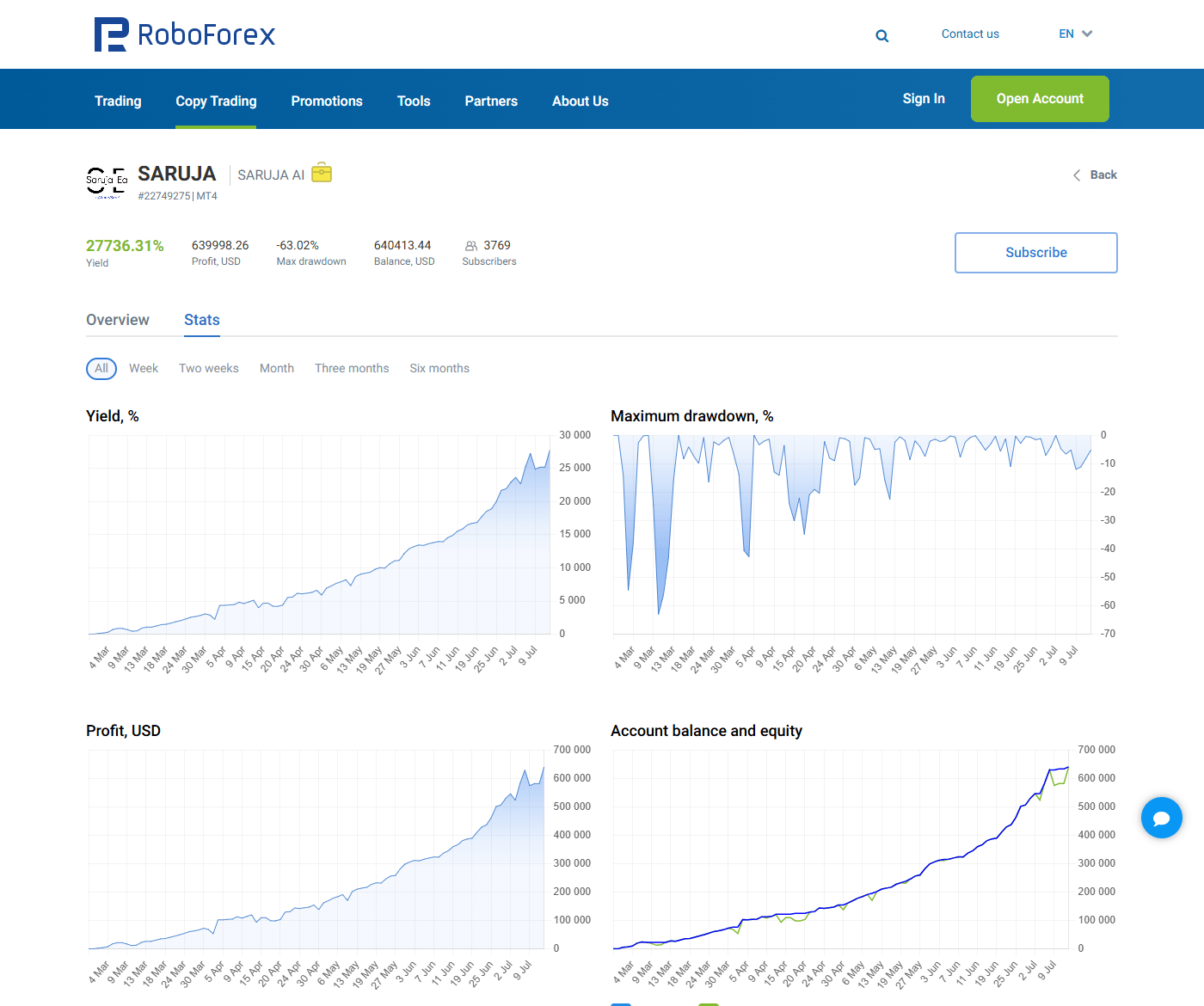
Our own RoboForex Copy Trading leaders page tracks this in real time on SARUJA AI, the platform's most-copied strategy — pictured above, mid-collapse and mid-recovery in the same chart: its all-time yield fell from 27,736% to 18,006% in three weeks between two checks, while the maximum drawdown sat exactly still at -63.02% the entire time. The yield number moves with the market. The drawdown number is what actually happened to an account that size, once, in the worst stretch on record — and it's the number that tells you what you're really signing up for.
The actual method: size against the worst case, not the recent quarter
Take a real number — your own total copy-trading capital — and work backward from the drawdown, not forward from the yield.
| Step | Example with $2,000 total capital |
|---|---|
| 1. Pick an allocation to one strategy | 20% → $400 |
| 2. Find that strategy's real maximum drawdown | SARUJA AI: -63.02% |
| 3. Multiply | $400 × 63% ≈ $252 possible loss on this one position |
| 4. Ask honestly | Would losing $252 without warning change anything for you? |
If the answer is yes, the allocation is too large — not because 20% is a bad number in the abstract, but because 20% of your capital times this strategy's worst case is more than you can absorb. The same 20% against a strategy with a -15% maximum drawdown is a completely different risk, even though the percentage allocated is identical.
This is the actual reason the generic ranges you'll find elsewhere disagree with each other: a "safe" percentage depends entirely on which strategy it's attached to. A rule that ignores drawdown can't give you a number that means anything.
Two mechanisms worth knowing, even if your platform doesn't offer both
Fixed vs. proportional allocation. Some copy-trading platforms let you assign a flat dollar amount to a strategy (fixed allocation); others scale your position to match the same percentage of their account that the strategy provider risks on each trade (proportional allocation). The two behave differently as a strategy's own balance grows or shrinks — worth checking which model your platform uses before assuming your allocation stays constant over time.
Equity stop-loss. A hard rule — not a mental one — that automatically closes your copied positions and returns remaining funds if your equity in that strategy falls below a set threshold. Not every platform offers this as a real automated feature; where it exists, it turns "I'll get out if it gets bad" from an intention into something that actually executes without you watching the account.
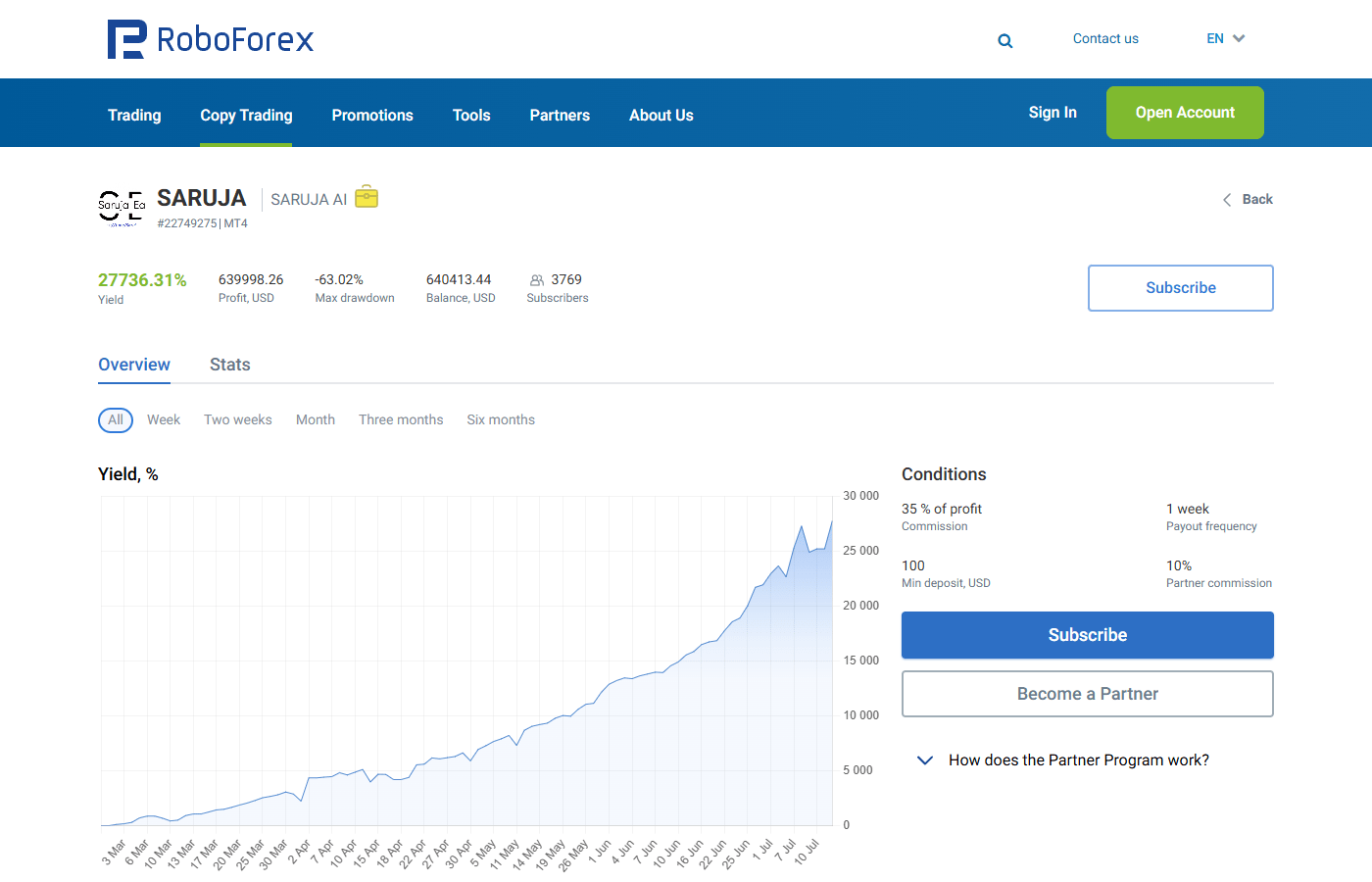
This is the chart that makes sizing against yield tempting in the first place — a long, smooth climb that looks nothing like a -63% drawdown waiting to happen. The drawdown chart above tells the other half of the same account's story; both are real, and both are needed before sizing anything.
Applying it to a strategy that looked fine right up until it didn't
Position sizing matters most exactly when nothing looks wrong yet. The same leaders page documented a real case of this: BLITZ / Alpha Framework sat at a "middle-ground" 131.69% yield and a -24.17% drawdown for weeks — a profile that would pass most sizing rules comfortably. Between August 1 and August 4, it collapsed to -76.36% all-time yield and a -94.19% maximum drawdown. Nothing about the account's numbers signaled this coming three weeks earlier.
That is precisely why sizing against the worst-recorded drawdown, not the current one, matters — a strategy's realized maximum can always get worse, and the moment it does is never announced in advance.
Sizing one strategy is not the same as building a portfolio
Everything above answers "how much into this one strategy." It doesn't answer "how many strategies should I run at once" — that's a separate question, covered in our guide to copy-trading portfolio diversification: spreading an allocation across strategies with genuinely different risk profiles and instruments, not just several accounts that all happen to move together. Do both. Sizing without diversification still leaves your whole allocation exposed to one strategy's worst month; diversification without sizing just means several positions are each too large.
If the strategy you're sizing has the smooth-climb-then-sudden-drop shape SARUJA AI has, it's worth understanding why that shape exists at all — see our guide on martingale strategies in copy trading for the mechanism behind it.
FAQ
Is there a single correct percentage to allocate per strategy? No, and treat any source that gives you one flat number without asking about the strategy's own drawdown with real skepticism. The right amount depends on that specific strategy's worst historical stretch and on how much of a loss you can actually absorb without it changing your decisions.
Does a low current drawdown mean a strategy is safer to size larger? Not on its own. BLITZ / Alpha Framework's drawdown was a moderate -24.17% right before it fell to -94.19% in days. Size against the maximum drawdown on record, not the current one — the current number can always get worse, and often does exactly when it looks safest.
Should I use the same sizing method for every strategy I copy? The method (size against maximum drawdown, not yield) stays the same; the resulting dollar amount won't, because each strategy's own worst case is different. A calmer, lower-drawdown strategy can reasonably carry a larger allocation than a high-yield, high-drawdown one — that's the whole point of doing the math per strategy instead of applying one flat percentage to all of them.
Bottom line
Skip the generic 10-30% ranges you'll find elsewhere — they can't account for the one variable that actually matters, which is the specific strategy's own worst-case drawdown. Multiply your proposed allocation by that number, not by the yield, and size down if the resulting loss would be more than you can genuinely absorb. Pair that with real diversification across strategies, not just across account names, and re-check both the allocation and the drawdown periodically — the RoboForex leaders page this example is drawn from is refreshed for exactly that reason.
Update, 2026-08-11: this stopped being a hypothetical. SARUJA AI, the account used above, lost its entire historical gain in about a week — see what happened and what replaced it in our rating.
Related
View category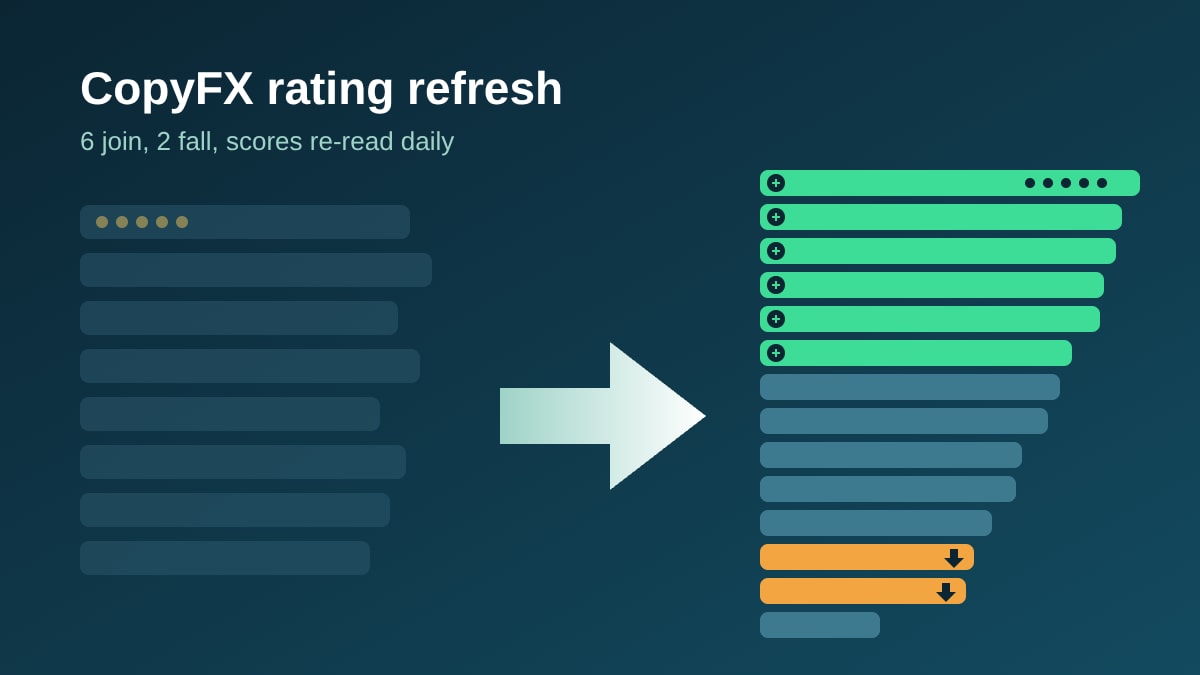
CopyFX Rating Refresh: Six Strategies Added, Two Falls, and a Score That Reads the Full Curve
Six RoboForex CopyFX strategies join our rating and none leave. Filmont gave back 48% from its August high and exactw sits well below its own; both stay, re-scored. And the score itself is now computed every morning from each strategy's full daily curve, which shows falls the platform's own drawdown figure never did.
Read article →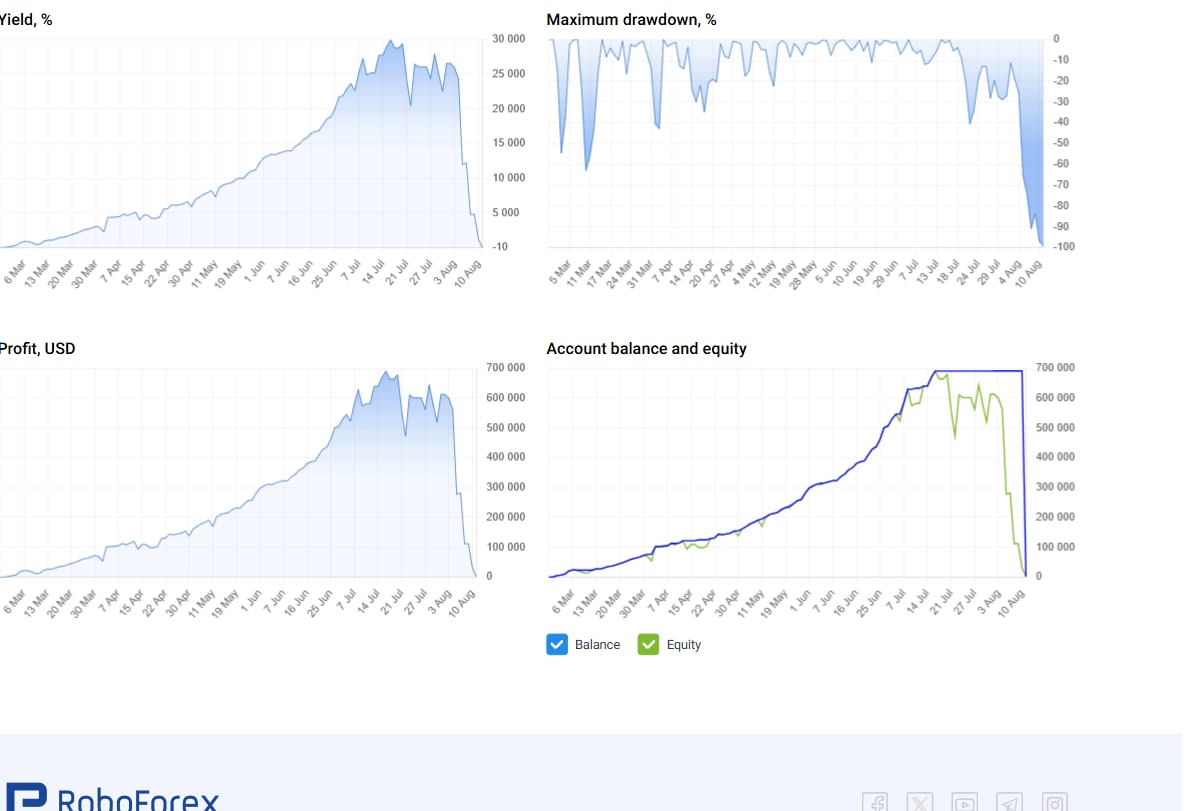
RoboForex CopyFX Update: SARUJA AI Collapses, Filmont and exactw Added
SARUJA AI, RoboForex CopyFX's most-copied strategy, went from +29,938% all-time yield to -2.91% in about a week. Real day-by-day numbers pulled from RoboForex's own data, why the collapse fits a known pattern, and why Filmont — Invictus Maneo and exactw — Albert Einstein now replace it in our recommended list.
Read article →
RoboForex Copy Trading Leaders: Who Is on Top Right Now
A periodically refreshed look at the top of RoboForex CopyFX — real yield and real drawdown, including a strategy this page recommended in July that lost 76% in the first days of August.
Read article →