
WALLSTREET GOLD 2 Review: XAUUSD Copy Trading as a Staircase, Not a Spike
WALLSTREET GOLD 2 is one of the most-copied accounts in our CopyFX rating: a gold-only robot with a staircase record and a card whose drawdown figure understates its worst fall. The card never showed the account's first-year fall, and the trader's original account on the same robot has taken a fall this one has not. What the full record shows, what the fee really takes, and how to size it.
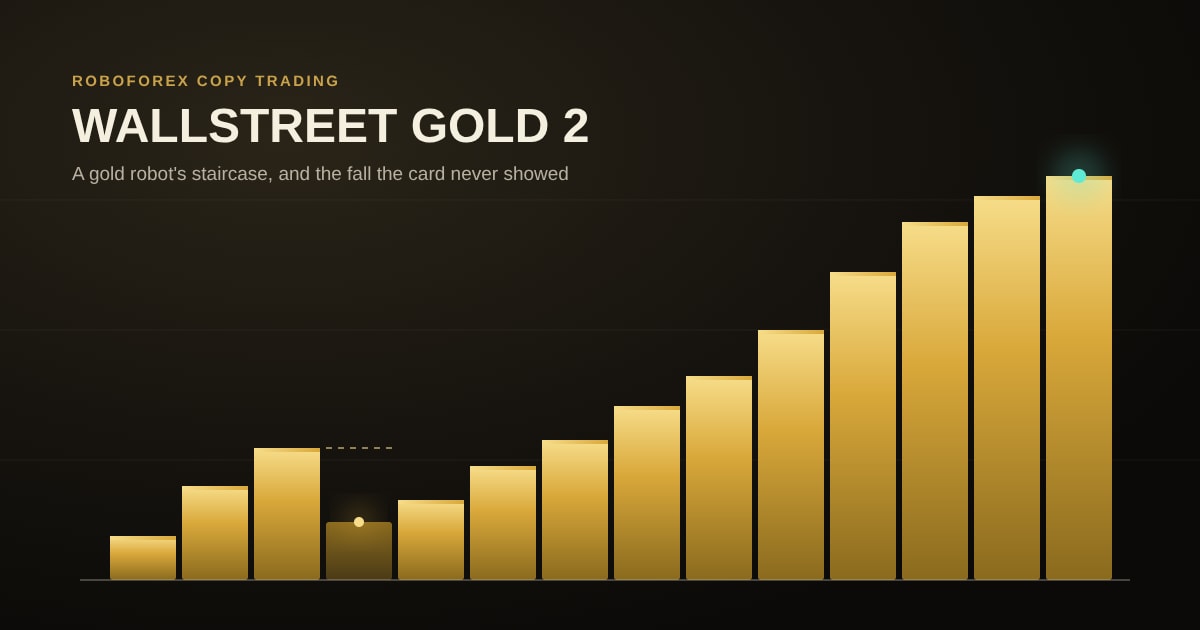
All figures in this review were read from RoboForex's public data on 23 September 2026, and the curves run to the same day. It is a snapshot of that day.
WALLSTREET GOLD 2 is one of the most-copied accounts on RoboForex's copy-trading platform and sits high in our CopyFX rating. On the day of this reading it had 141 copiers; on our 14 September pull of the whole rating, a count like that put it in the top thirty of more than five thousand listed accounts, where the median account with any copiers at all has four. It trades gold and nothing else, with a stop and a target on every position, and its card shows a maximum drawdown under ten percent against a return in the hundreds. For anyone looking at XAUUSD copy trading, it is the kind of card that ends the search.
This review is built around two things the card does not show. The first is that the account fell 28.9% between May and October 2024 and took until February 2025 to get back above its May peak, nine months under water, while the drawdown printed on the card never rose above 9.98%. The second is that the trader runs the same gold robot on an older account, WALLSTREET GOLD, which climbed to +1,248% by March 2026, lost half of that by August and was still 45% below that peak on the day of this reading; the reviewed account is the calmer setting of the same system, and the two moved in the same direction on 85 of the 97 days on which both moved by more than half a percent.
Neither finding takes the record away. The account has 31 calendar months of results, 23 of them positive, and it set a new all-time high on the day of this reading. What the findings change is the size of the fall a follower should be sized for, and that is the number this page is about.
What the account is
| Strategy | WALLSTREET GOLD 2 (trader MTD, account 75033737) |
| Software | An automated gold robot, the trader's own by their description |
| Instruments traded | XAUUSD only: 673 of 673 closed trades with an instrument recorded |
| Running since | 4 March 2024 |
| Account type | Standard EUR account, MetaTrader 4, leverage 1:500 (not a cent account) |
| Minimum to follow | $100 on the card; the trader recommends €400 on an ECN account |
| Trader's fee | 25% of your profit above its previous high, settled weekly |
| People copying it | 141 |
| Trades | 688 |
| Trader's own balance | about $3,900 (€3,423) |
RoboForex publishes the account's live figures; the copy page is WALLSTREET GOLD 2 on RoboForex Copy Trading.
688 trades in 30 months is about five a week. The account has closed results on 485 of the roughly 665 trading days since it opened, so it trades most weeks but not every day, and it has never carried much open risk: the description promises a stop and a target on every trade, and the balance-versus-equity history bears that out. The gap between the two, which is what an open loss looks like from outside, has never exceeded 4.5% of the balance, and in money terms the largest open loss in the whole record was €32, in May 2026.
A gold robot, in the trader's words
The card's description is short: an "automated robot designed to trade GOLD" that "opens a few but safe trades, all with SL and TP" and "opens more trades than WALLSTREET GOLD, as it is configured on a different time frame and with different SL and TP settings". Then a minimum balance, €400 for an ECN account or €200 for a cent account, and links to a Telegram channel and a small site. The site describes the operator as someone with "several copytrading strategies that I have developed and optimized over the years", says the robots are offered only through copy trading and not sold as software, and names RoboForex as the primary broker.
One thing to clear up before the numbers, because the name is searched for: a commercial expert advisor called WallStreet GOLD Trader is sold by another vendor as part of a robot bundle. Nothing in the public record connects that product to this account, the trader's own site describes the strategies as their own development, and this review treats the software as the trader's. Which program runs the account is not something a copy-trading card can tell you either way.
Three claims in the description can be checked against the record.
"Designed to trade GOLD." True without qualification. Every one of the 673 closed trades with an instrument recorded is XAUUSD. On the trader's older account, below, that is not quite the case.
"A few but safe trades, all with SL and TP." The trade count is modest, about five a week, and the open-risk history is as clean as the description implies: no day in the record shows an open loss above 4.5% of the balance. "Safe" is a different claim from "with a stop". A stop on every trade limits what one position can do; it does nothing about a run of stopped-out trades, and the 28.9% fall of 2024 was made of exactly that: five months of losing trades, one at a time, each one closed as promised, with no single day in it worse than −8.4%.
"It opens more trades than WALLSTREET GOLD." Also true, 688 against 450, and the more interesting half of that sentence is what the older account's description now says about itself: "After the latest losses, it began operating as GOLD 2 and incorporated an additional strategy with tighter Stop Loss and Take Profit levels (GOLD 3)." By the trader's own description, the original account was switched to the reviewed account's settings after its losses, with a tighter third variant added on top. Of the two configurations the trader ran through 2024 and 2025, the reviewed one is the one they kept.
XAUUSD copy trading as a staircase
| Window | Return | Reported drawdown |
|---|---|---|
| All time (since 4 March 2024) | +565.92% | −9.98% |
| Last year | +297.04% | −9.94% |
| Last 2 weeks | +5.19% | −3.41% |
| Last week | +1.24% | −0.79% |
By calendar year the account made +35.1% from March to December 2024, +84.9% in 2025 and +155.1% in 2026 to the day of this reading. Sliced into four non-overlapping quarters, the last twelve months read +50.4%, +94.0%, +21.6% and +11.9%: every quarter positive, but the last two together are smaller than either of the first two on its own. The six months to 23 March 2026 returned +191.8%; the six months since returned +36.1%. That is the shape of the staircase in the title: gold's run from the autumn of 2025 into the spring of 2026 produced most of the record, and the steps since have been shorter.
Twenty-three of the account's 31 calendar months have been positive. The worst month was −11.3% (August 2024) and the best +35.7% (March 2026). Of the 130 weeks with a closed result, 79 were positive and 48 negative. The biggest single days run from −8.9% (27 March 2025) to +16.6% (12 January 2026), which is the range a follower of this account should expect, and a reason the weekly fee below costs more than it looks.
The drawdown, measured twice
RoboForex prints a maximum drawdown of 9.98% for this account. That figure is the worst single step in its daily series, which happened on 17 October 2024, not the distance from a peak to the trough that followed, which is why our score reads the full curve instead. On the curve, the deepest fall is 28.9%: from +51.7% on 11 May 2024 to +7.8% on 17 October 2024, five months of decline in which no single day lost more than 8.4%, followed by three and a half more months before the curve got back above its May peak on 3 February 2025. A follower who joined at the peak spent nine months below their entry. The card said 9.98% the whole time.

Since then the falls have been shallower and shorter, and there have been three of nearly the same depth: 13.8% from 5 February to 7 March 2025, 13.9% from 1 to 21 October 2025, and 14.0% from 29 November to 9 December 2025, each recovered within days to weeks rather than months. The last of the three deserves a note. The same stretch, 28 November to 9 December, shows as a dip on every account of the gold breakout EA in our Short Stop Is Law review, run by a different trader on different software. When two unrelated gold robots lose in the same week, the loss came from gold, not from either robot, and a follower holding several gold strategies for diversification should expect them to fall together on days like those.
So the honest range for this account is not "under ten percent". It is a 14% dip three times in the last two years in normal conditions, and a 29% fall with a nine-month recovery once in its history. The platform's number is the smaller of two ways to measure the same curve, and here the difference is a factor of three.
Four accounts, one trader
RoboForex links strategies to a trader through its client identifier, the same field that surfaced the six Short Stop Is Law accounts. MTD's identifier returns four accounts. Two are the gold robot in two configurations, opened a month apart in early 2024; two were opened in June 2026 and are three months old.
| Account | Opened | All time | Reported drawdown | Deepest fall on the curve | Trades | Copiers | Fee |
|---|---|---|---|---|---|---|---|
| WALLSTREET GOLD, 72159373 | 4 Feb 2024 | +646.65% | −21.65% | 51.5% (24 Mar – 18 Aug 2026, not recovered) | 450 | 47 | 25% |
| WALLSTREET GOLD 2, 75033737, reviewed here | 4 Mar 2024 | +565.92% | −9.98% | 28.9% (11 May – 17 Oct 2024) | 688 | 141 | 25% |
| MTD MANUAL, 72178437 | 1 Jun 2026 | +12.19% | −5.64% | 20.6% (31 Jul – 15 Sep 2026, not recovered) | 87 | 41 | 25% |
| ASIAN GOLD, 77047973 | 6 Jun 2026 | +14.92% | −25.16% | 23.4% (28 – 29 Jul 2026, not recovered) | 424 | 3 | 25% |

WALLSTREET GOLD is the original. It is the same robot on a slower time frame with wider stops and targets, by the trader's description, and its record is the reviewed account's record with the volume turned up. It fell 39.6% between April and July 2024, while the reviewed account was in its own 28.9% fall, and took until June 2025 to recover, four months longer. Then it made +373% in the six months to 23 March 2026, including two calendar months of about +60% each (January and March), against +192% on the reviewed account over the same six months. And then it lost 34.2% in April 2026 alone, 51.5% from its 23 March peak by 18 August, and on the day of this reading it was still 44.6% below that peak while the reviewed account was at a new high. Its worst open loss was 12.7% of the balance, on 15 April 2026, against 4.5% on the reviewed account. It also does not quite trade gold only: 25 of its 450 trades are currency pairs, spread across 17 of them, and two are the German index. Forty-seven people copy it.
The two gold accounts moved in the same direction on 85 of the 97 days on which both had a move of more than half a percent. That is one system at two settings, and it cuts both ways. The reviewed account's result is not one fortunate run, because the same robot at another setting produced a similar shape on a second account. And the reviewed account's calm since 2024 is a property of its settings, not of the method: the method, at the other setting, fell by half from its peak this year.
ASIAN GOLD is a different robot, and its description is the one to read slowly: "If the market moves against the trade, it may open multiple positions in the same direction, but it always maintains a total SL of 25%." Adding positions in the direction of a losing trade is the mechanism our martingale explainer describes, and the 25% total stop is the promise that it will not run to zero. Both halves of that sentence turned out to be true. The account made +20.5% in its first seven weeks, and on 29 July 2026 it lost 23.4% in a single day, from +20.5% to −7.7%; the card's reported drawdown of 25.16% is that day. The total stop fired in its eighth week. Three people copy it. Its 424 trades in fifteen weeks are more than the reviewed account closes in a year.
MTD MANUAL is the trader's hand-traded account, across 28 instruments, with "a maximum stop-loss of around 5%" per trade. It reached +37.2% on 30 July 2026, eight weeks after opening, and had given back 20.6% of that by 15 September. Forty-one people copy it, nearly as many as copy the original gold account, on a record of sixteen weeks.
Between them the four accounts have 232 copiers and about $7,000 of the trader's own money. The reviewed account holds more than half of both.
What you actually pay
The fee on the reviewed account has been 25% of profit, settled weekly, since 14 April 2024; the first six weeks were free, and the fee has never changed since. RoboForex charges it on cumulative profit above your previous high, so a losing week is not charged and a recovery back to the old high is not charged either. That is the fairer of the two common mechanisms, and it still takes more than a quarter of what this account makes, because every fee leaves your balance at the weekend and stops compounding from then on, which is the effect our copy trading commission analysis measured across the platform.
Run on this account's own curve, with a follower who joined a year before this reading and stayed: the curve rose +297.0%, the follower kept +184.3%, and the fee took 37.9% of the gain across 31 weekly charges. Over the account's whole history the share is 42.8%: +537% on the curve from the first recorded day, +307% for the follower. On the slower six months since March 2026 it is 27.6%, closer to the headline, because a flatter curve gives compounding less to lose. The 25% is the floor of what the fee costs, never the whole of it.
The trader's money
The account is denominated in euros. It opened with €522.53 on 4 March 2024 and held €3,423 on the day of this reading, about $3,900 on the card. Between those two figures the balance history shows no deposit or withdrawal of any size: the balance divided by the account's cumulative return has stayed within a few percent of the opening stake for the whole thirty months. The trader has let the result compound and has not taken any of it out. The original account is the same, opened with €200 and never topped up, which is why its fall from the March peak had cost the trader about €1,200 of a €2,750 balance in real money by the day of this reading, with the account still 45% below that peak.
That is the opposite of what the Short Stop Is Law family showed, where the trader moved capital between accounts on the same days. Here the balance on the card is simply the record, and the trader's exposure to the outcome is the whole of it.
What being in the rating does not mean
RoboForex removes an account from its rating only when its equity is under $50 for three consecutive days or its yield reaches −90% for ten. Everything above that bar stays listed. The platform's rating is a filter for near-total destruction, not for quality, and the account's presence on it is not the broker's endorsement.
What would tell you this has changed
- A fall past 14% on this account. Three dips of that depth in the last two years, each recovered within weeks, is the account's normal. A deeper one, or one that lasts months, is the 2024 shape returning.
- The reviewed account starting to track the original. The two moved together on 85 of 97 shared days. If the original's 2026 collapse begins to show on this curve, the settings have changed or the market has stopped suiting them.
- A fee change. The fee has been 25% since April 2024. A rise would be the first.
- The trade count jumping. About five trades a week is what this configuration does. A run of 30 or 40 in a week is the ASIAN GOLD pattern, not this one.
Where it stands
WALLSTREET GOLD 2 earns its place on things that check out: a gold-only robot with 688 closed trades and a stop on each, an open-loss history that never exceeded 4.5% of the balance, 23 positive months out of 31, a trader whose own money has compounded in the account since day one, and a second account running the same robot that shows the result comes from the method. For XAUUSD copy trading on this platform, that is more evidence than most cards can offer.
What holds it back is the size of the fall the card hides. The account has been 28.9% down and nine months under water; the same method at the other setting has been 51.5% down this year and is still 45% below its peak; a third account by the same trader hit a 25% total stop in its eighth week. The card's 9.98% describes none of that. A follower sizing an allocation should size it against the family's falls, not the card, and our position-sizing guide is built for exactly that arithmetic. The fee then takes more than a third of what is left. Copy trading carries real risk, and nothing here predicts what the next five months will do.
Related
View category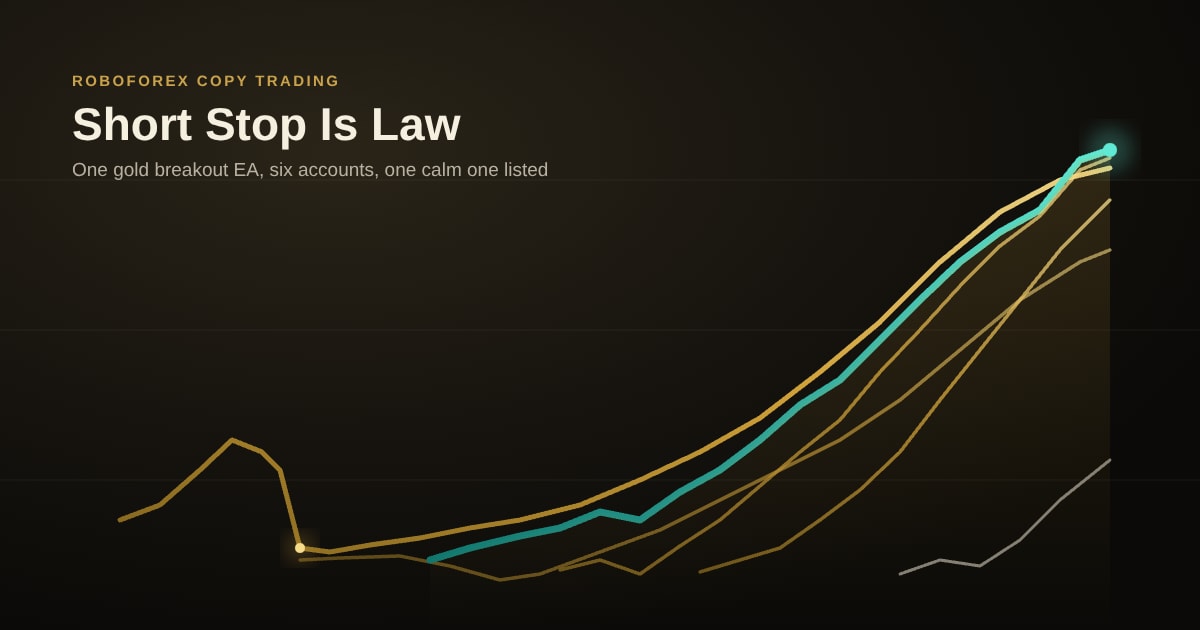
Short Stop Is Law Review: A Gold Breakout EA on Six Accounts
Short Stop Is Law sits high in our CopyFX rating on a record with no double-digit fall. The same trader runs the same gold breakout EA on five other accounts, and three of them have already been through falls the listed one has not. What the whole family shows, what the fee history says, and how to size it.
Read article →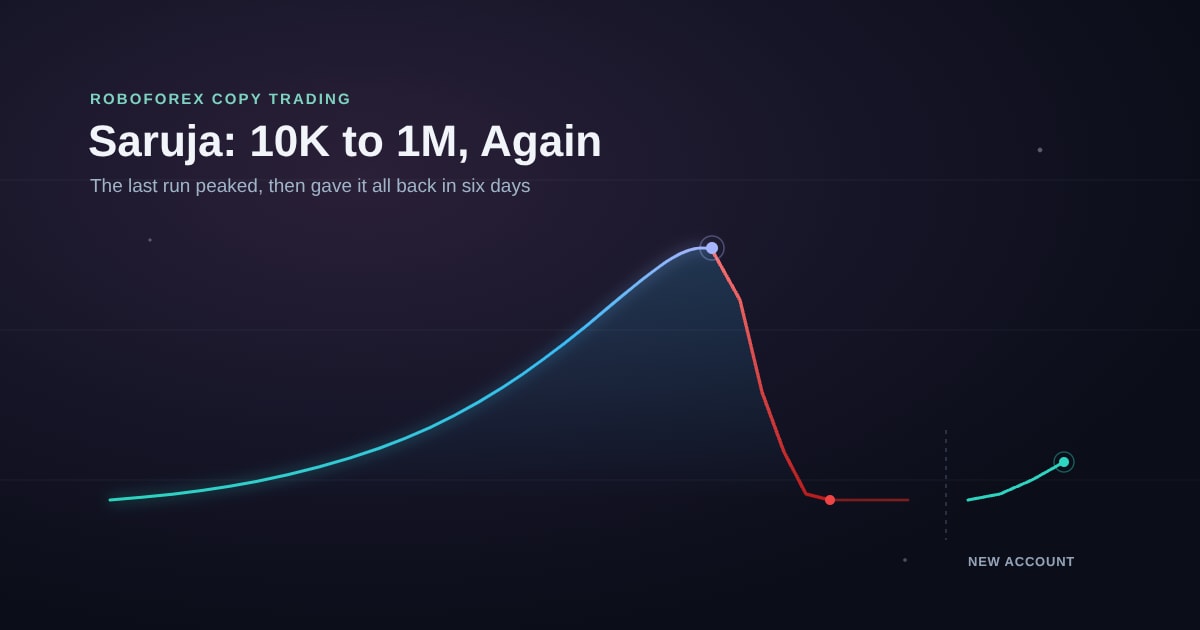
Saruja 10K to 1M Journey: The New Account, and What the Last One Did
Trading has started on the account behind the Saruja 10K to 1M journey. The same operator’s last account made a very large return and then gave all of it back in under a week — which is both the case for copying this one and the reason to keep it small.
Read article →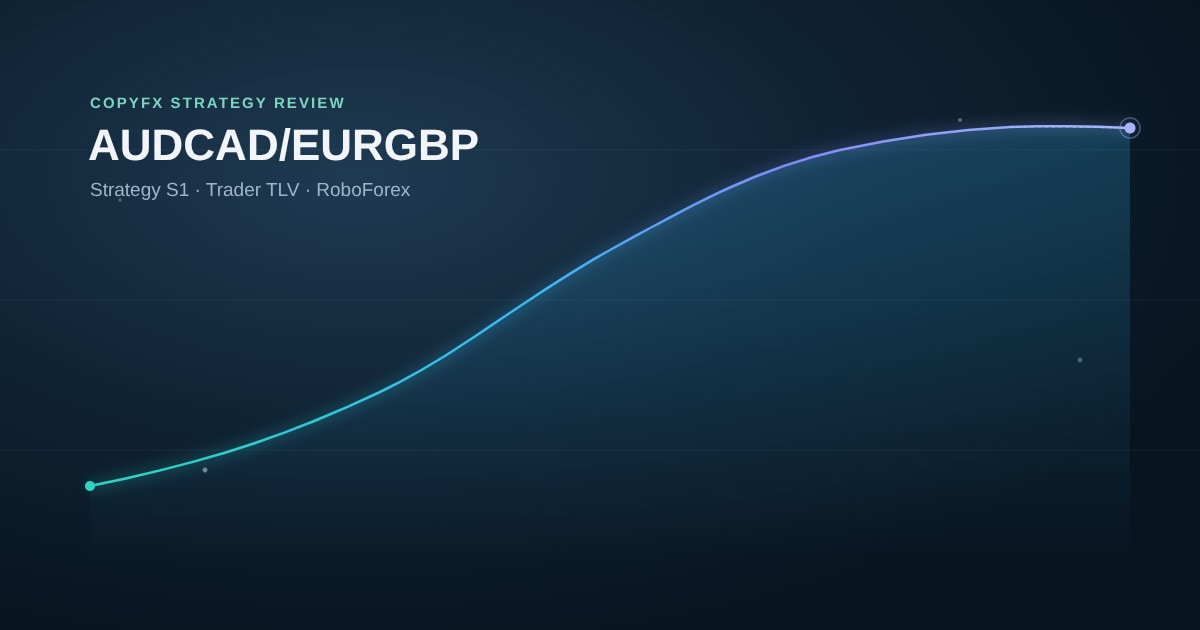
S1 AUDCAD/EURGBP Copy Trading Strategy Review: A Long Record, a Recent Slowdown
S1 AUDCAD/EURGBP has been running on RoboForex's CopyFX platform since 2023 and trades ordinary currency pairs, unlike most of the rating — but its growth has clearly slowed over the past year. Here's what the record, the fees, and the cent-account mechanics actually show.
Read article →