
Saruja AI on RoboForex Is Not One Trader
Fourteen RoboForex copy-trading accounts carry the Saruja name, run by eleven different people. What the name actually means, why the robot behind it has never been for sale, and what happened the last two times it collapsed.
If you are looking at a Saruja account on RoboForex, the first thing to establish is which one. There are fourteen of them, run by eleven different people, and they have almost nothing in common except the name.
One of them lost effectively everything in August 2026 with thousands of accounts still attached to it. Another has never placed a single trade and already has more than a hundred people copying it. A third is called "Low risk" and has been most of the way to zero within the last fortnight.
This page sorts them out. Figures were read from RoboForex's own live data on 25 August 2026, and the 2023 accounts from their public Myfxbook records the same day.
The fourteen Saruja RoboForex accounts
| Account | Run by | Opened | Where it stands |
|---|---|---|---|
| SARUJA AI Not recommended |
SARUJA | Feb 2026 | The famous one. Gave back its entire gain and has stopped trading. Still listed, still being copied by thousands. |
| 10K To 1M JOURNEY Worth a look |
SARUJA | Aug 2026 | Same operator as the account above, by RoboForex's own records. Days old with no trades of its own — worth watching for what it does, not funding for what the last one did. |
| Saruja Low risk Not recommended |
Xaugainz | Apr 2026 | Advertises daily percentage targets. Near-total drawdown inside the last two weeks. Charges half of any profit. |
| SARUJA Worth a look |
SARUJAIlight | Oct 2024 | The oldest of the set and the only long, ordinary record here. Lowest fee of the fourteen. Has gone quiet lately and is slightly down over the last few months. |
| Saruja LongLife Worth a look |
SarujaNext | Mar 2026 | Renamed onto the Saruja brand this month. Shallow losses so far, but only a few months old. In our rating, low in it. |
| SARUJA Not recommended |
SARUJAAI | Jul 2026 | Opened after the collapse under the collapsed account's own name. Weeks old. In our rating, near the bottom. |
| Saruja EUR Pairs Not recommended |
GlobalTraders88 | Nov 2024 | Long record, deep losses. The same operator runs three siblings, all worse. |
| Saruja EA Trade Not recommended |
GlobalTraders88 | Nov 2024 | Sibling of the above, same launch week, same pattern. |
| Gold IA Saruja Not recommended |
CacuatroTraderBR | Dec 2025 | Mid-pack, thin sample. This operator's non-Saruja accounts are among the calmest anywhere. |
| Muntazx Not recommended |
SarujaMuntazx | Mar 2026 | Enormous gain in months, with a drawdown to match. The shape that just killed the famous one. |
| Saruja Gold Algo Not recommended |
MonkTrader | Jun 2026 | Currently inside RoboForex's own removal threshold. May disappear from the platform shortly. |
| Saruja Not recommended |
MonkTrader | Jul 2026 | Sibling of the above. Its worst drawdown is happening now, not in its history. |
| SARUJA AI RM Not recommended |
Axe | Aug 2026 | Opened three days after the collapse, describing itself as a "remastered" version. Already deeply down. |
| Copy Saruja Not recommended |
JLtradercopy | Aug 2026 | Opened with the smallest balance the platform allows. No trades, no description. |
Three of these carry a link so you can open the account page and read the operator's own description before deciding anything. A link is not a recommendation — the verdicts above are, and only three of the fourteen clear even a qualified one. Nothing on this page is rated as something we recommend; our recommendations live in the CopyFX rating, where two of these appear on merit and everything else here does not.
Saruja is the name of a robot, not a trader
This is the part almost nobody gets right, and it explains the whole page.
"Saruja" is the name of a trading robot — an expert advisor — that circulates on MetaTrader. Anyone can run it, on any account, under any nickname. Several of the operators above say so openly in their own descriptions; one refers to running an "improved" version of it.
So the name on a card tells you what software might be running, and nothing whatsoever about who is running it, how much they risk, or whether they have done this before. Two accounts with identical names can be a careful operator and a reckless one.

The timeline settles a common assumption. It is tempting to read this as opportunists piling onto a name after a famous blow-up — but the oldest Saruja account here has been running since October 2024, roughly sixteen months before the account that made the name famous even existed. Eleven of the fourteen predate the collapse. Only three came after it.
The name was already on the platform. What the collapse added was search traffic.
The robot itself has never been for sale
This matters if you arrived here looking for a download, because a lot of people do and what they find is not what they think.
Saruja has never been sold, never given away, and — the part that settles it — never leaked. It does not appear in MetaTrader's own market or code base, on the forums where expert advisors are traded, on the sites that exist purely to host cracked builds, or anywhere on GitHub.
That absence is the evidence. Pirated trading software circulates fast and indiscriminately; anything distributed to customers turns up on a warez forum within weeks. Three years of visible promotion with no leaked copy anywhere means no copy ever left the operators' hands.
The operators say so themselves, in the founding post of their own channel: followers will not need a server to run anything, because the platform copies the trades for them. That is the whole arrangement in one sentence. You are not buying software. You are subscribing to an account.
So: if someone offers you a Saruja robot to download, whatever they are selling, it is not this. The operators have publicly warned that channels and paid advertisements are impersonating them — which means the people most likely to be defrauded here are the ones searching hardest for the thing that does not exist.
The one everyone means
When people search for Saruja on RoboForex, they almost always mean the account that ran up an extraordinary headline percentage and then handed all of it back in about a week in August 2026. We wrote that up while it was happening: how the SARUJA AI account lost its entire gain.
Two things about it are worth repeating here, because they shape everything else on this page.
It has stopped trading — no new positions for weeks — and it is still in the rating, with a working copy button and thousands of accounts still attached. RoboForex removes an account from its rating only once its yield has been at or below −90% for ten days running, or its equity has been under 50 USD for three days. Everything above that line stays listed automatically. Being on the rating is not a quality check; it is a check that the account has not been destroyed yet.
The same operator has already opened a new one
This is the finding that matters most today, and it is not an inference from a similar nickname. RoboForex's own data links the collapsed account and a brand-new one to the same client record — the platform is telling you it is the same person.
The new account is days old, has never placed a trade, and its description announces a start date. It has already gathered well over a hundred followers.
There is a real case for watching it, and it is worth stating fairly. The previous account did make a great deal of money before it lost it — somebody who entered early and took profits out along the way did well out of it. The operator now has the experience of that collapse, and an audience large enough to hold him to it.
So: you are allowed to invest in it, and we are not going to tell you not to. But be clear about what you would be buying: a new account from the operator whose previous account lost everything, with no trading history of its own, sold on the reputation the previous account earned before it destroyed itself. The last one blew up. This one may too. If you go in anyway, go in with money you can lose entirely, and understand that the follower count is not evidence — it is people arriving on a name.
It has done this before, twice
The August collapse reads like a freak event. It was not. Two accounts traded under this name in 2023 and both are still publicly tracked on Myfxbook, and both ended the same way.
| Account | Ended at | Worst drawdown | Final balance |
|---|---|---|---|
| Saruja (2023) | −88.07% | 89.70% | $0.00 |
| Saruja EA (2023) | −95.27% | 96.78% | — |
Those pages are open and anyone can read them. The earliest public trace of the name is March 2023, which puts the pattern three years ahead of the account that made it famous.
So the cycle is visible in the record: open an account, produce a spectacular run, lose everything, abandon it, start again under the same name. August was the third turn of it that we can document, not the first.
What the numbers say the system actually does
The marketing calls it AI. The trading says something more specific, and it is measurable from an investor's own publicly tracked copy account rather than from anything the operators publish.
That account shows a 92% win rate while still losing money. Both halves are real, and together they are the whole explanation: the average loss runs roughly eighteen times the average win in dollars. Almost every trade is a small winner; the rare loser is enormous. Of 53 positions, 49 were short, all on gold.
A strategy with that shape does not cut losing trades — it holds them and waits, which works until the day the market does not come back. That is the same mechanism described in our note on how averaging systems produce smooth curves right up until they do not, and it is what the operators' own post-mortem describes when it says the position moved into profit several times and was not closed.
One consequence is worth stating plainly, because it explains why a wipeout does not end the business. The fee is charged weekly on profit, and weekly fees are banked as they are earned — they are not returned when the account later gives everything back. On the collapsed account the operators kept five months of them on gains that no longer exist. The fees stayed with the trader; the losses stayed with the copiers.
An account with no trades is worse than a bad one
Two of the fourteen have never traded and one of them has a substantial following. That is a different category of risk from a strategy with a poor record, and it is worth being precise about why.
With a bad-but-trading strategy you can at least see the shape of the danger: what it trades, how often, how far underwater it has been. You can size your position against that and get out on a visible signal.
With a zero-trade account every number on the card reads 0%. An untrained eye sees "no losses". What it actually means is "no information". The copy relationship is live from the moment you subscribe, so the first position that operator ever opens is mirrored into your account immediately, at their size and their leverage, with nothing to have judged it against.
Names are not promises, and neither are fees
One account here is called "Low risk" and has been almost wiped out inside the last two weeks. Another is called "remastered". A third was opened with the exact balance at which the platform delists accounts.
The fee tells you more than the name does. Across these fourteen it runs from 5% of profit up to 50%. The ones with genuine multi-year records sit in the middle of that range. A trader asking for half of your profit is telling you what kind of return they expect to produce — and, by implication, what kind of risk they intend to take to get it. Note also that a trader has no money of their own in your account, so a profit share caps their downside at forgone fees while yours is the whole balance.
One operator, several accounts, and only the winner advertised
Two of the people above run several accounts each. In both cases the accounts were opened within days of one another and run the same approach.
The results are not similar. One operator's set ranges from a large gain to a heavy loss, with drawdowns from mild to near-total. That range is not evidence of skill in the good one — it is what happens when the same method is run several times and only the survivor is shown to you.
You can see this because the platform's data exposes the link between accounts. A reader looking at a single card cannot. That is worth remembering every time you see one strong account presented on its own — and it is the same reasoning behind our note on how averaging systems produce smooth curves right up until they do not.
How to check which one you are looking at
Four things, all visible before you deposit anything:
- The account number, not the name. It is the only unique identifier on the page; names repeat and get changed.
- When it was opened. Under about a year is not a track record, whatever the percentage says.
- Whether it is trading now. An account with no recent trades is either paused or finished, and the card does not distinguish those.
- The drawdown, read as a floor rather than a fact. Whatever figure is shown, the decline a follower actually watched was larger — the platform's number is measured in a way that understates it.
Where we stand
Two Saruja accounts appear in our CopyFX rating, both low in it, both with the reason written next to them — we added them and explained what their percentages actually rest on rather than leaving people to find them without context. We rate accounts on risk against return and publish the ones that earn a place, including the ones that fail, with the reason attached.
If you want to invest in something outside that list, that is your call and we are not in the business of forbidding it. What we will do is describe the risk plainly: on this particular name, most of the accounts have lost most of their value, the most famous one lost all of it, and the newest one has no record at all.
We re-check these accounts monthly and date the page each time. If an account here disappears from RoboForex between updates, it did not get removed for your protection — it crossed the destruction threshold.
Related
View category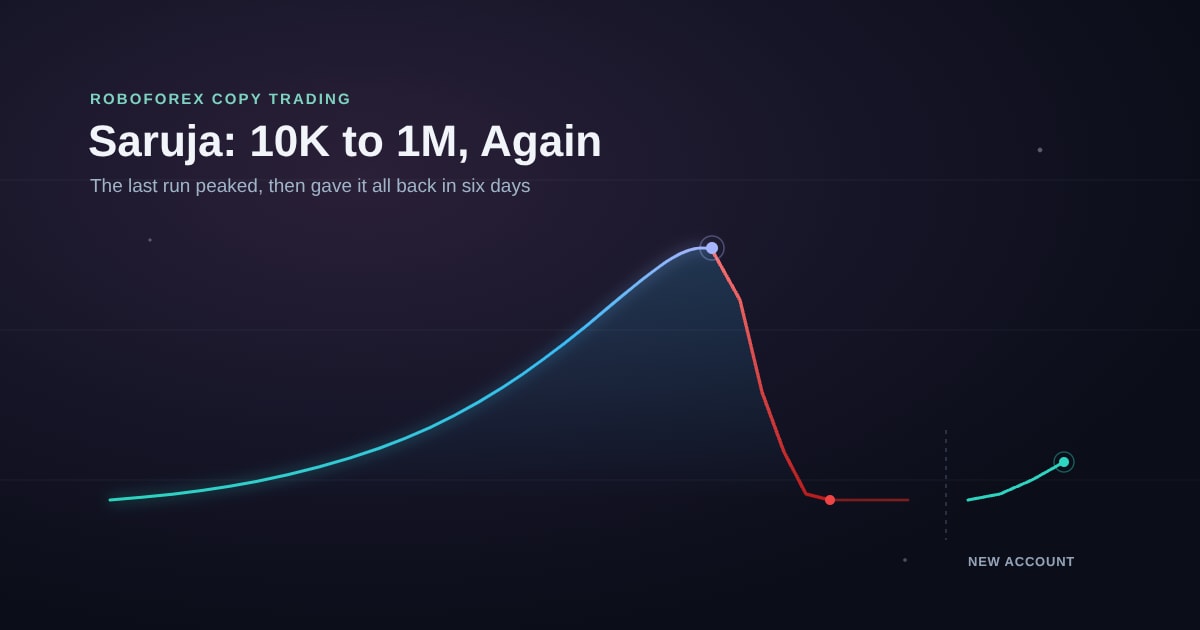
Saruja 10K to 1M Journey: The New Account, and What the Last One Did
Trading has started on the account behind the Saruja 10K to 1M journey. The same operator’s last account made a very large return and then gave all of it back in under a week — which is both the case for copying this one and the reason to keep it small.
Read article →
Cent Account Copy Trading: What the Leaderboard Doesn't Tell You
A copy trading leaderboard ranks strategies by percentage without saying which accounts are cent accounts. The broker's own data carries the flag; the page never shows it.
Read article →
Invictus Maneo Review: Where the Risk Actually Sits
Filmont's Invictus Maneo trades a real funded account rather than a cent one, which is rare among the high-return CopyFX strategies. What its reported maximum drawdown leaves out matters more than the number itself.
Read article →