
Cent Account Copy Trading: What the Leaderboard Doesn't Tell You
A copy trading leaderboard ranks strategies by percentage without saying which accounts are cent accounts. The broker's own data carries the flag; the page never shows it.

Open any copy trading leaderboard and you are given a tidy row of numbers: yield, maximum drawdown, profit in dollars, balance, how many people are copying. What you are usually not given is the one fact that decides what those numbers mean — whether the account behind them is a cent account.
On RoboForex's Copy Trading rating, that fact is not shown anywhere on a strategy's page. It is not a hidden column or a setting you have to switch on. It is simply absent — while the broker's own public API, the one feeding that very page, returns an explicit is_cent flag for every account.
This page is about what cent account copy trading actually is, what it does to a leaderboard, and what happens to your position sizes when you copy across account types. Figures were read on 27 August 2026.
What a cent account is
A cent account is an ordinary trading account with everything scaled down by a factor of a hundred.
Two things shrink together. The balance is denominated in cents rather than dollars, so a $10 deposit shows as 1,000. And the contract size shrinks to match: HFM, which documents this more plainly than most, defines a cent lot as "0,01 of a Standard lot or 1,000 units", with margin requirements "as low as 10 US cents". Vantage describes its own the same way — "your balance represented in cents instead of US dollars".
Because both halves scale by the same factor, the arithmetic is honest. One pip on one cent lot is one hundredth of one pip on one standard lot, against a balance that is also one hundredth the size. A 5% gain on a cent account is a real 5% of that account's equity. Nothing is being faked.
That is worth saying clearly, because the rest of this page is about the ways the same fact misleads.
Not every small account is a cent account, and the distinction matters. A micro-lot account shrinks the contract but keeps the balance in real dollars. Only a cent account relabels the money as well. XM, for instance, currently offers three plans — Standard, Ultra Low and Shares — and none of them is a cent account.
What it does to a leaderboard
A leaderboard ranks strategies by percentage. Percentages are scale-free, which is normally the point: it lets a $500 account and a $500,000 account be compared on skill rather than size.
The problem is that scale-free also means evidence-free. A percentage tells you what a strategy did to its own equity. It does not tell you how much equity that was, how much of it belongs to the person trading, or whether the position sizes involved were ones anybody would take with real money at stake.
Here is a live family of strategies on RoboForex's rating, read from the platform's own data. Six accounts share the AIVA name across two different owner accounts:
| Strategy | Cent account | Balance | All-time yield | Max drawdown | Copying it |
|---|---|---|---|---|---|
| AIVA | yes | $97.40 | −42.44% | −31.88% | 589 |
| AIVA01 | yes | $110.11 | +71.02% | −30.94% | 90 |
| AIVA PRO | yes | $239.90 | +7.40% | −9.80% | 60 |
| AIVA PRO 2 | yes | $236.95 | −17.99% | −49.12% | 28 |
| AIVA PRO 3 | no | $481.39 | +75.55% | −58.34% | 23 |
| AIVAPRO01 | yes | $115.64 | +40.83% | −30.24% | 23 |
Five of the six are cent accounts. Read the first and last columns against each other:

The account carrying 72% of the family's followers holds 8% of its money. The relationship runs the same way down the whole list — the more people copying, the less capital the account itself has behind it.
None of that is visible on the leaderboard. What a prospective follower sees on the flagship's page is a yield figure, a drawdown figure, a column headed Profit, USD, a balance, and a minimum deposit of 100 USD. The word "cent" does not appear on the page. Neither does "ProCent", nor "account type".
To be precise about what is and is not being claimed here: the balance figure is not secretly in cents. The API normalises it to real dollars, and the $100 minimum is a real $100. The issue is not a hidden multiplier. It is that the single label which tells you how to read the whole row is missing from a page whose own data source provides it.
What happens when you copy across account types
This is the part that decides your risk, and it is where a reader deserves the broker's exact words rather than a summary.
RoboForex supports cross-copying — an investor on one account type may follow a trader on another, as long as both are on the same platform. Its help page warns that "trading results may differ between Traders and Investors, even with the same deposit amount", and that "some trades may not be copied if the Investor's account does not support specific instruments".
It then states the conversion rule:
Cent → Standard: Trade volume is divided by 100 Standard → Cent: Trade volume is multiplied by 100
And immediately below it, works an example:
Classic Mode Example. Trader: MT4, ProCent account. Investor: MT4, Pro account. Volume multiplier: 1. The Trader opens a position of 0.5 cent lots. Since the Investor uses a Pro (standard lot) account, the system converts the volume: 0.5 cent lots × 1 = 0.5 standard lots.
Those two passages cannot both be right. Half a cent lot is 500 units of the base currency. Half a standard lot is 50,000. The rule says divide by a hundred; the example multiplies by a hundred — and the gap between them is the difference between a position sized like the trader's and a position one hundred times larger.
The page's other example, for Proportional mode, does convert the units properly: it treats a 0.5 standard lot position as "50 cent lots" before applying the equity ratio. So the documentation is internally inconsistent rather than uniformly wrong, which is arguably worse — it gives no way to tell which behaviour to expect.
We are not going to tell you which one the system actually does; we have not placed a trade to find out. What we can say is that if you are on a standard account and the strategy you are about to copy is on a cent account, this is a question to put to support in writing before you commit money, and to size your first allocation as though the answer might be the unfavourable one.
Our note on how position size decides what a copied strategy does to your balance covers why a hundredfold error in that one variable is not survivable.
Why cent accounts exist, honestly
There are good reasons for them, and a page that only listed the problems would be misleading in its own way.
They let a strategy be tested with real execution at trivial cost. A demo account does not have real slippage, real spread widening or real emotions attached. A cent account does, for ten dollars.
They make position sizing learnable. Sizing is the hardest habit in trading to acquire, and acquiring it on an account where a bad decision costs cents rather than a month's income is a genuinely better way to learn.
They lower the floor for people the industry otherwise ignores. Vantage's cent account opens at $50, HFM's at nothing at all.
There is also a case for copying one. If your own balance is small, a strategy trading cent lots can be mirrored far more precisely than one trading standard lots, where the smallest position the platform will open may already be more than you wanted to risk. A cent account is not a worse thing to copy. In the right hands it is a better one.
So the label is information, not a verdict, and the rest of this page should be read that way.
The one asymmetry worth naming is this: on a cent account the trader's own money in the trade is a hundredth of what the same percentage implies, while the money following it is whatever the followers brought. Nothing about that is against the rules, and it is not evidence of bad intent. But how much of their own capital a trader has beside yours is a reasonable thing to want to know, and the leaderboard is the one place a reader would look for it.
What being in the rating does not prove
Worth stating plainly, because it is easy to read presence in a ranked list as a filter. RoboForex removes an account from its copy trading rating only when equity falls under $50 for three days running, or yield sits at or below −90% for ten consecutive days.
That is the whole bar. It is a filter for near-total destruction, not for competence — the reasoning behind how we score these strategies ourselves starts from exactly that gap.
What to check before copying anything
Five things, in order of how much they change the answer:
- Is it a cent account? If the platform will not tell you, ask. On RoboForex the flag exists in the data behind the page, so support can answer it.
- What is the account's own balance, and how long has it traded? A percentage earned on a hundred dollars over eight months is a test result. The same percentage on a funded account over three years is a record.
- What happens to lot size when your account type differs from the trader's? Get it in writing. See above for why.
- When did the drawdown happen? A maximum drawdown with no date attached is half a number — the point we made at length in our review of a strategy whose entire published drawdown was earned in one recent week.
- How much of the strategy's money is the trader's own? It is the one number that cannot be optimised for a leaderboard.
The strategies in our own CopyFX ranking are scored with these questions already applied. Account type was the one we had been reading and not printing, which is a fair thing to have been caught by our own article, so it is on the ranking now — as a plain label rather than a warning, for the reasons above. Three of the entries carry it, including the one in first place.
Related
View category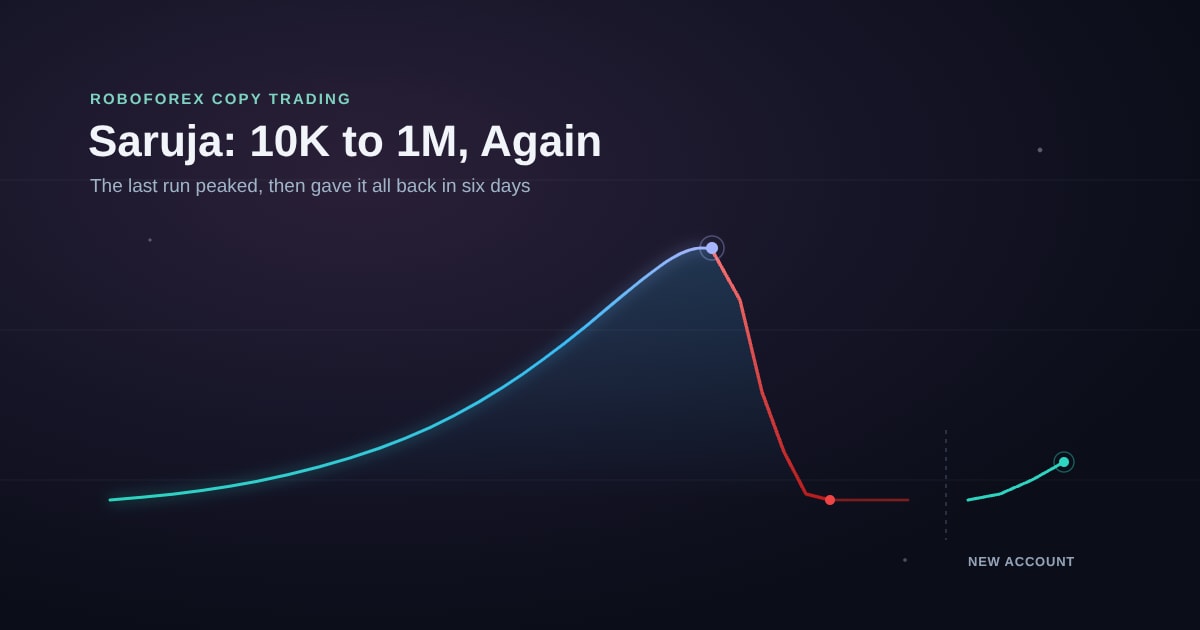
Saruja 10K to 1M Journey: The New Account, and What the Last One Did
Trading has started on the account behind the Saruja 10K to 1M journey. The same operator’s last account made a very large return and then gave all of it back in under a week — which is both the case for copying this one and the reason to keep it small.
Read article →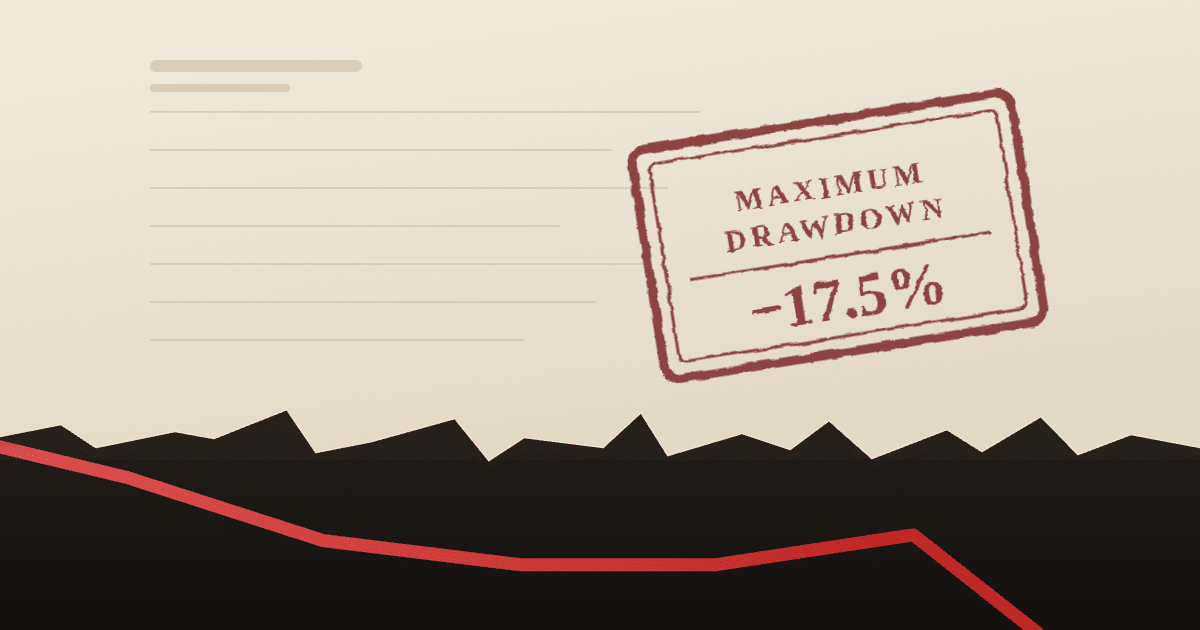
Invictus Maneo Review: Where the Risk Actually Sits
Filmont's Invictus Maneo trades a real funded account rather than a cent one, which is rare among the high-return CopyFX strategies. What its reported maximum drawdown leaves out matters more than the number itself.
Read article →
Saruja AI on RoboForex Is Not One Trader
Fourteen RoboForex copy-trading accounts carry the Saruja name, run by eleven different people. What the name actually means, why the robot behind it has never been for sale, and what happened the last two times it collapsed.
Read article →