
Invictus Maneo Review: Where the Risk Actually Sits
Filmont's Invictus Maneo trades a real funded account rather than a cent one, which is rare among the high-return CopyFX strategies. What its reported maximum drawdown leaves out matters more than the number itself.
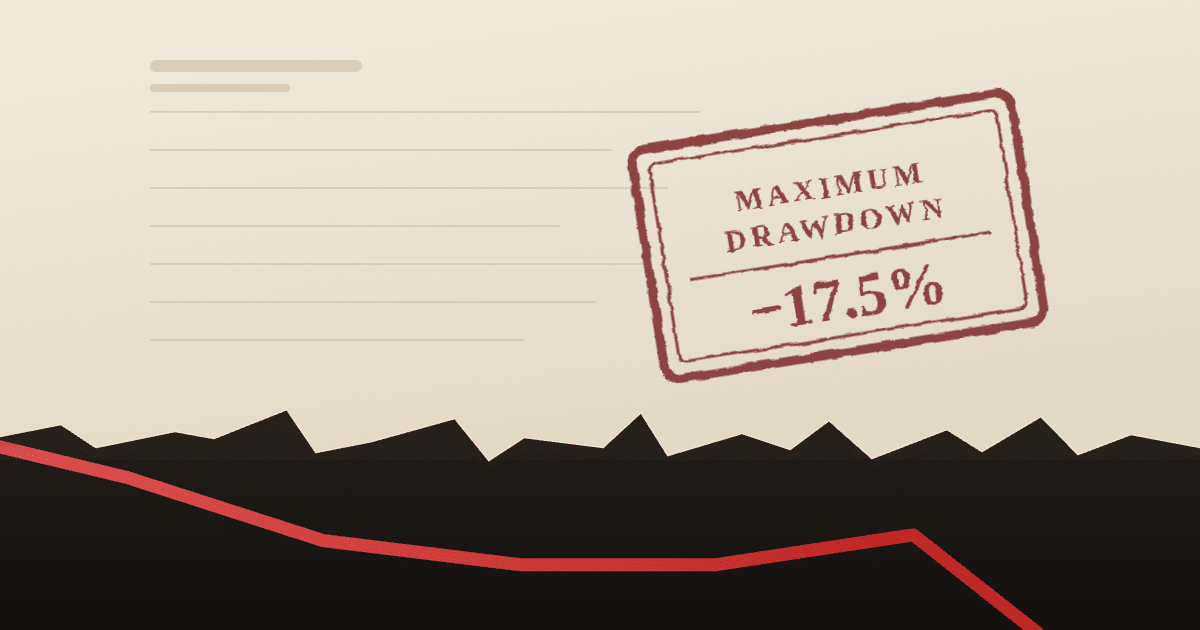
Invictus Maneo is the second-placed entry in our CopyFX ranking, and on the headline numbers it is the most impressive account in the list: +651.24% in a little over eight months, on a standard account rather than a cent one, with a reported maximum drawdown of only −17.5%.
That last figure is the one worth slowing down on. It is accurate, and it is also almost entirely a record of the four weeks before this page was written — which is not what most people assume when they read a maximum drawdown.
All figures were read from RoboForex's live data on 26 August 2026 and are a snapshot of that day.
What the account is
| Strategy | Invictus Maneo (trader Filmont, account 24257117) |
| Running since | 13 December 2025 — a little over eight months |
| Platform | MT4, standard account, not a cent account, leverage 1:1000 |
| Minimum to follow | $100 |
| Trader's fee | 45% of your profit, settled weekly |
| People copying it | 166 |
| Trades | 658 |
| Account balance | $38,299 |
Two lines there matter more than they look.
It is not a cent account. A large share of the spectacular percentages on this platform come from cent accounts, where the money actually at risk is a hundredth of what the percentage suggests. This one holds $38,299 in real dollars, so the operator is carrying a real sum alongside the people copying him. That is the single strongest thing in its favour and it is why it scores where it does in our ranking.
Eight months is not a track record. By all-time return the account sits 129th of roughly 5,000 in the rating — but most of what is above it has years behind it. A partial year ranked against full histories flatters the newcomer, and nothing here has yet been tested by a genuinely bad market.
The record, and the drawdown inside it
| Window | Return | Reported drawdown |
|---|---|---|
| All time (8 months) | +651.24% | −17.5% |
| Last two weeks | −10.67% | −11.78% |
| Last week | +7.70% | −3.86% |
Read the middle row against the top one. The account is up 651% over its life and down 10.67% over the last fortnight, which tells you most of what you need to know about how it moves.
Now the part that the ranking table cannot show you. Here is the account's own daily curve for the last month:

It peaked on 11 August at +740.99%. Seven days later, on 18 August, it read +597.53%. Measured as a fall from that peak — which is what a drawdown is — that is −17.06%, with the steepest single day being −10.93% on 18 August.
The account's whole published maximum drawdown is −17.5%. Nearly all of it was produced in that one week. Not during an early settling-in period, not under some different market two years ago. A fortnight before you read this.
If you had started copying with $1,000 at the 11 August peak, you would have watched it become roughly $829 within the week. As of 26 August it is still 10.67% below that peak.
What a max drawdown in copy trading does not tell you
This is worth a short detour, because it applies to every strategy in the ranking and it is the main thing we check when scoring one.
It carries no date. Seventeen percent lost gradually in an account's first month, and seventeen percent lost last week, are the same published figure and completely different information. The platform shows the number with nothing attached to say when it happened.
It understates the real decline. The published dd_max is calculated in a way that consistently comes in under the true peak-to-trough fall in equity — on another account we measured, a month reported at −1.07% containing a week at +4.51% forces a decline of at least 5.34%, while the same call gave that month's drawdown as 3.03%. Treat the figure as a floor.
It says nothing about how the loss arrived. Seventeen percent bled away over three months is an ordinary rough patch. Seventeen percent in seven days, eleven of it in one session, means the positions are big enough to move the account hard when a trade goes wrong. Our note on how position size decides what a copied strategy does to your balance covers why that difference decides how much you can safely allocate.
For this account, the honest summary is: the drawdown figure is real, it is recent, and it is a floor.
What the trader claims
The strategy's description reads: "Consistent intraday and short-term swing trading with a strong focus on discipline, precision, and capital growth. Strict risk management, no martingale or aggressive grids."
The martingale half holds up. 658 trades in eight months is a normal intraday pace rather than the signature of a doubling system, and the curve does not show the shape described in our piece on why averaging systems produce smooth equity curves right until they do not. There is no evidence here of the mechanism that destroyed the accounts we wrote about earlier this month.
"Strict risk management" is harder to sign off on, and not only because of the August week.
The other account
RoboForex's own data links a second strategy to the same client ID. This is the platform's linkage, not a guess from a similar name:
| Strategy | Opened | Return | Reported drawdown | Copying |
|---|---|---|---|---|
| Invictus Maneo | Dec 2025 | +651.24% | −17.5% | 166 |
| Scalp | 24 Aug 2026 | +35.29% | −56.1% | 3 |
Scalp was opened two days before this page was written. In those two days it has turned over 65 trades, returned 35%, and reported a maximum drawdown of 56.1% — and by the point above, that published number is a floor, not the worst of it.
This is not evidence that Invictus Maneo is badly run. The eight-month account has behaved nothing like the two-day one, and the new account may well be a deliberately aggressive experiment that is being kept separate on purpose. But it is the same person. If part of why you would copy this trader is a description promising strict risk management, what he opened this week belongs in that assessment.
It is also a reminder that copying one strategy is a bet on an operator, not on a track record — the argument for spreading a copy portfolio across unrelated traders rather than concentrating it.
What you actually pay
Filmont takes 45% of your profit. That is high for this platform: Vendo DD50, the account above him in our ranking, charges 30%.
The mechanism matters more than the rate. The fee is calculated and settled weekly, on that week's profit. Losing weeks generate no fee — but they also do not refund fees already paid on earlier weeks.
Put this account's August through that. A follower copying through the strong first half of the month paid on those gains. The 11–18 August fall then removed a large part of the underlying profit. The fees on the gains stay paid; the decline that followed is the follower's alone. This is not particular to Filmont — it is how weekly profit-share works across the platform — but it is why a strategy that swings hard in both directions costs more than its headline rate suggests, even over a period where it ends up roughly flat.
What being in the rating does not mean
RoboForex removes an account from the copy trading rating only when its equity falls below $50 for three days running, or its yield sits at or below −90% for ten consecutive days.
That is the whole bar. The rating filters for near-total destruction, not for competence — the reasoning behind how we score these strategies ourselves starts from exactly that gap. Appearing in the list, high or low, is not an endorsement by the broker.
What would tell you this has broken
Concrete things to watch rather than a feeling:
- A second fall of similar depth before the first is recovered. It is still 10.67% under its August peak. A fresh decline from here would mean that week was a pattern, not an event.
- A worse single day than −10.93%. That would say position sizes are growing rather than being held.
- The Scalp account's behaviour appearing on this one. If the aggressive approach migrates, the eight-month record stops describing what you are copying.
Where it stands
Invictus Maneo earns its second place on things that can be checked: real money on a standard account, no cent-account inflation, a coherent trade pace, and no martingale signature. Those are not small, and 651% in eight months is not a number to wave away.
It is held back by the shortness of the record, by a fee at the top of the range, and by the fact that its entire published risk history was written this month. It is a strategy to size small and watch closely rather than one to back heavily on the strength of the headline figure — and if you take one habit from this page into the rest of the ranking, make it asking when a maximum drawdown happened before you decide what it means.
Related
View category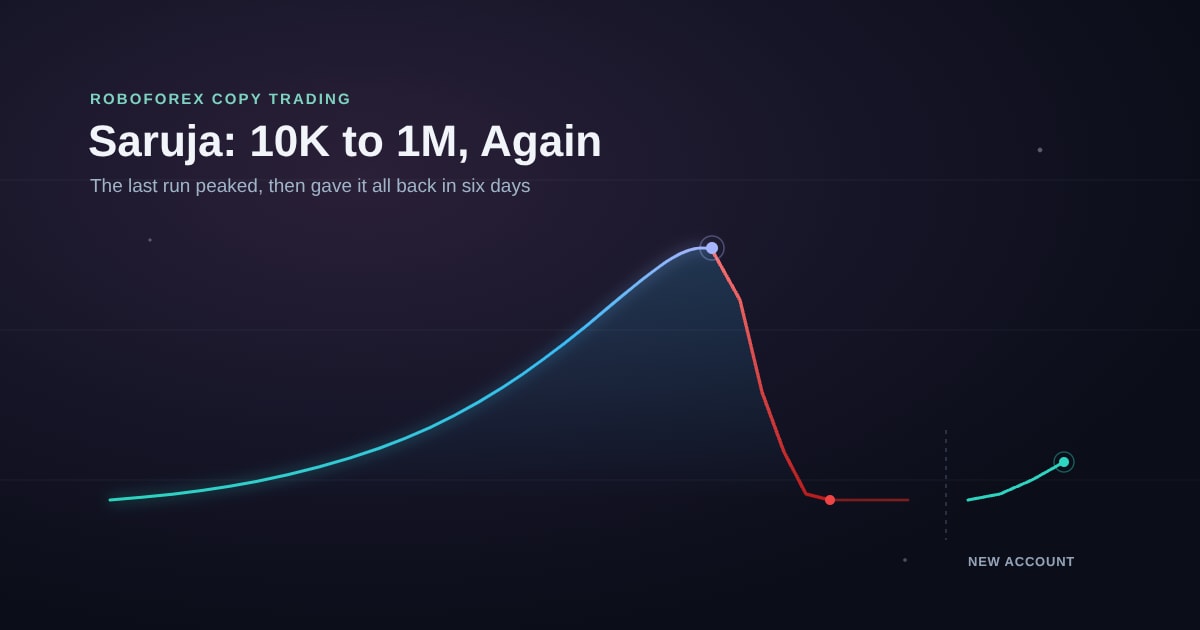
Saruja 10K to 1M Journey: The New Account, and What the Last One Did
Trading has started on the account behind the Saruja 10K to 1M journey. The same operator’s last account made a very large return and then gave all of it back in under a week — which is both the case for copying this one and the reason to keep it small.
Read article →
Cent Account Copy Trading: What the Leaderboard Doesn't Tell You
A copy trading leaderboard ranks strategies by percentage without saying which accounts are cent accounts. The broker's own data carries the flag; the page never shows it.
Read article →
Saruja AI on RoboForex Is Not One Trader
Fourteen RoboForex copy-trading accounts carry the Saruja name, run by eleven different people. What the name actually means, why the robot behind it has never been for sale, and what happened the last two times it collapsed.
Read article →