
Forex Swap Explained, and Why a Swap-Free Account Is Rarely Free
What an overnight swap actually is, why the triple-charge night is not always Wednesday, and what brokers charge instead when an account is advertised as swap-free.
Open a position, hold it past the rollover, and a number appears in your account that you did not agree to and cannot easily predict. Most explanations of it are wrong in the same three ways, and the fourth thing they leave out entirely is the one that costs people money.
This is the mechanic, and then the part about accounts advertised as free.
Why holding overnight costs anything
The textbook answer is settlement. Spot FX settles two business days after the trade, so a position still open at the rollover would require actually delivering both currencies — and rolling it forward avoids that.
That is true, and for a retail account it is not the whole story. Most retail products are contracts for difference, which are never deliverable. Your position has no value date at all. What is being rolled is the broker's own hedge, and what you are charged is their cost of carrying it plus their margin. Some brokers describe it that way outright: that you are effectively being lent the money to hold the position, with the market rate used as an input and an administration fee on top.
Both framings describe the same charge. The second one explains why the number in your terminal never quite matches the interest-rate differential you could calculate yourself.
Why it can be a credit, and usually is not
The size of the roll is anchored to the interest-rate differential between the two currencies. If the currency you are long pays more than the currency you are short, that differential is in your favour.

Here is the part that explains the disappointment. MetaTrader stores two independent values per symbol — one for long positions, one for short — which the broker sets separately. They are not one number with the sign flipped.
So add them together. In a world with no markup they would roughly cancel. They will not, and the gap is the broker's margin, subtracted from both directions at once. On a pair where the two currencies pay similar rates, that markup is enough to make holding a buy cost money and holding a sell cost money.
You can check this tonight on your own account, and it takes about a minute — see below. It is the single most useful thing in this article, because it turns "swaps are a cost" from something you were told into something you have seen.
The triple-swap night is not Wednesday
Almost every article states that Wednesday carries three days of swap, because a Wednesday rollover moves the value date across the weekend.
The reasoning is right and the rule is not. MetaTrader stores the triple-charge day as a per-symbol setting, and brokers set it to match each instrument's settlement convention.

Two published schedules, both read on 9 August 2026 and both subject to change:
- IC Markets Global (Raw Trading Ltd, Seychelles FSA SD018) puts forex, metals, bonds and commodities on Wednesday — and energies and indices on Friday.
- Exness puts indices and stocks on Friday, and states that USD/CAD is charged on Thursday, because that pair settles one business day out rather than two.
So on one account, at one broker, the extra night depends on what you traded. Wednesday is a good guess for a major FX pair and a bad assumption for anything else. Your broker publishes its own schedule; that is the one that applies.
Where to actually look

In MetaTrader 4: open the Terminal window — View → Terminals, or Ctrl+T — then the Trade tab. There is a Swap column. MetaQuotes' own help puts it plainly: charging of swaps is stored in this cell.
That column is the whole verification. Open a small position in the morning, look at it after the rollover, and you have the real number for your account, your instrument and your broker — which no article, including this one, can tell you.
Swap-free accounts, and what replaces the swap
Swap-free accounts exist because interest is prohibited under Islamic law, and an overnight swap is interest on a leveraged position. That part is straightforward.
What is not straightforward is what the broker charges instead, and this is where the reading gets interesting. The omission follows the page type, not the broker. The same firm's educational article will describe swap-free as simply having no swap, while its own account terms and conditions describe an administration fee, a widened spread, or both.
A worked example of that gap, read on 9 August 2026: AvaTrade's Islamic account page carries four statements about the same product that a reader cannot easily reconcile — a headline promising no overnight fees for up to five days, an explanation that the account is not subject to any special fees or interest, a forex section saying swap fees are fully transferred into daily administration fees on all forex products, and an account section saying positions held longer than five days may incur a fee. The binding conditions appear only as asterisked footnotes: MetaTrader 4 crypto unavailable, certain currency pairs unavailable, and Islamic accounts subject to an increased spread on FX pairs.
Note also that AvaTrade operates through several separately regulated entities, so what that page says is what applied to that page on that date.
The grace period is not counted the way you would count it

At IC Markets Global, grace is counted in grace days consumed by rollovers, and the triple-swap night consumes three of them at once. Its page says an ordinary overnight rollover counts as one, and that on the applicable triple-swap night the rollover counts as three rather than one.
Follow that through. A forex position opened on Monday with five grace days spends one on Monday night, one on Tuesday night, and three on Wednesday night. By Thursday morning it is being charged. Five grace days, three free nights.
The same page carves out exceptions in both directions — some energy instruments get no grace period at all, a couple of yen pairs get fewer days — and notes that once holding fees start they may be charged for calendar days including weekends. So grace is spent by rollovers, but charging runs on the calendar. Two different clocks in one product.
Other schemes count plain calendar days instead. The number is not the point. Which of the two your account uses is the point, and it is in the terms rather than the marketing.
Three more things worth knowing before switching
The carve-outs cluster where swap is largest. Swap-free rarely covers everything, and the exclusions tend to land on exotic pairs, metals and energies — precisely the instruments whose overnight cost was worth avoiding.
Holding for weeks can be the behaviour that removes the status, at some brokers retroactively. If the plan is to hold a carry position for a month, read the eligibility terms specifically for a holding-period clause before opening.
Swap-free is not always about religion. At least one large broker makes swap-free the default and reserves a separate per-lot administration fee triggered by trading activity. Whether that is cheaper than a swap depends entirely on how long you hold, and it is a different cost shape rather than a smaller one.
Does any of this matter for you?
Honestly: if you close before the rollover, none of it. Swap applies at a fixed instant. A day trader who is flat overnight pays exactly zero regardless of how alarming the swap table looks.
It matters, and compounds, for anyone holding for days or weeks — swing positions, carry trades, a copy-trading allocation following a manager who holds through the week. That is the reader who should do the sixty-second check above before choosing where to trade.
What we do and do not score
Our forex broker ranking scores regulation, platforms, costs, overnight financing and several other components, with the weights published on our methodology page. Overnight financing was added as its own component on 2026-08-10, specifically because of the gap this article used to describe.
That doesn't replace doing your own check, though. Our financing score looks at whether a broker's swap-free account is genuinely free or just replaces the swap with another fee, and whether rates are published transparently - it can't substitute for reading the actual schedule for the specific instrument and account type you trade. Find it, read the two directional values, and if you are looking at a swap-free account, find the clause that says what replaces the swap.
If you are still choosing a broker, our broker ranking is here, and the Exness review goes into how its cost structure fits together — that broker is also a useful case study for this article, since swap-free is its default rather than an add-on.
The short version
A swap is not a fee your broker invented, and it is not purely the interest-rate differential either. It is that differential plus a markup, stored as two separate numbers, charged at one instant, on a night that is not always the one you were told.
And an account advertised as swap-free has not removed that cost. It has reshaped it into something with a different name, usually disclosed somewhere other than the page that advertised the account.
Related
View category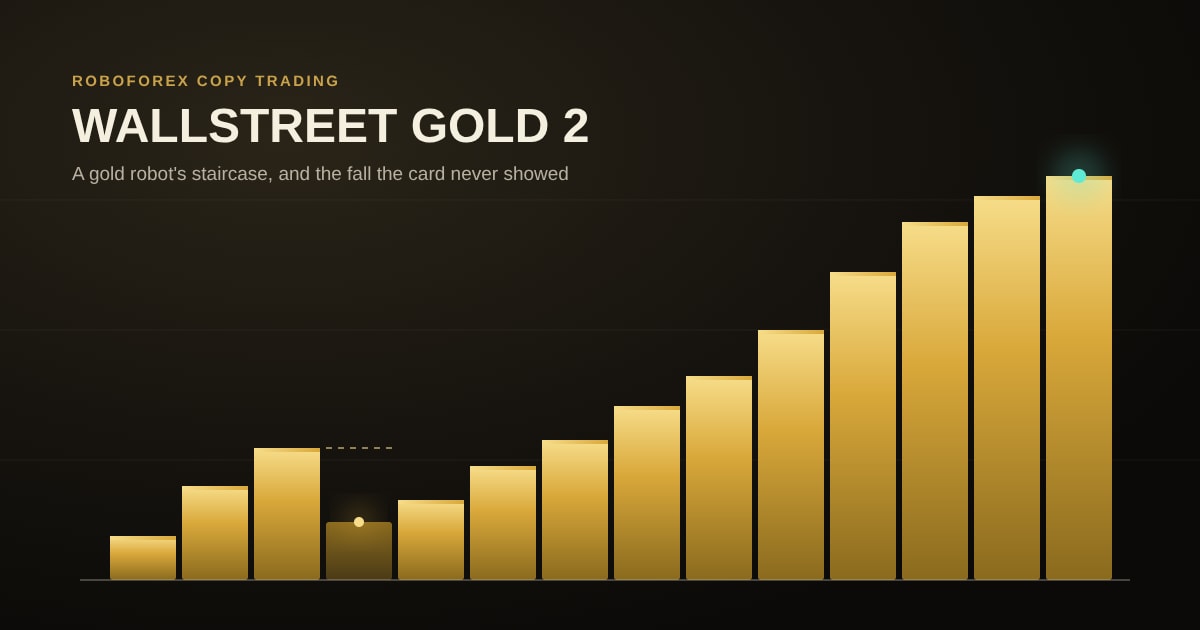
WALLSTREET GOLD 2 Review: XAUUSD Copy Trading as a Staircase, Not a Spike
WALLSTREET GOLD 2 is one of the most-copied accounts in our CopyFX rating: a gold-only robot with a staircase record and a card whose drawdown figure understates its worst fall. The card never showed the account's first-year fall, and the trader's original account on the same robot has taken a fall this one has not. What the full record shows, what the fee really takes, and how to size it.
Read article →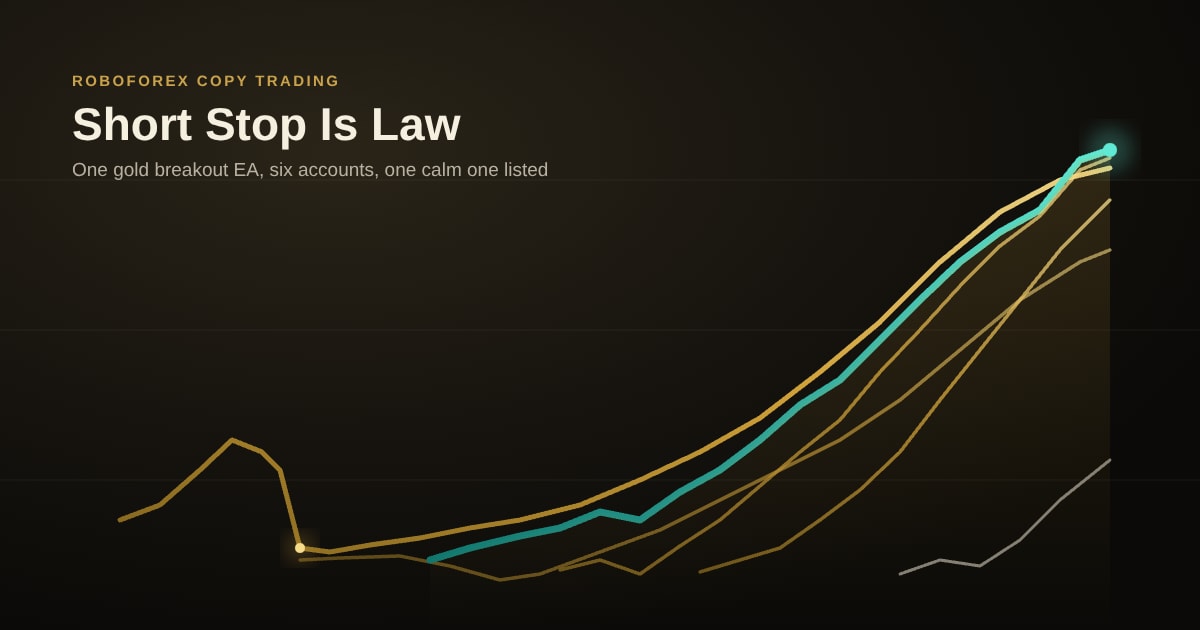
Short Stop Is Law Review: A Gold Breakout EA on Six Accounts
Short Stop Is Law sits high in our CopyFX rating on a record with no double-digit fall. The same trader runs the same gold breakout EA on five other accounts, and three of them have already been through falls the listed one has not. What the whole family shows, what the fee history says, and how to size it.
Read article →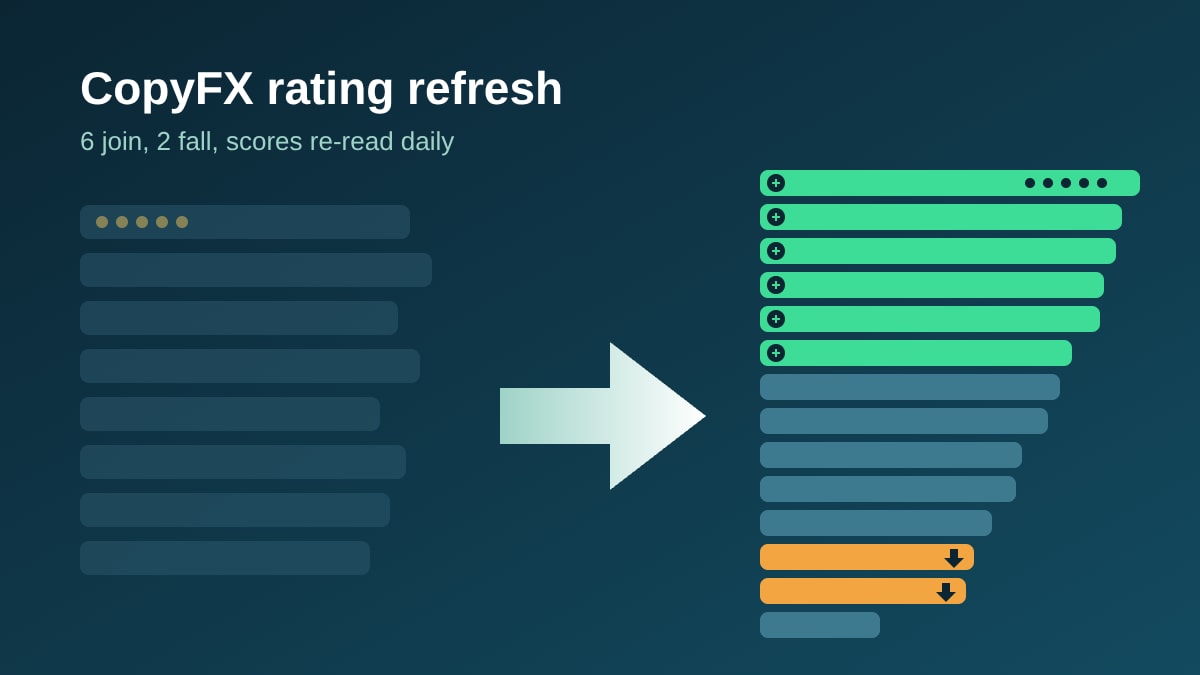
CopyFX Rating Refresh: Six Strategies Added, Two Falls, and a Score That Reads the Full Curve
Six RoboForex CopyFX strategies join our rating and none leave. Filmont gave back 48% from its August high and exactw sits well below its own; both stay, re-scored. And the score itself is now computed every morning from each strategy's full daily curve, which shows falls the platform's own drawdown figure never did.
Read article →