
Bybit Copy Trading: Reading a Leader Card Before You Follow One
The board opens sorted by return, and return is the number that predicts least about what a follower earns. What the card measures, what it quietly forgets, and the four things worth reading instead.
Bybit's copy-trading board opens sorted by return, and that is the least useful column on the page.
The deeper problem is that no number on the card carries the account's history. Everything you are shown is computed over a recent window - ninety days is the longest view the platform offers - so whatever happened before that is simply not on the page. The board is, by construction, a display of everyone's best recent stretch. Picking a leader from it means answering "who looks good right now?", when the question you are actually asking is "who survives?".
None of this is an argument against copy trading, or against the exchange itself, which runs one of the larger copy-trading books in crypto. It is an argument about reading the card: what each number really measures, which ones are theatre, and what to look at instead.
The worked examples below come from our own regular readings of the board - we keep a rating of Bybit's leaders precisely because the durable record has to live somewhere - but the mechanisms they illustrate are properties of how the board works, not of any particular week.

The return on the card is not your return
Bybit's ROI is the leader's own: their profit measured against their own equity plus what they deposited. It says nothing about what a follower earned, because followers arrive at different times, with different amounts, and copy at different sizes.
The gap is not subtle. On one of our readings, the highest published return on the whole board was 863% - and the followers of that account were collectively $6,847 down. Second place at 687% had followers $17,223 down. Eighth place at 428% had followers $19,427 down. Three of the ten proudest numbers on the board sat above accounts that had lost their followers money.
The leader who had actually made followers the most - $316,863 between them - was 38th by return, with a modest-looking 118%. The second-best, at $273,390, was 77th. The third had made followers $43,201 while posting a return of minus 36%, which put it 618th on the board you are shown first.
Across the 768 leaders on that reading with enough real activity to judge - out of more than seven thousand the board listed - the correlation between the return on the card and the money followers actually made was 0.07. Statistically, near enough to none: sorting by the big number is close to sorting at random. If you read one column, read the follower profit.
The drawdown does not remember
The other number people lean on is maximum drawdown, and it has a stranger problem: it does not persist.
Because the statistic lives inside a trailing window, a bad stretch ageing out of the window takes the drawdown with it. And a leader who stops a strategy and starts a new one begins the statistics again. Either way, the figure in front of you describes a recent period rather than the person running the account - and the card does not tell you which of the two you are looking at.
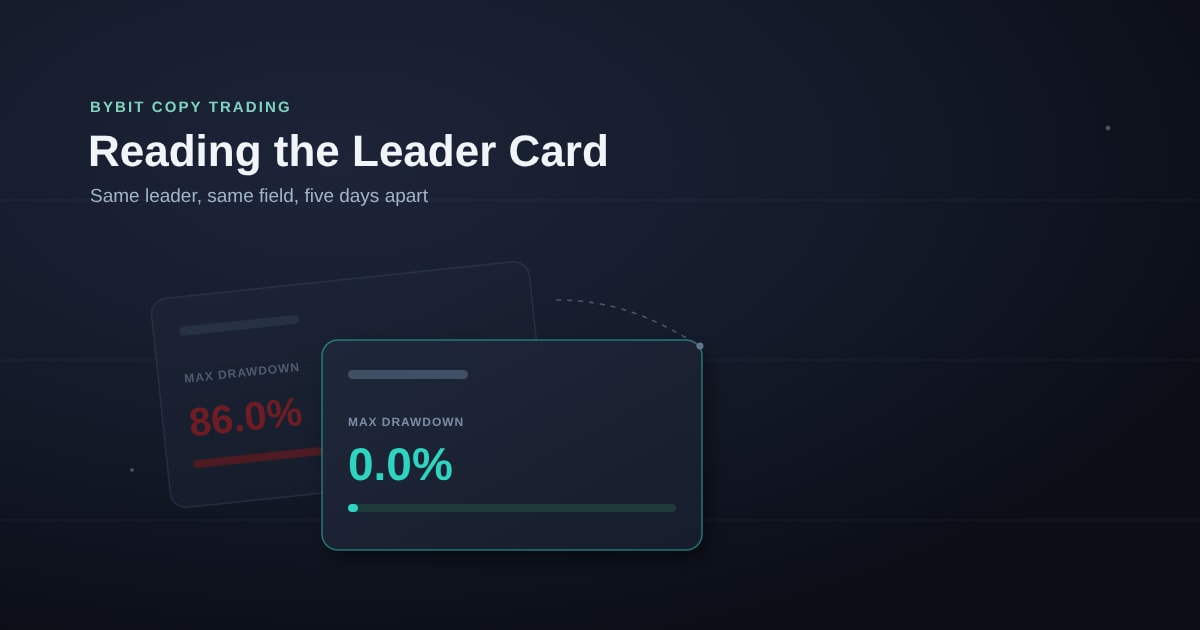
Here is what that looks like in practice: the same field, for the same five leaders, as Bybit's own card showed it five days apart. Neither number is ours - both are theirs.

On the first reading, Rebirth's card showed a maximum drawdown of 86.0%. Five days later the same card showed 0.0%. Fimonacci went from 84.7% to zero. Nick_ly went from 84.6% to zero, and its return moved from minus 77.8% to zero as well - a completely clean card for an account that had been deeply under water the week before.
Nor is this an occasional glitch: between those two readings, a third of the judged leaders - 257 of 768 - came to show a shallower drawdown than the same card had shown days earlier.
A high win rate is not the tell
Two hundred of those 768 leaders won at least nine trades in ten. Their average maximum drawdown was 33.5%, and the worst of them had been to 100%.
That is the shape worth understanding. A high win rate is produced by closing winners early and letting losers run, or by adding to losing positions until the market comes back - the pattern behind a martingale, which produces a beautiful equity curve until the one time it does not. Nine wins in ten and a third of the account gone is not a contradiction; it is the same fact told twice.
The leaders winning under 60% of their trades averaged a 43.3% drawdown - worse on average, but the two groups overlap so heavily that the win rate sorts nobody usefully. It is neither a danger sign nor a safety signal. It is close to noise.
The profit-to-loss ratio frequently divides by zero
Of the sixty leaders we pull trade-level detail for, nineteen had not closed a single losing trade when we last looked. Their profit-to-loss ratio is arithmetically undefined, and something is displayed anyway.
A leader with twenty wins and no losses has demonstrated one thing: they have not closed a loser yet. Open positions do not count against the record until they are shut, so an account sitting on several deep unrealised losses can present a perfect ratio right up to the moment it cannot.
What is actually worth reading
Four things, roughly in order. Together they are most of what separates a Bybit copy trading leader worth following from one that merely ranks well.
Follower profit. The only column that measures the outcome you are buying. Everything else measures the leader's own account.
Age. Among the leaders we could date on a recent reading, the median account was 425 days old - but the default sort promotes whatever is hot, and a two-month-old account with a spectacular number is the most common thing on the board. A record short enough to fit inside one good market is not a record.
Followers and money per follower. Two hundred followers averaging $20 each is a marketing result. Twelve followers with real money behind them is a different signal, and neither is visible from the headline count.
What the leader risks themselves. An operator running their own $500 alongside your $5,000 is not sharing your problem.
Then there is the number no card will ever show you: how much of your own capital belongs in any single strategy. Decide that before you open the board rather than after something on it impresses you - we worked through the arithmetic of position sizing separately, and it matters more than which leader you pick.
The full history has to live somewhere
Nothing on Bybit lets you see past the window. Ninety days is the longest view the card offers, and the account's complete record is not available on the platform at all - the flattering recent stretch is the only story it can tell.
So we keep the record ourselves. The ranking we maintain reads the board regularly and remembers every reading: a leader is scored against the deepest drawdown we have ever recorded for them, not the one on display today, and an account that wipes its card clean does not wipe our copy of it. That is the practical difference between the board and the rating - the board shows the best recent window, the rating shows everything we have seen. How the score is built is written out in full, and the page prints the date it was last read, because a rating that hides its age is doing the same thing the card does.
If you want the background on the venue rather than the leaderboard - fees, custody, what the exchange is actually good at - the full review is here.
The worked examples above come from our readings of the board in late August and early September 2026. The mechanisms they illustrate - what the return measures, what the window forgets - are properties of how the leaderboard works, not of that week. Copy trading carries risk, and none of the numbers above predict future performance.
Related
View category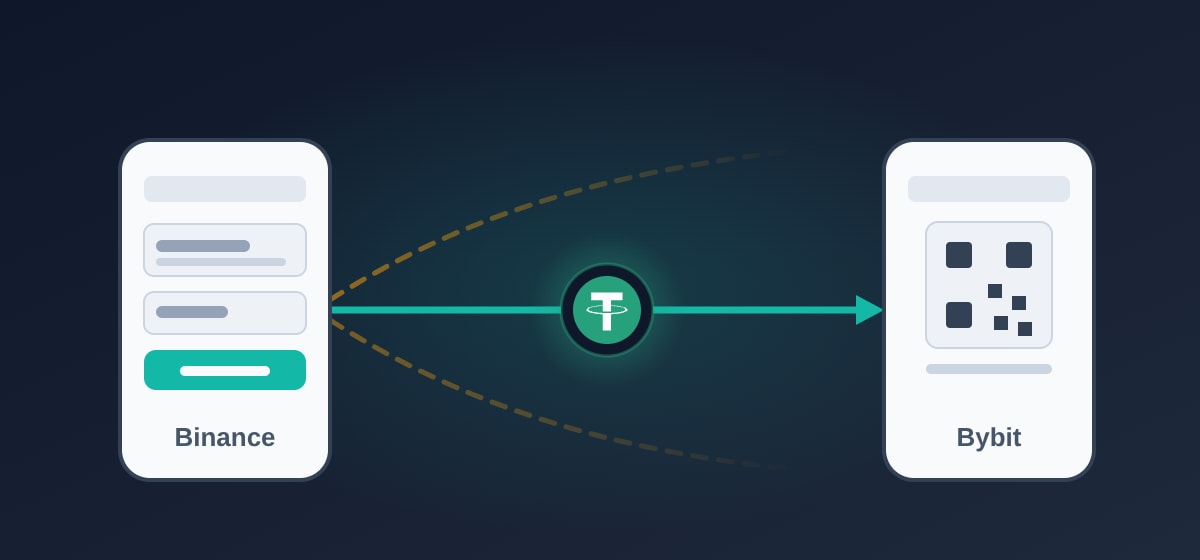
Binance to Bybit USDT Transfer: The Fee on Every Route
TRC20 is the most expensive way to move USDT out of Binance, not the cheapest — and Binance's own withdrawal note says so. The fourteen routes Bybit actually credits, what each costs to send, the five chains that would swallow the money, the account-side locks that stop a transfer before it starts, and what recovery really costs when it goes wrong.
Read article →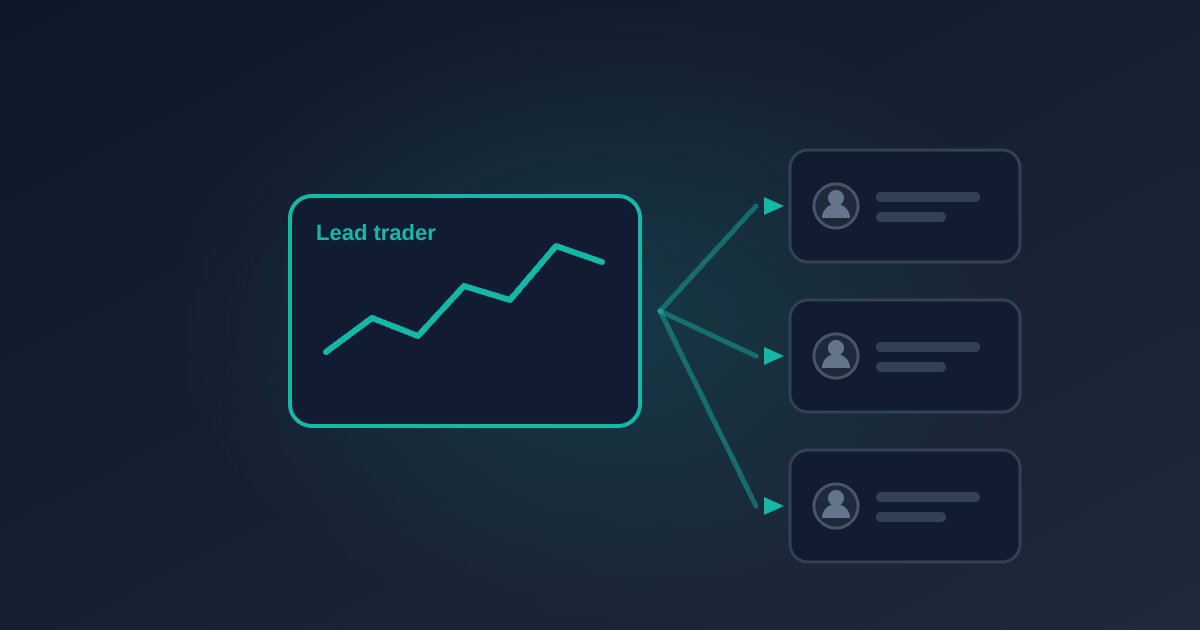
Bybit Review: Trading Tools, Fees, Copy Trading and Risks
A practical Bybit review covering trading tools, futures, copy trading, bots, fees, risks and how Bybit compares with Binance.
Read article →
Binance and Bybit: What to Check Before You Deposit
How to decide between two crypto exchanges instead of being told which one wins: five questions to answer before you register, the fee lines a headline rate hides, the order to learn futures in, and why your own verified account is the last check.
Read article →