
Trezor Review: Three Wallets, One Security Floor
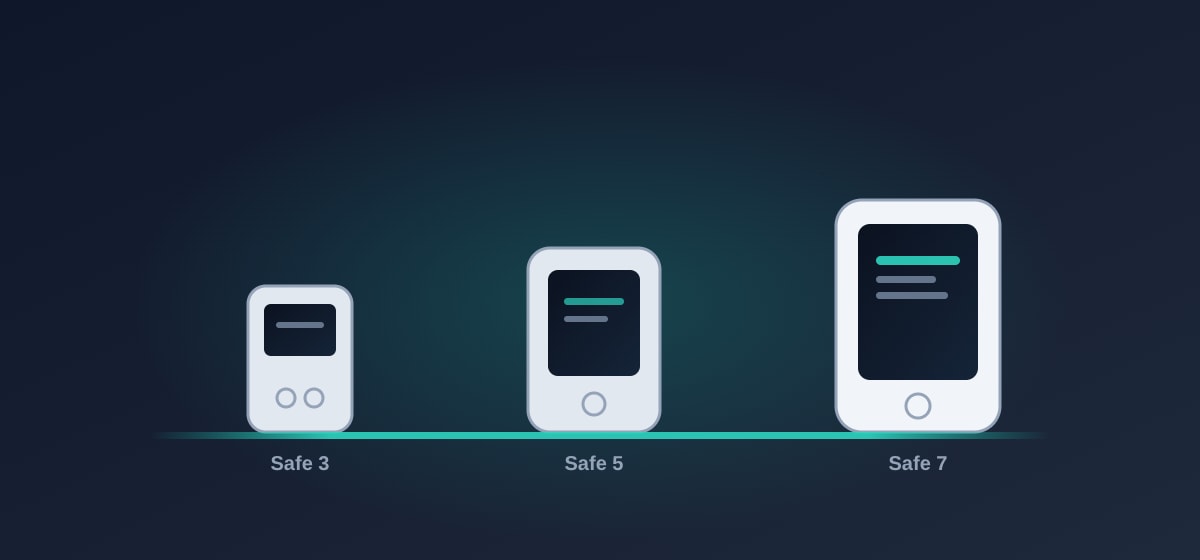
Safe 3, Safe 5 and Safe 7 share a certified secure element, open-source firmware and Multi-share Backup. The feature that most protects you is on the 59-dollar device; the extra 190 buys screen and wireless.
Quick verdict
Trezor makes three hardware wallets, and the useful thing to know before comparing them is what they have in common rather than what separates them.
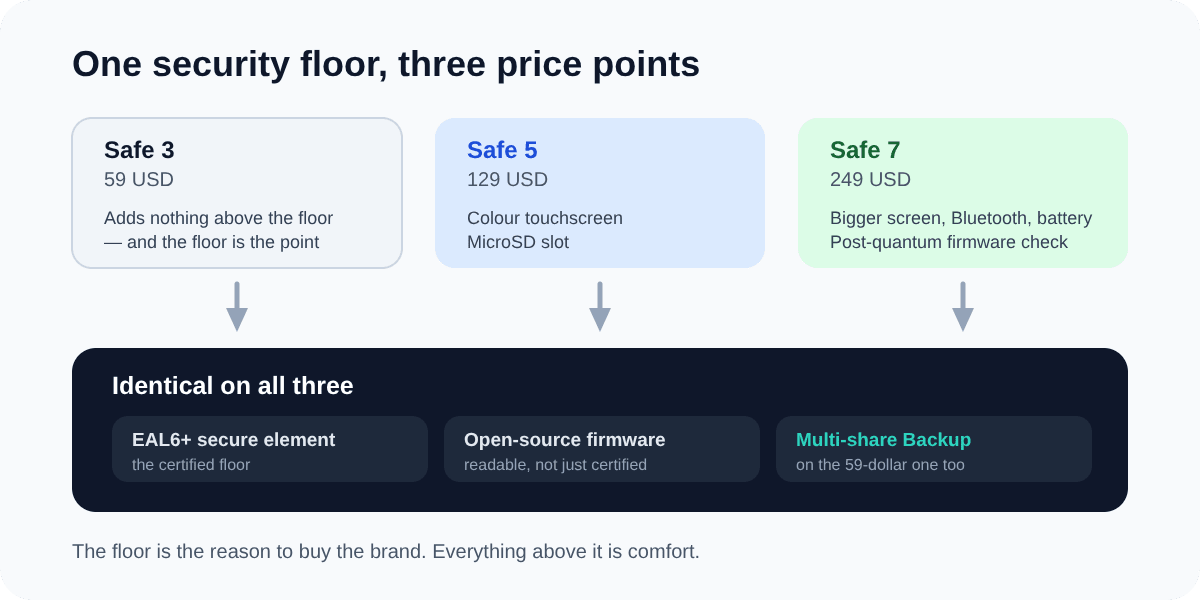
All three Trezor devices carry a certified secure element. All three run the same open-source firmware. All three support Multi-share Backup, which is the single feature most worth buying this brand for. The cheapest costs 59 USD and the most expensive 249, and the security floor is the same at both ends.
What the extra money buys is a better screen, wireless connectivity, and on the newest device a post-quantum signature protecting the firmware. Those are real improvements. None of them is the thing protecting your coins.
The three devices
| Model | Price | Screen | Connection | Secure element | Post-quantum firmware |
|---|---|---|---|---|---|
| Trezor Safe 3 | 59 USD | 0.96in monochrome OLED | USB-C | EAL6+ certified | No |
| Trezor Safe 5 | 129 USD | 1.54in colour, 240×240 | USB-C, MicroSD slot | EAL6+, NDA-free | No |
| Trezor Safe 7 | 249 USD | 2.5in colour, 520×380 | USB-C, Bluetooth 5.0+, battery | Three chips from three vendors | Yes |
Each model also comes in a Bitcoin-only variant at the same price, running firmware that supports nothing but Bitcoin. Fewer features means less code, and less code means less to go wrong — that is the whole argument, and it is a reasonable one if Bitcoin is genuinely all you hold.
The Safe 7 is the one with the loudest marketing and the most to unpack, which is why it has a review of its own — linked from the table above — covering what its quantum claim actually reaches.
What is identical across the range
This is the part comparison tables tend to bury, and it is what makes the cheapest model a serious recommendation rather than a compromise.
The same firmware. Trezor Suite is one application, and all three devices run open-source firmware you can read. That is Trezor's long-standing position and it is the reason the brand exists in the shape it does.
A certified secure element. Safe 3 and Safe 5 both carry an EAL6+ certified chip. The Safe 7 adds two more chips alongside it, but the certified floor is common to the line.
Multi-share Backup. All three support splitting your recovery secret into several shares, where a subset restores the wallet. This is not a premium feature on the expensive model. It is on the 59-dollar one.
That last point deserves emphasis, because it inverts how these devices are usually sold. The feature that most reduces your chance of losing everything is available at the bottom of the range. The features that cost more are conveniences.
Multi-share Backup, and why it is the reason to buy Trezor
A single recovery phrase written on paper is a single point of failure in two directions at once. It can be lost — fire, flood, a house move — and it can be found, by anyone who goes looking.
Multi-share Backup splits the secret into several shares and lets you set how many are needed to restore. Three shares where any two work means one can be destroyed without loss, and one can be stolen without exposure. You put them in different places and neither accident nor theft is a single event any more.
The cost is complexity, and it is a real cost. More pieces means more to track, and a scheme you do not fully understand is worse than a phrase you do. Set it up when you are calm and unhurried, and write down where the shares are — separately from the shares.
If you are holding an amount where losing it would genuinely matter, this is the argument for Trezor over the alternatives, and it applies at every price in the range.
Trezor Keep Metal is not a wallet
Worth clearing up, because the name suggests otherwise and it appears alongside the devices in Trezor's own shop.
Keep Metal is a set of steel plates for stamping your recovery words into, sold in Single Share, Multi Share and 24-Word variants. It stores a backup. It does not sign transactions, it does not connect to anything, and it is not an alternative to a wallet — it is what you write the backup on instead of paper, so that a fire does not end your holdings.
Useful, and unrelated to which device you buy.
Open source, and the argument behind it
Trezor's position is that a security claim you cannot inspect is a claim you have to take on trust, and the industry's usual answer — a certification you are not allowed to read the underlying documentation for — is not good enough.
That is why the firmware is open, why the Safe 5's secure element is described as NDA-free, and why the Safe 7's headline chip is marketed on being auditable rather than merely certified.
Whether that argument moves you is temperament rather than mathematics. Some buyers want a certificate from a lab; others want to read the code. Trezor is unambiguously built for the second kind, and that is the clearest way to decide whether the brand is for you at all. It is also why it scores where it does in our hardware wallet rating — highest on the balance between certified security and open verifiability, rather than on features or coin count.
The August 2026 data breach
On 13 August 2026 Trezor disclosed that a shipping and fulfilment provider, ShipMonk, had been breached, exposing customer records: 13,689 people, of whom 11,742 had name, email, phone number and delivery address taken. The orders concerned were placed between 10 May and 8 August 2026.
No device was compromised, no keys were touched, and no recovery backups were in that system.
What it says about the company is the part that belongs in a Trezor review covering the whole range rather than one device. The failure was at a logistics partner rather than in Trezor's own infrastructure, the disclosure came three days after Trezor was notified, and a 90-day data retention policy is what limited the window to three months rather than the whole customer history. That is a reasonable showing, and it is a materially smaller incident than the 2020 breach at Ledger, which exposed over a million customers from that company's own database and still feeds phishing years later.
It is not nothing. A list of confirmed hardware wallet owners with delivery addresses is exactly what a phishing operation wants. If you ordered inside that window, the practical detail is in the Safe 7 review — but the short version is that no message about your Trezor deserves trust, and nobody legitimate will ever ask for your recovery words.
Which model actually fits you
Safe 3, at 59 USD. The right default for most people. Certified secure element, open firmware, Multi-share Backup. The screen is small and monochrome, which matters only when you are checking a long address, and you should be checking it carefully anyway.
Safe 5, at 129 USD. Buy it for the colour touchscreen if you transact often enough that reading and confirming on a small mono display becomes a chore. The MicroSD slot is a genuine addition. The security story is the same as the Safe 3.
Safe 7, at 249 USD. Buy it for the three-chip architecture and the auditable secure element if that specific argument appeals, or for Bluetooth if you want to use it away from a computer. Do not buy it expecting the quantum feature to protect your coins — it protects the device's firmware, and Trezor says so itself.
Any of them in Bitcoin-only firmware, if Bitcoin is all you hold and you want the smallest possible attack surface.
If you have not settled the more basic question of whether you need a hardware device at all, the trade-off against software wallets is laid out in our guide to the wallet types.
Bottom line
Trezor sells one security philosophy at three prices. The floor — certified element, open firmware, Multi-share Backup — is the same on the 59-dollar device as on the 249-dollar one, and that floor is the reason to buy the brand.
Everything above it is comfort: a bigger screen, no cable, a firmware signature built for a threat that has not arrived. Worth paying for if you want them. Not worth waiting for if you do not, because the device protecting your coins today is the one you actually own rather than the one you are still deciding about.
Prices and specifications were read on Trezor's own product pages on the day of writing; check the current ones before ordering.
Related
View category
Trezor Safe 7 Review: What "Quantum-Ready" Actually Protects
Trezor built post-quantum cryptography into the Safe 7, and it guards the bootloader, firmware and device authentication — not your coins. Three chips from three vendors, an auditable secure element, and a data breach disclosed a week ago.
Read article →
Ledger Review: Which Hardware Wallet Model Actually Fits You
A practical Ledger review covering all five current hardware wallet models, the Secure Element security core, Ledger Recover explained honestly, and the 2020 breach's lasting phishing risk.
Read article →
DEVI Algo Trading Review: Three Bybit Accounts, One Brand
Three accounts share the DEVI name and a near-flat risk profile, and the cleanest record of the three is the one to trust least. Which of the family a copier can actually judge, and what its perfect flagship cannot prove.
Read article →