
DEVI Algo Trading Review: Three Bybit Accounts, One Brand
Three accounts share the DEVI name and a near-flat risk profile, and the cleanest record of the three is the one to trust least. Which of the family a copier can actually judge, and what its perfect flagship cannot prove.
Search for DEVI algo trading on Bybit's copy board and three accounts answer: DEVI ALGO TRADING, DEVI Classic SOL, DEVI Flex Algo Strategy. Same name on the door, same near-flat risk profile, three different dials - and, on our readings, the cleanest-looking record of the three is the one our rating trusts least.
Worth saying first, because we have caught name-squatters beside two other leaders in this series: nothing in the platform's data actually ties these three together. The user ids are far apart, the accounts opened at different times, and the profit shares differ. What ties them is the brand name and a shared style of trading. That reads like one operation running a product line - but unlike the Sort-of twins, which were registered the same day, here the connection is the label, not the paperwork. Treat each account on its own record.
The flagship's page on the exchange is the one carrying the searched name, so start the tour there.
Three dials, one style

All three run drawdowns around one to two percent - our own record, which keeps the worst reading we have ever taken of each account, agrees with the cards. On risk taken, the family is one strategy in three sizes. The spread in our scores comes from somewhere else entirely.
DEVI ALGO TRADING, the flagship: 617 days old, the biggest book of the three at roughly $284,000, and a 100% win rate - 58 closed trades, zero closed losses. Its profit-to-loss ratio literally divides by zero. It also charges a 30% profit share, the expensive end of the whole board.
DEVI Classic SOL: 465 days, 51 wins against 11 losses, a 1.33 ratio, a 10% share.
DEVI Flex Algo Strategy: the youngest at 373 days, 80 wins against 12 losses - and a ratio of 2.08, meaning the average win is about twice the average loss. On a board where the quiet accounts almost always run the opposite shape, that combination with a 1.02% drawdown is genuinely rare, and it is why Flex sits near the very top of the rating we keep.
The perfect-record problem
Why does the oldest, biggest account of the family score lowest with us?
Because a record with no closed losses at 617 days is not evidence of safety - it is the absence of evidence. As we showed when we took apart the leader card itself, open positions do not count against a record until they close, so a card can stay perfect right up to the day it cannot. Classic SOL's eleven closed losses and Flex's twelve are things a copier can inspect: how big, how often, how handled. The flagship's zero is a question mark wearing a medal, and our scoring treats twenty-plus wins with no losses as a warning rather than a boast - which is the whole disagreement between our 2.47 and its board-friendly card.
Add the price. At a 30% share the flagship charges three times what its own siblings charge for the same house style with inspectable records. Whatever else is true of the family, that pricing assumes certainty no card can prove.
The week the family moved as one

Across our readings of 28 August, 2 September and 5 September, all three follower ledgers rose into the middle reading and gave it back by the last one - about $5,700 returned across the family in three days, while the audiences barely moved (the flagship's follower count sat frozen at 37 on all three dates). Correlated books are the practical warning here: whether or not one hand runs all three, the ledgers move like it does. Spreading a copy allocation across two DEVI accounts is not diversification in any way that matters - the same week took money from all of them at once.
None of this made anyone's card look worse, note. Drawdowns stayed at one to two percent throughout; the giveback lived in the followers' unrealised column, where cards do not look.
What copying a DEVI account actually risks
The style is the quiet kind we keep writing about: small, frequent, disciplined - and short on stress tests. Between the three there are 23 closed losses in nearly four combined years of trading, which speaks to control and says nothing about a long adverse stretch. Size against the shape, not the history: the arithmetic of how much belongs in one strategy matters more here than the choice within the family.
And if you do choose within the family, our reading is plain: Flex has the record a copier can actually judge - real losses, wins bigger than losses, the family's own risk profile - at a third of the flagship's price. Its page is here. The flagship asks you to pay the most for the record that can be checked the least.
Readings quoted are ours, taken 28 August, 2 September and 5 September 2026. The mechanisms - unfalsifiable perfect records, correlated books, the rolling window - are how the board works on any date. Copy trading carries real risk, and nothing above predicts future performance.
Related
View category
HFT. Sort of Review: The Quietest Kind of Bybit Copy Trading
A card with almost no drawdown, a win rate that looks unreal, and the arithmetic that reconciles the two. Plus the same-day twin account, and the imitators not to confuse with either.
Read article →
Bluntz Review: Bybit Copy Trading Without the Fireworks
The board scrolls past him, and his followers have been paid more than anyone else’s. What the quiet account does differently, the five days that halved his headline while his followers earned, and the look-alike not to confuse him with.
Read article →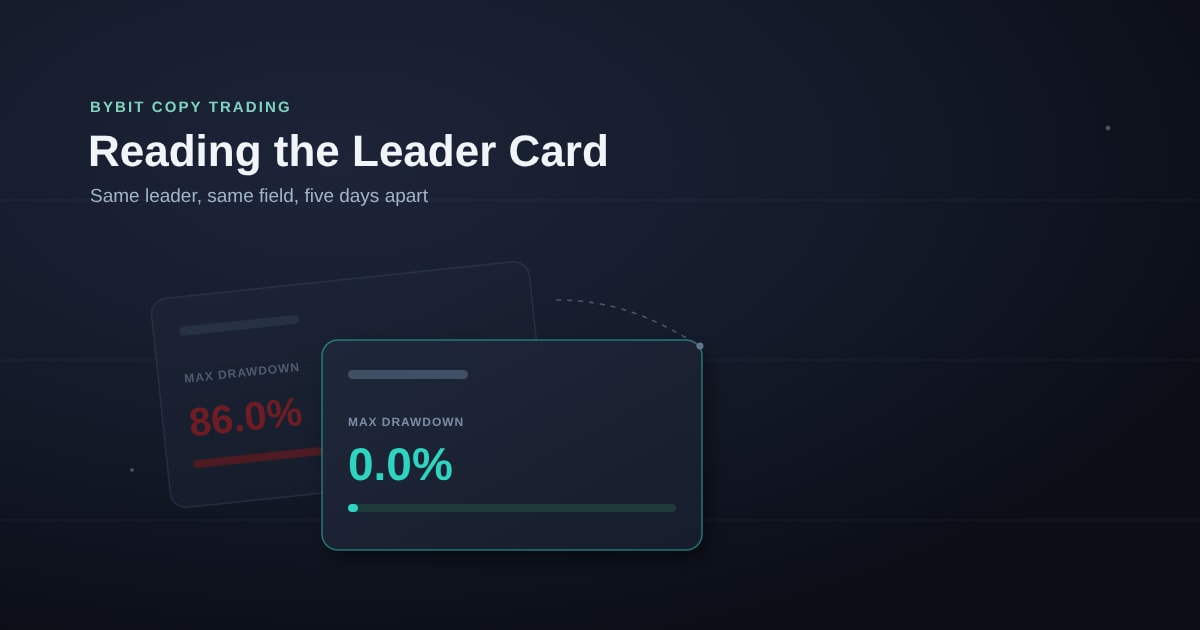
Bybit Copy Trading: Reading a Leader Card Before You Follow One
The board opens sorted by return, and return is the number that predicts least about what a follower earns. What the card measures, what it quietly forgets, and the four things worth reading instead.
Read article →