
What Is XRP? The XRP Ledger, Destination Tags and Fast Settlement Explained
What XRP was actually built for, how the XRP Ledger reaches consensus without mining, and the one detail (destination tags) that trips up first-timers sending to an exchange.

XRP, Ripple and the XRP Ledger - not all the same word
Three names get used almost interchangeably, but they mean different things. XRP is the digital asset itself. The XRP Ledger (XRPL) is the open-source blockchain XRP actually lives on - anyone can run a validator on it, nobody owns it. Ripple is a private company that helped create the XRPL and builds payment products on top of it, but Ripple doesn't control the ledger any more than any other single validator operator does. Most everyday use ("send some XRP," "check the XRP price") only ever needs the first term - the distinction mostly matters when you read something like "Ripple did X" and want to know whether that's actually a statement about the asset, the network, or one company that uses it.
What it was actually built for
Bitcoin was built to be digital cash. Ethereum was built to run arbitrary programs. XRP was built for one narrower job: settling value transfers between institutions and exchanges fast and cheaply, originally as an alternative to the slow, expensive correspondent-banking rails banks use to move money internationally. That specific design goal explains almost everything else about it - why it confirms in seconds instead of minutes, why the fee is fixed and tiny instead of floating with demand, and why exchanges and payment providers are its heaviest real-world users rather than day-to-day retail spending.
Consensus, not mining
Bitcoin and Litecoin decide whose turn it is to add the next block through Proof of Work - computers racing to solve a deliberately hard math puzzle. The XRP Ledger does it differently: a network of independent validators (anyone can run one; each participant chooses which ones they trust) compares proposed transaction sets with each other and only finalizes the ones a supermajority agrees on.

No puzzle to solve means no mining hardware, no competing for block rewards, and a full settlement cycle that takes seconds rather than minutes - the entire reason XRP ends up in payment-rail and exchange-liquidity use cases more than Bitcoin or Litecoin do.
Destination tags: the one detail that actually costs people money
This is the single most practically important thing to know about XRP specifically, and it doesn't have a real equivalent on Bitcoin, Litecoin or Ethereum. Exchanges don't give each customer their own unique XRP deposit address - operationally, that would mean tracking thousands of separate addresses. Instead, most exchanges use one shared XRP address for every customer, and identify whose deposit is whose using a second number: the destination tag.

If you're sending XRP to a centralized exchange account, you need both the address and the correct tag - miss the tag (or use the wrong one) and the funds can arrive on-chain successfully while the exchange has no way to credit your specific account, which usually means opening a support ticket and waiting. If you're sending to a personal, self-custody wallet instead (Exodus, Ledger, Xaman/XUMM), there's no shared-address problem to solve - the address alone identifies you, no tag needed. Before sending, it's worth knowing which kind of destination you actually have.
The account reserve - a real number that changes
Every XRP address has to hold a small minimum balance to stay active on the ledger - not a fee, a refundable-in-principle anti-spam deposit. As of the XRPL's 2024 reserve reduction (set by network vote, and it can change again), the base reserve is 1 XRP, down from a long-standing 10 XRP, plus a small 0.2 XRP reserve per additional object the account owns (trust lines, open offers). Sending XRP to a brand-new address for the first time? Make sure the amount clears the current base reserve, or it may not activate the account at all.
How XRP compares to the other "fast" options
XRP isn't the only crypto asset built around speed. Solana takes a different approach entirely - a single high-throughput network processing thousands of transactions per second using its own Proof-of-History-assisted consensus, aimed more at general-purpose apps (DeFi, NFTs) than specifically at institutional settlement. Litecoin stays closer to Bitcoin's original design (Proof of Work, just tuned for faster blocks) rather than replacing the consensus model outright. None of the three is strictly "better" - they optimized for different jobs, which is exactly why converting between them (see our Litecoin to XRP exchange guide) is a real, common thing to do rather than an arbitrary pairing.
Where this is actually useful
If you're moving value into or out of XRP, our Litecoin to XRP exchange guide covers the practical side (rates, reserve, minimum amounts) for that specific direction, and the crypto exchange rating compares where you'd hold or trade it more broadly.
Bottom line
XRP's entire design - fast finality, tiny fixed fees, consensus instead of mining - traces back to one goal: fast institutional settlement, not general-purpose computing or everyday retail spending. The one detail worth remembering before you ever send it to an exchange is the destination tag - get that right, and the rest works exactly like any other fast, low-fee crypto transfer.
Related
View category
What Is Cryptocurrency? Blockchain, Coins and Tokens Explained
A real, practical explanation of how blockchain works, why a coin and a token are not the same thing, and why that distinction is the most common way people lose funds.
Read article →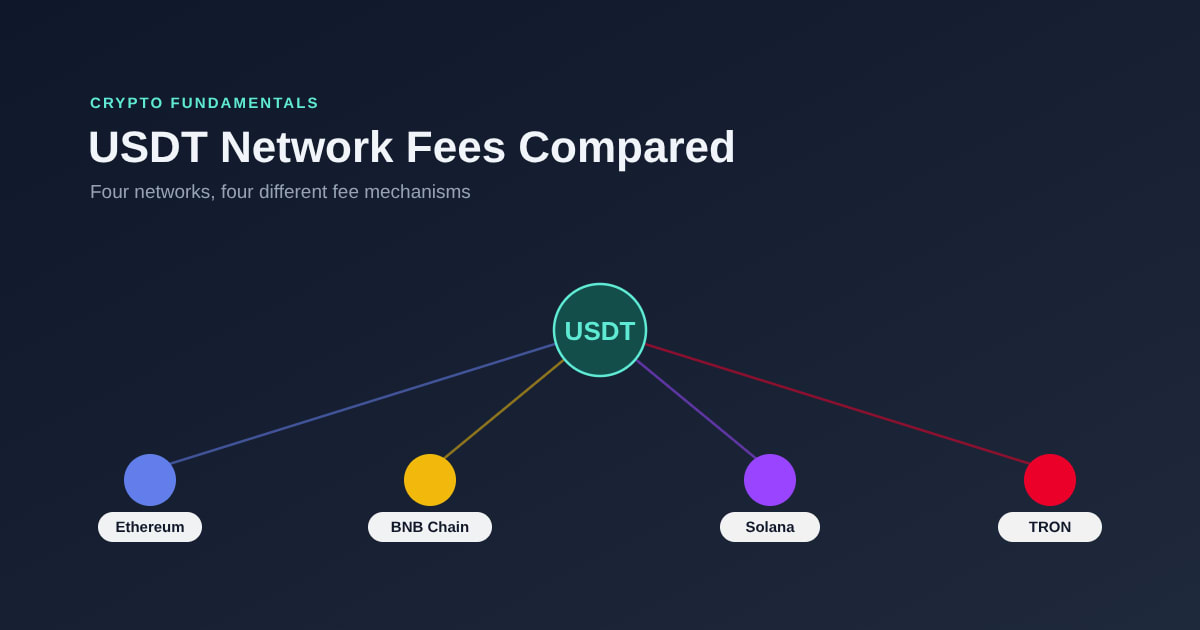
USDT Network Fees Compared: TRC-20 vs ERC-20 vs BEP-20 vs SPL
The same USDT transfer costs a fraction of a cent on one network and up to $15 on another - and it's not about which is 'better,' it's four structurally different fee mechanisms. What decides each one, and how to tell before you send.
Read article →
What Is a Seed Phrase? The Words That Are Your Money
A seed phrase is not a password you can reset - it is a fixed encoding of a random number, and that number is your entire wallet. How BIP-39 actually builds one, why 12 words is not weaker than 24, and what the mechanics change about how you store it.
Read article →