
What Is a Seed Phrase? The Words That Are Your Money
A seed phrase is not a password you can reset - it is a fixed encoding of a random number, and that number is your entire wallet. How BIP-39 actually builds one, why 12 words is not weaker than 24, and what the mechanics change about how you store it.
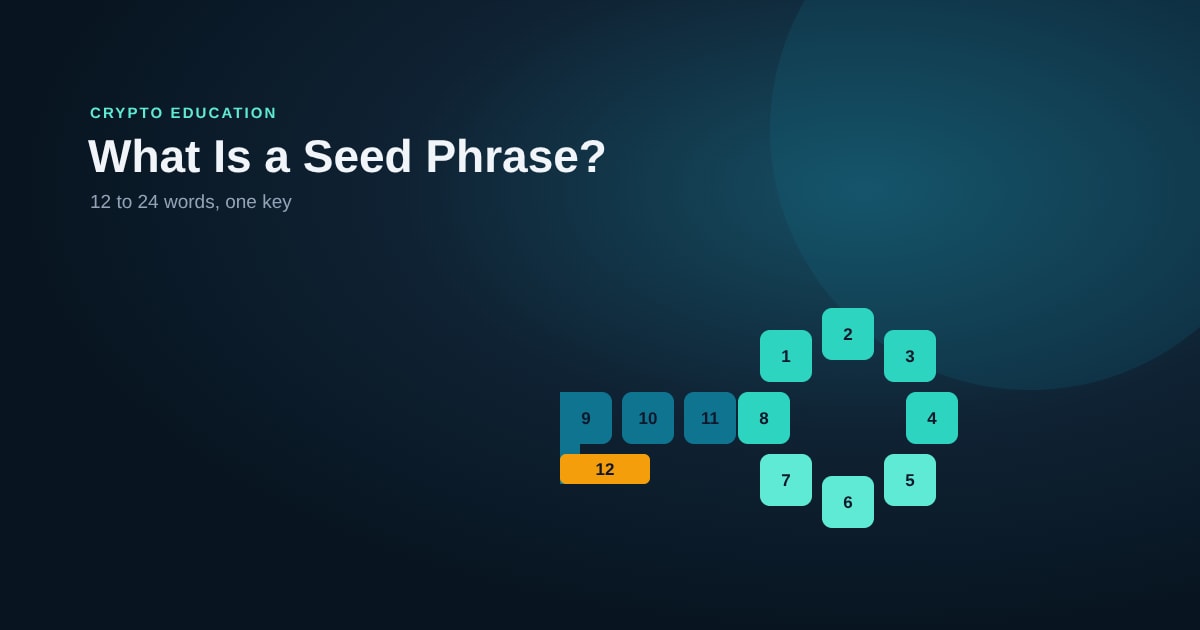
What is a seed phrase? Not a password you chose and can change if it leaks. It is a human-readable encoding of a random number, and that random number is the only thing that ever generates every private key your wallet controls. Lose the phrase and there is no support ticket that gets your funds back. Anyone who reads it now controls the funds, instantly, with nothing else needed.
This piece is part of our crypto fundamentals series - if blockchain, coins and tokens are still unclear, that piece is the better place to start.
Where the words actually come from
A wallet does not pick 12 words and remember them. It generates a genuinely random number first - called entropy - and only then turns that number into words, using a public, fixed rulebook called BIP-39.

The process, in order:
- The wallet generates 128 to 256 bits of true randomness.
- It appends a short checksum - the first few bits of that number's own SHA-256 hash - to the end.
- The combined result is sliced into 11-bit chunks. Since 2¹¹ is exactly 2,048, each chunk is a number from 0 to 2047.
- Each number picks one word from a fixed, published list of exactly 2,048 words.
| Entropy | + checksum | = total bits | Words |
|---|---|---|---|
| 128 bits | 4 bits | 132 bits | 12 |
| 160 bits | 5 bits | 165 bits | 15 |
| 192 bits | 6 bits | 198 bits | 18 |
| 224 bits | 7 bits | 231 bits | 21 |
| 256 bits | 8 bits | 264 bits | 24 |
Every row divides evenly by 11, which is exactly why the word counts land where they do - 132 ÷ 11 = 12, 264 ÷ 11 = 24. The word count is not a security tier a wallet chose to offer you; it is a direct readout of how much entropy went in.
Why the last word is not a random word at all
Look again at step 2. The checksum bits sit inside that final 11-bit chunk alongside a few real entropy bits, which means the last word of any seed phrase is partly determined by everything before it.
This is what lets a wallet catch a typo the moment you type it in. Mistype any of the first eleven words and the eleventh chunk's checksum bits no longer match what the twelfth word implies - the wallet can tell something is wrong before it ever tries to derive a single key. It cannot tell you which word is wrong, and it cannot recover a phrase that is missing words entirely - only that the set you entered is internally inconsistent.
Twelve words are not "weaker" than twenty-four in any way that matters
It is a common assumption that a 24-word phrase is meaningfully safer than a 12-word one, the same way a longer password is safer than a short one. The math does not support that read for phrases this size.
128 bits of entropy - a 12-word phrase - has roughly 3.4 × 10³⁸ possible values. That is a number large enough that guessing one correctly by brute force is not a realistic risk at any timescale worth planning around, with any hardware that exists or is seriously proposed. Moving to 256 bits does not close a real gap in practice; it makes an already-astronomical number larger still.
The real reasons some wallets default to 24 words are different: matching a hardware vendor's own convention, aligning with a specific standard the wallet targets, or simple caution that costs nothing to apply. None of that makes a 12-word phrase, generated properly, an unsafe choice. What actually threatens a seed phrase is never brute force - it is the phrase being seen, copied, or phished.
One phrase, any compatible wallet
Because BIP-39 is a public standard and every compliant wallet uses the identical 2,048-word list, a phrase generated in one wallet application restores the identical set of keys in a completely different one. This is deliberate and useful: it is what makes self-custody portable rather than a permanent commitment to one company's software.
It is also why our software wallet ratings and hardware wallet ratings treat the seed phrase itself as a constant across products - the real differences between wallets are in custody model, interface and, for network-specific wallets like the ones we rate for TRON, how they handle what the network itself charges. The words underneath are the same idea everywhere.
The optional word BIP-39 also defines, and almost nobody uses
BIP-39 supports an optional passphrase on top of the word list - sometimes called a "25th word," even though it can be any string, not another dictionary word. Add one, and it gets mixed into the key-derivation step: the same 12 or 24 words with a different passphrase produce an entirely different, entirely valid wallet.
This has a real practical use most people never touch: it lets a physical seed-phrase backup be useless on its own. Someone who finds the written words still cannot access funds without the passphrase, which can be memorized and never written down anywhere. The tradeoff is exactly what it looks like - forget the passphrase, and the words alone no longer restore anything either.
What this actually changes about storing one
None of the mechanics above change the practical rule: a seed phrase should exist in exactly the number of physical places you have deliberately decided on, and nowhere digital. Not a phone photo, not a cloud note, not a password manager's plain-text field, not an email draft. A photo can sync to a cloud account you don't fully control; a note can be indexed and backed up somewhere you never chose. The words are the funds - store them the way you would store a self-custody deposit box, not a login.
That is the whole security model in one sentence: whoever can read those words, in the correct order, has already won. Everything about how a wallet is built exists to keep the number of people and systems that ever see that string as close to one as possible.
Related
View category
What Is KYC in Crypto? Verification Tiers, the Travel Rule and What "No KYC" Means
KYC is the identity check anti-money-laundering law requires before a business handles your money; on an exchange it sits between sign-up and the first withdrawal. What is checked and why, the verification tiers of the eight exchanges we rate side by side, the travel rule that now follows a withdrawal to another exchange or your own wallet, what the "no-KYC" exchangers on our monitor actually do instead, and the database your passport ends up in.
Read article →
What Is a Stablecoin? USDT vs USDC, and What Holds the Dollar Peg
A stablecoin is a company’s promise to pay one dollar per token, kept at a dollar by traders who can redeem with the issuer and arbitrage the market back. USDT and USDC compared on reserves, redemption, freezing, European and US rules and networks; the two days each broke the peg, as the exchanges printed them; and which coin the exchanger market actually takes.
Read article →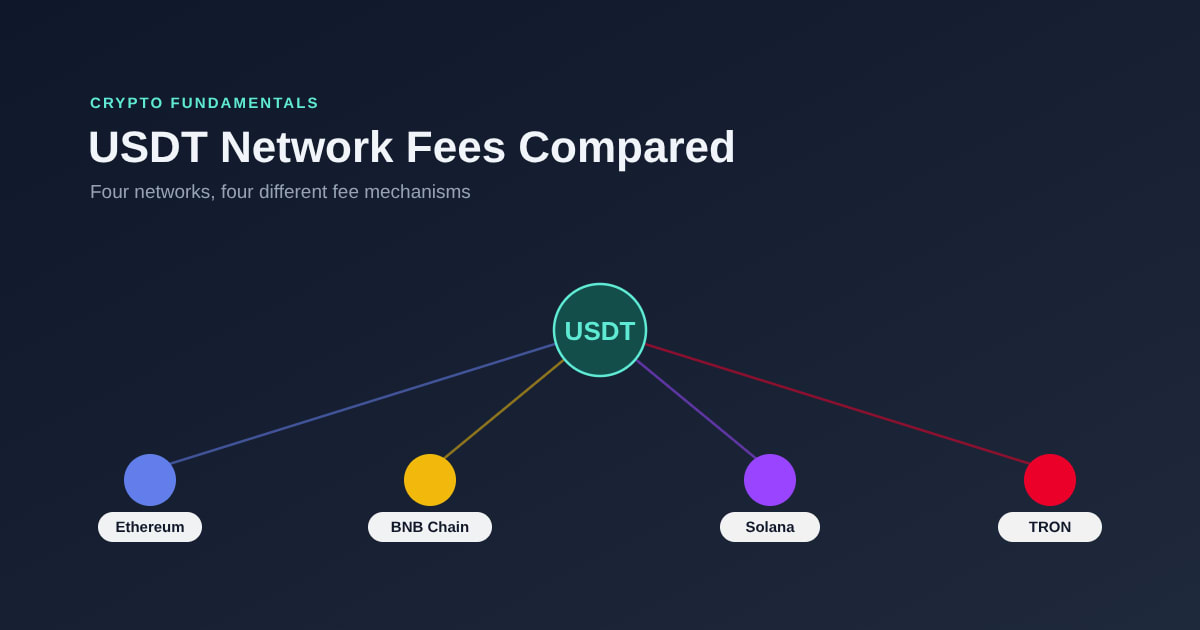
USDT Network Fees Compared: TRC-20 vs ERC-20 vs BEP-20 vs SPL
The same USDT transfer costs a fraction of a cent on one network and up to $15 on another - and it's not about which is 'better,' it's four structurally different fee mechanisms. What decides each one, and how to tell before you send.
Read article →