
USDT Network Fees Compared: TRC-20 vs ERC-20 vs BEP-20 vs SPL
The same USDT transfer costs a fraction of a cent on one network and up to $15 on another - and it's not about which is 'better,' it's four structurally different fee mechanisms. What decides each one, and how to tell before you send.
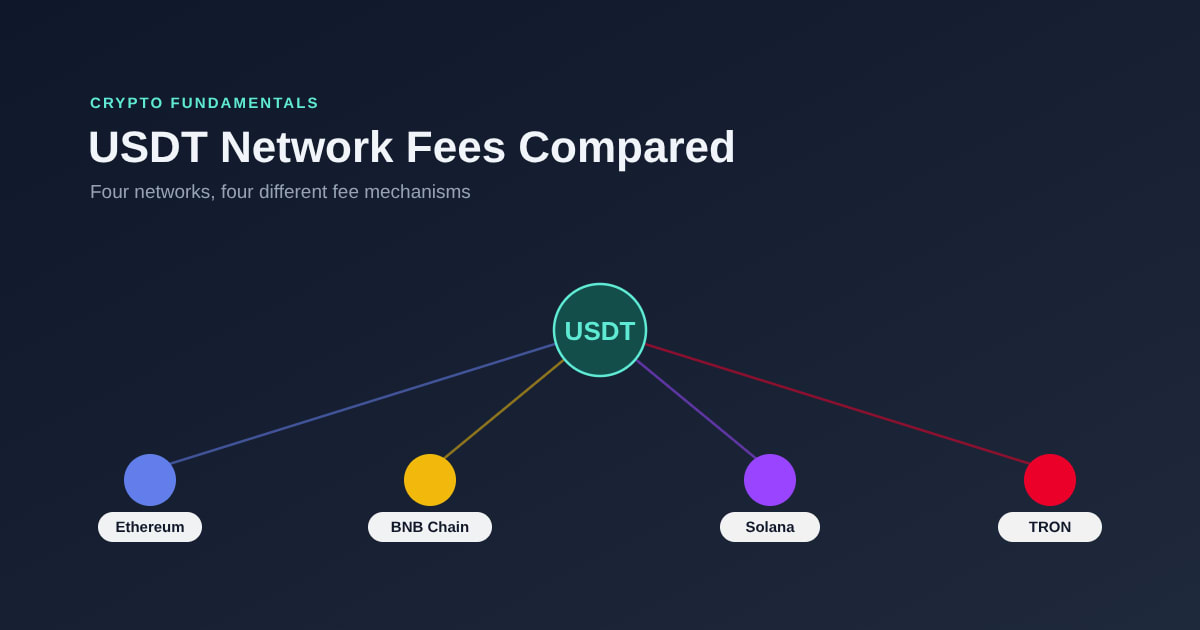
Send the same 100 USDT twice - once over Ethereum, once over TRON - and the fee is not a slightly different number. It is a differently-shaped thing. One is an auction that moves with everyone else's activity on the same chain. The other is a resource you can own in advance and pay nothing at the point of sending. Picking the wrong one is the single most avoidable way to overpay on a routine transfer, and it has nothing to do with luck.
This piece is part of our crypto fundamentals series - the coin-vs-token distinction covered there is exactly why USDT can exist on four unrelated networks in the first place, each with its own fee mechanism underneath the same ticker.
All figures below were checked on 1 September 2026 and are a snapshot of that day, except where individually dated.

Ethereum (ERC-20): an auction, not a price
Ethereum's fee is not set by USDT, or by the size of the transfer - a $10 send and a $10,000 send cost exactly the same, because gas is priced by computation, not value moved. What actually decides the number is how many other transactions are competing for block space at that exact moment. During a quiet stretch, a transfer can clear for well under a dollar; during a busy one - a popular token launch, a wave of liquidations - the same transfer can cost ten dollars or more for identical work.
That volatility is the real lesson, not any single figure. A quote you read yesterday is a snapshot of yesterday's congestion, not a price you can rely on today.
BNB Smart Chain (BEP-20): the same auction, usually calmer
BSC runs on the same gas-auction logic as Ethereum, but with far more block capacity relative to typical demand, so the price rarely spikes the way Ethereum's does. A routine USDT transfer here usually lands somewhere in the five-to-thirty-cent range. The fee is paid in BNB rather than USDT itself, which means a wallet needs a small BNB balance on hand before it can move USDT at all - an easy thing to forget the first time, since the balance you're actually trying to send is denominated in a completely different asset.
Solana (SPL): a fixed fee, with an optional tip
Solana takes a different approach entirely: the base fee is fixed by the protocol itself at 5,000 lamports per signature, which works out to a small fraction of a cent regardless of network conditions. A separate, optional priority fee only comes into play when a transaction is competing for the same specific accounts as a lot of other activity at once - ordinary transfers rarely need one. This is the cheapest and most predictable of the four in normal use, which is also why our own USDT to SOL swap tool settles quickly without the fee ever becoming part of the decision.
TRON (TRC-20): the one that depends on you, not the network
TRON is the odd one out, and it is worth reading closely because it is also the network most CopyFX and exchange withdrawals default to. Instead of an auction, TRON accounts spend two resources - energy and bandwidth - that a wallet can either hold in advance or burn TRX to cover on the spot. A wallet with staked energy sends USDT for free. A wallet without it pays real money for the same transfer, and USDT specifically carries a resource surcharge no wallet can avoid, on top of everything else.
That mechanism, the exact current numbers, and what a wallet actually needs to do about it are covered in full in our TRON wallet rating's own network guide rather than repeated here - it is the deepest treatment of any single network's fee behaviour on this site, and duplicating it would only make both pages weaker.
The comparison that actually matters
| Network | Typical fee | What decides it |
|---|---|---|
| Ethereum (ERC-20) | $0.40 – $15 | Network congestion, changes hour to hour |
| BNB Smart Chain (BEP-20) | $0.05 – $0.30 | Same auction model, calmer in practice |
| Solana (SPL) | ~$0.0004 | Fixed by protocol, rarely varies |
| TRON (TRC-20) | $0 – $4.48 | Whether your wallet holds staked energy |
Read the right column, not just the left one. Ethereum and BNB Smart Chain move with everyone else's activity on the same chain - the number you see is a moment, not a fact. Solana barely moves at all. TRON is the only network here where the fee is substantially a choice you made in advance, not something happening to you.
Why this matters beyond the fee itself
The network a transfer uses is not just a cost line - it is also what "arrived" actually means. Sending USDT to an address on the wrong network is how funds get stranded rather than lost outright, and it is the exact mistake this site's guide on moving USDT between Binance and Bybit walks through in a real, worked example. Before sending anything meaningful, confirm the receiving side is expecting the same network you're sending on - the fee difference between TRC-20 and ERC-20 is real, but it is nothing next to the cost of choosing the wrong one entirely.
If you're moving USDT through an independent exchanger rather than between two exchange accounts, our own rate monitor shows live offers across several of these networks side by side, so the fee difference above is something you can check against a real quote rather than take on faith.
Related
View category
What Is a Stablecoin? USDT vs USDC, and What Holds the Dollar Peg
A stablecoin is a company’s promise to pay one dollar per token, kept at a dollar by traders who can redeem with the issuer and arbitrage the market back. USDT and USDC compared on reserves, redemption, freezing, European and US rules and networks; the two days each broke the peg, as the exchanges printed them; and which coin the exchanger market actually takes.
Read article →
What Is KYC in Crypto? Verification Tiers, the Travel Rule and What "No KYC" Means
KYC is the identity check anti-money-laundering law requires before a business handles your money; on an exchange it sits between sign-up and the first withdrawal. What is checked and why, the verification tiers of the eight exchanges we rate side by side, the travel rule that now follows a withdrawal to another exchange or your own wallet, what the "no-KYC" exchangers on our monitor actually do instead, and the database your passport ends up in.
Read article →
What Is a Seed Phrase? The Words That Are Your Money
A seed phrase is not a password you can reset - it is a fixed encoding of a random number, and that number is your entire wallet. How BIP-39 actually builds one, why 12 words is not weaker than 24, and what the mechanics change about how you store it.
Read article →