
Coinbase Review: The Spread You Are Not Shown, and How to Stop Paying It
Coinbase is the easiest major exchange to start with and one of the most expensive to stay on by default. This review is built around the spread — roughly 0.5% folded into the price and never shown on your receipt — what it really costs, and the free way to stop paying it.
Quick verdict
Coinbase is the easiest major exchange to start with and one of the most expensive ways to actually buy crypto — and most of that cost is in a number it never shows you at checkout.
We rate it 3.75 out of 5. It scores highest of the eight exchanges we track on regulation and transparency, and lowest of the eight on fees. Both of those facts have the same root cause: it is a Nasdaq-listed US public company, and that shapes everything from its filings to its pricing.
This review is mostly about one thing, because it is the thing that costs readers real money and almost nobody explains it properly: the Coinbase spread.

You can open an account at coinbase.com — we have no affiliate arrangement with Coinbase, so that is a plain link, and nothing on this page changes depending on whether you use it.
Coinbase at a glance
| Our score | 3.75 / 5 |
| Best for | Beginners, US-friendly onboarding, fiat access, simple buying |
| Weakest at | Cost of the simple buying flow |
| Strongest at | Regulatory transparency — the only Nasdaq-listed major exchange |
| Interfaces | Simple buy/sell, Advanced Trade, self-custody wallet, card |
| Known incident | May 2025 support-contractor data breach — details below |
The spread you are not shown
When you buy crypto on the standard Coinbase app, you pay in two places. One is disclosed to you. The other is not shown as a line item at all.
The disclosed part is the Coinbase Fee, which runs roughly 0.99% to 2.99% depending on the amount and how you pay. On small purchases it appears as a flat charge — around 0.99 USD on a 10 USD buy, around 2.99 USD on a 200 USD buy.
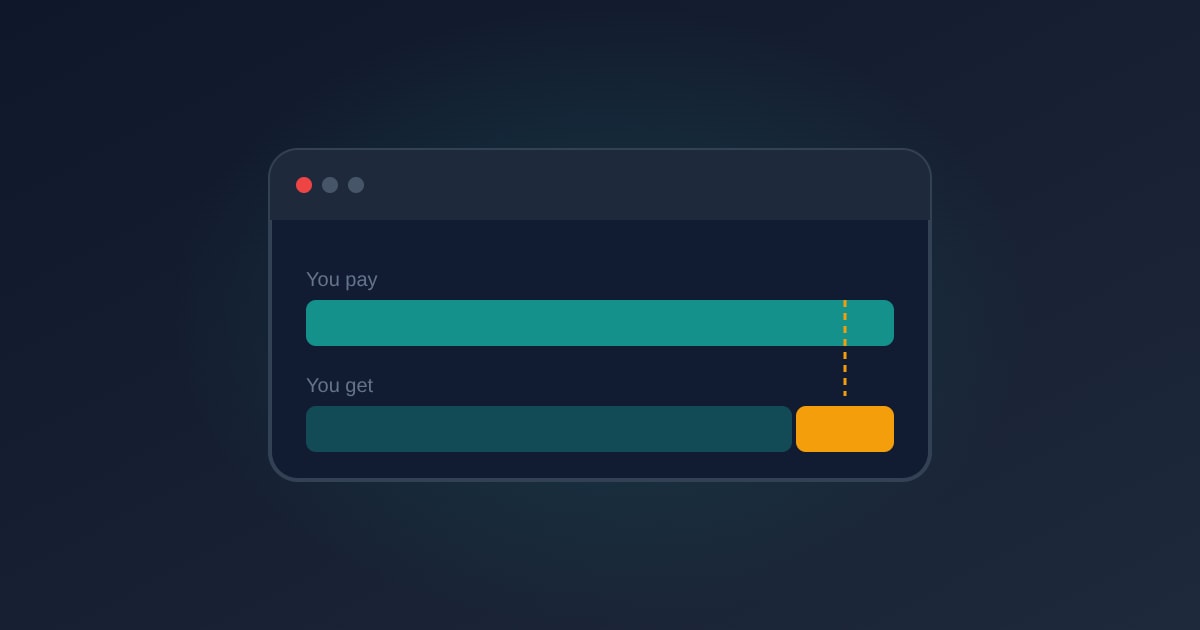
The undisclosed part is the spread: roughly 0.5%, built directly into the exchange rate you are quoted. You are not charged it; you are simply quoted a slightly worse price than the market one, and the difference stays with Coinbase.
This is not hidden in the sense of being secret — Coinbase documents that a spread exists. It is hidden in the sense that matters: it never appears on your receipt. You see a fee, you accept it, and you never learn that a second cost was folded into the price before the fee was even calculated.
The spread is also why "how much did that actually cost me" is such a common question about Coinbase and such an unsatisfying one to answer from the app alone.
What a small buy actually costs
Put real numbers on it and the picture changes.
Buy 10 USD of Bitcoin through the simple interface and you pay about 0.99 USD in fee plus roughly 0.5% in spread. That is over 10% of your money gone before the price moves at all. Your position needs a 10% gain just to break even.
Scale it up and the proportion improves but the absolute number gets uncomfortable. A 5,000 USD purchase through the simple flow typically costs somewhere around 125 to 175 USD all in.
The same 5,000 USD bought on Advanced Trade costs roughly 30 USD.
That is not a rounding difference. It is four to five times the cost, for the same asset, on the same platform, in the same account.
How to stop paying the Coinbase spread
Here is the part that makes the rest of this review worth reading: you already have access to the cheaper option, and it is free to switch to.
Advanced Trade is not a separate product you sign up for. It is a different view of the same Coinbase account, and it works differently in the way that matters: your order goes to the order book directly, so there is no spread built into standard Advanced execution. You pay a visible maker-taker fee instead.
At under 10,000 USD of 30-day volume — which is most people — that is roughly 0.40% maker and 0.60% taker. Both are published, both appear before you confirm, and neither is folded into the price.
The practical rule:
- Buying a small amount once, and convenience genuinely matters more than cost? The simple flow is fine. Just know what you are paying for it.
- Buying regularly, or buying anything above pocket-money size? Use Advanced Trade. On a 5,000 USD purchase the switch is worth roughly 100-145 USD, and it takes one tap.
- Placing a limit order rather than buying at market? You are likely paying the lower maker rate as well.
Nothing about this is a trick or a loophole. It is simply that the default interface is the expensive one, and Coinbase has no particular incentive to walk you out of it.
Does Coinbase One remove the spread?
This is where the subscription needs reading carefully, because "zero trading fees" is doing a lot of work in the marketing.
Coinbase One comes in three tiers:
| Tier | Price | Zero-fee trading up to | Account insurance |
|---|---|---|---|
| Basic | 4.99 USD / month | 500 USD monthly volume | 1,000 USD |
| Preferred | 29.99 USD / month | 10,000 USD monthly volume | 10,000 USD |
| Premium | 299.99 USD / month | Unlimited | 250,000 USD |
Preferred and Premium also return 25% of Advanced spot fees in USDC, capped at 100 USD a month.
Now the part that matters: Coinbase One removes the explicit trading fee. It does not remove the spread. Quoted prices on the simple flow can still carry it, and the zero-fee benefit does not apply uniformly across every order type and product.
So a Basic subscriber buying 500 USD a month is paying 4.99 USD to avoid roughly 5-10 USD of explicit fees — while still paying the spread underneath. Whether that is worth it depends entirely on volume, and the honest answer for most casual buyers is that switching to Advanced Trade saves more than subscribing does, and costs nothing.
Coinbase One earns its price for people already trading meaningful volume on Advanced, where the 25% USDC rebate and the insurance start to matter. It is a poor substitute for simply using the cheaper interface.
Security: the 2025 breach, stated plainly
In May 2025 Coinbase disclosed a breach that was not a hack in the usual sense. Overseas customer-support contractors were bribed to hand over customer data. Roughly 69,000 to 70,000 users' personal information was exposed — names, addresses, contact details, partial identity documents. A 20 million USD ransom was demanded and refused. Remediation and reimbursement costs were estimated at 180 to 400 million USD.
Two things are true about this at once, and both belong in an honest review.
No customer crypto was stolen. Coinbase's cold-storage and key management were not compromised, and this is a materially different event from an exchange losing user funds.
But it was still a real failure, and a category of failure that is harder to engineer away than a technical one: the weak point was people with legitimate access, not code. Exposed personal data is also the raw material for the social-engineering attacks that follow, which is why the practical response for any Coinbase user is unglamorous — hardware two-factor authentication rather than SMS, and deep scepticism toward anyone contacting you claiming to be Coinbase support.
We scored security 3.5 of 5 for this. Not disqualifying, not dismissible.
Regulation: the one thing nobody else matches
Coinbase scores 4.5 of 5 on regulation in our model, the highest of the six exchanges we rate, and the reason is structural rather than reputational.
It is the only major crypto exchange that is a Nasdaq-listed US public company. That means audited 10-K and 10-Q filings on a fixed schedule, with customer crypto holdings carried on the balance sheet and reviewed by external auditors. Every other exchange in our rating asks you to trust a proof-of-reserves attestation it commissioned itself.
For anyone whose main worry is "will this platform still exist and still have my money next year", that difference is the strongest answer available in this industry. It is also, directly, why the fees are higher — public-company compliance is expensive, and someone pays for it.
Who Coinbase actually suits
A good fit if: you are buying your first crypto and want the least confusing route; you value being able to read audited financial statements about the company holding your money; you want fiat on-ramps that work smoothly with a US or European bank.
A poor fit if: cost is your main criterion and you will not switch to Advanced Trade; you want the widest possible selection of smaller tokens; you trade derivatives heavily, where other platforms are both cheaper and deeper.
How Coinbase compares
Coinbase's profile is unusual enough that the comparison matters more than the standalone score. It is the most transparent and among the most expensive; most rivals invert both.
- Coinbase vs OKX — the sharpest contrast: the most institutionally transparent option against the highest-scoring exchange in our rating.
- Bybit vs Coinbase — derivatives depth and cost against regulatory standing.
- The full crypto exchange rating shows how all eight score component by component, and our methodology explains what each component is weighted at and why.
Bottom line
Coinbase is a genuinely good place to start and a genuinely expensive place to stay on the default settings. The single most valuable thing a new user can know about it is that the spread exists, it is around 0.5%, it is not on your receipt, and Advanced Trade does not charge it.
Learn that in your first week and Coinbase becomes a reasonable long-term choice. Never learn it, and you will pay several times more than you needed to for years without ever seeing the line item that explains why.
Related
View category
LetsExchange Closed: Pending Swaps, the Deadlines and What Our Monitor Saw
The instant-swap service LetsExchange ceased operations on 1 October 2026. What the announcement commits to, how to raise a stuck swap before support closes, and why our monitor kept quoting it for five days.
Read article →
What Is KYC in Crypto? Verification Tiers, the Travel Rule and What "No KYC" Means
KYC is the identity check anti-money-laundering law requires before a business handles your money; on an exchange it sits between sign-up and the first withdrawal. What is checked and why, the verification tiers of the eight exchanges we rate side by side, the travel rule that now follows a withdrawal to another exchange or your own wallet, what the "no-KYC" exchangers on our monitor actually do instead, and the database your passport ends up in.
Read article →
What Is a Stablecoin? USDT vs USDC, and What Holds the Dollar Peg
A stablecoin is a company’s promise to pay one dollar per token, kept at a dollar by traders who can redeem with the issuer and arbitrage the market back. USDT and USDC compared on reserves, redemption, freezing, European and US rules and networks; the two days each broke the peg, as the exchanges printed them; and which coin the exchanger market actually takes.
Read article →