
What Is a Stablecoin? USDT vs USDC, and What Holds the Dollar Peg
A stablecoin is a company’s promise to pay one dollar per token, kept at a dollar by traders who can redeem with the issuer and arbitrage the market back. USDT and USDC compared on reserves, redemption, freezing, European and US rules and networks; the two days each broke the peg, as the exchanges printed them; and which coin the exchanger market actually takes.
What is a stablecoin? A token on a blockchain that is meant to be worth exactly one unit of an ordinary currency, almost always one US dollar, all day, every day. Bitcoin is a bet on a price; a stablecoin is a promise that there is no price to bet on. Whether that promise holds depends entirely on what stands behind the token and on who is allowed to cash it in, and those two things are where USDT and USDC, the two coins that make up most of the market, genuinely differ.
This page explains the mechanism first, because "which is safer" cannot be answered without it. Then it puts the two coins side by side on reserves, redemption, freezing, regulation and networks, shows the two occasions when each of them broke the peg as the exchanges actually printed them, and finishes with what our own exchanger monitor says about which coin is easier to turn back into money.
Three ways to make a token worth a dollar
Only one of them is what people mean when they say USDT or USDC, but the other two matter because their failures are the reason the first kind is regulated the way it is.
Fiat-backed. A company holds real dollars, or assets it can turn into dollars within days, and issues one token for every dollar it holds. To get a token you send the company a dollar; to get a dollar back you send it a token, which it destroys. USDT, issued by Tether, and USDC, issued by Circle, both work this way. Everything on this page from here on is about this kind.
Crypto-collateralised. Instead of dollars, the backing is other crypto, locked in a smart contract in larger amount than the tokens issued, so the collateral can fall a good deal before the token is under-backed. DAI is the best-known example. It removes the company from the middle and adds the risk that a fast crash burns through the cushion.
Algorithmic. No backing at all in the ordinary sense; a mechanism that mints and burns a sister token to push the price back to a dollar, on the theory that the sister token will always be worth something. Terra's UST was the largest of these and in May 2022 the theory failed in a week. That collapse is the reason the first chart below exists, because the panic it started spread to USDT within two days.
How the peg actually holds
Neither Tether nor Circle sets the price of its token. On any exchange the token trades against dollars, euros or other coins like anything else, and its price is whatever the last buyer paid. What keeps that price at a dollar is a group of traders who can do one thing a retail holder cannot: swap tokens for dollars with the issuer at exactly one to one.
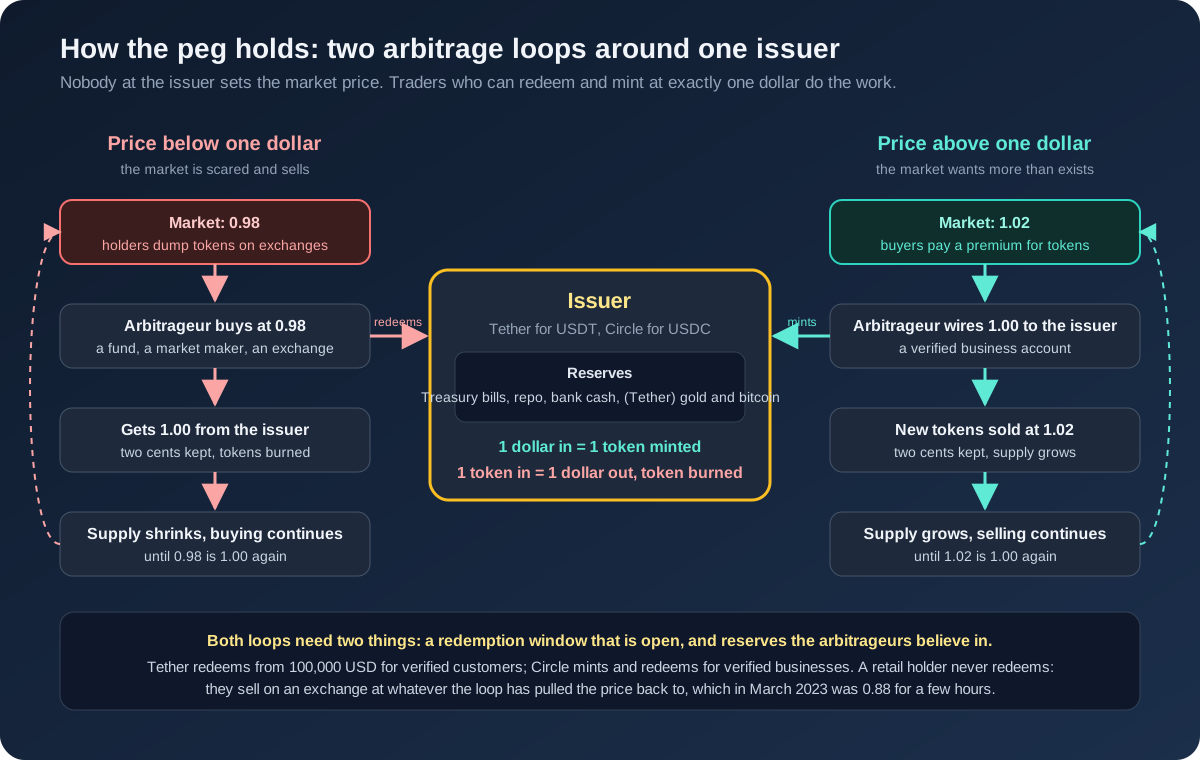
If the token trades at 0.98, those traders buy it on the market, hand it to the issuer, receive 1.00 and keep two cents. Every token they redeem is destroyed, so the supply on the market shrinks while the buying continues, and the price climbs back. If the token trades at 1.02, the loop runs the other way: wire a dollar to the issuer, receive a new token, sell it at 1.02, keep two cents, and the extra supply pushes the price back down. The issuer's job is only to stand at one dollar with the door open. The market does the rest.
Two things have to be true for the loop to work, and both of them are on the comparison table below. The redemption door has to be open to someone, and the traders who use it have to believe the dollars are really there. In May 2022 the first condition held and USDT recovered in a day. In March 2023 the second one wavered for USDC over a weekend when redemption could not run at all, because banks were closed, and the price went far lower and stayed there longer.
Retail holders never touch this loop. Tether's own fee page sets its minimum direct redemption at 100,000 USD, charges a 150 USD verification fee, and takes the greater of 1,000 USD or 0.1% on the way out; Circle mints and redeems only for verified businesses. Anyone smaller sells on an exchange at whatever the loop has pulled the price back to, which is why the hourly lows in the charts below are the number that matters to a normal holder, not the daily close.
USDT vs USDC: the same promise, different companies
Both tokens are a dollar liability of a private company. What differs is who the company is, what it holds against the liability, how it reports it, and which laws it has chosen to live under.
| USDT (Tether) | USDC (Circle) | |
|---|---|---|
| In circulation, 19 Sep 2026 | about 183 billion USD | about 74 billion USD |
| Issuer | Tether, a private company | Circle, listed on the New York Stock Exchange since June 2025 |
| What backs it | Its Q2 2026 attestation (BDO, as of 30 June 2026) lists 187.75 bn of assets against 183.64 bn of tokens: about three quarters in cash, cash equivalents and short-term deposits, most of it direct US Treasury bills, and the rest in gold (more than 146 tonnes), bitcoin and secured loans | Its reserve page for 27 August 2026 lists about 74 bn: overnight repo on Treasuries (49.6 bn), short-term Treasuries (13.2 bn) and deposits at large banks (11.2 bn), most of it inside a BlackRock-run money-market fund |
| How it is reported | Quarterly attestation by an audit firm; a live figure on its own transparency page | Monthly report signed by Deloitte; a live figure on its own transparency page |
| Who can redeem | Verified customers from 100,000 USD; the greater of 1,000 USD or 0.1% per redemption | Verified businesses through Circle Mint; the first 40 m USD a day free, then 2 to 5 basis points |
| Can it freeze your tokens | Yes; its financial-crime unit with Tron and TRM Labs reported more than 450 m USD frozen by May 2026 | Yes; froze about 75,000 USDC across 44 addresses when Tornado Cash was sanctioned in August 2022 |
| European rules (MiCA) | Not compliant by choice; delisted from spot trading for EEA users on Coinbase (December 2024), Kraken and Binance (March 2025) | Compliant since 1 July 2024 under a French e-money licence |
| US rules (GENIUS Act) | Not in the shape the law describes today; will need to be, or be sold as something else in the US, once the Act is in force | Already the shape the law describes |
| Native networks | Concentrated: Tron and Ethereum hold over 95% of supply, roughly half of it on Tron | Spread: issued natively on 38 networks according to Circle |
| Worst hour on record | 0.941 USD on Coinbase, 12 May 2022 | 0.882 against USDT on Binance, 11 March 2023 |
Figures are the issuers' own, read on 19 September 2026 from their attestations, fee pages and press releases, or from public exchange candle data where the row says so. Reserve composition is as the issuers report it; nobody outside them has counted the dollars.
A few rows deserve a sentence each.
The excess. Tether's attestation shows 4.11 bn USD more assets than tokens. That cushion is what absorbs a fall in the gold or bitcoin it holds before token holders are under-backed, and it halved between the first and second quarters of 2026 as those prices moved. Circle's reserve is almost entirely Treasuries and bank cash, so it has no such swings and no such cushion.
The bank problem. The March 2023 episode was not about Treasuries. Circle had disclosed that 3.3 bn USD of its reserve, about 8% of its cash, sat at Silicon Valley Bank when that bank was closed on a Friday, and the market priced the token as if some of that money were gone. It was not; US regulators guaranteed the deposits on the Sunday. But for two days no arbitrage loop could run, because the redemption side needs a bank that is open.
Freezing. Both issuers can blacklist an address on the blockchains they issue on, and both do. For a holder this cuts both ways: it is how funds are recovered after a hack and how a sanctioned wallet is stopped, and it is also why a stablecoin in your own wallet is not the same as a banknote in your pocket. The circumstances in which an exchange freezes an account, which is a separate mechanism, are in why crypto exchange accounts get frozen.
Regulation. Europe's MiCA rules for stablecoins applied from 30 June 2024, and they require an issuer to hold a large share of its reserve in EU bank deposits. Circle took a licence and complied. Tether's chief executive called the deposit rule "an incredibly big systemic risk" and did not, so USDT came off spot trading for European users at Coinbase, Kraken and Binance over the following year, which is the single most practical difference between the two coins for anyone in the EEA. In the United States the GENIUS Act, signed on 18 July 2025 and in force by January 2027 at the latest, requires one-to-one reserves in cash and short-term Treasuries with monthly disclosure from a licensed issuer. USDC is already built that way; USDT, with gold, bitcoin and loans in its reserve, is not.
The two times the peg broke
News reports round these to "fell below a dollar". The exchanges kept the candles, and the candles say something more useful: how low, for how long, and how quickly the loop pulled the price back.
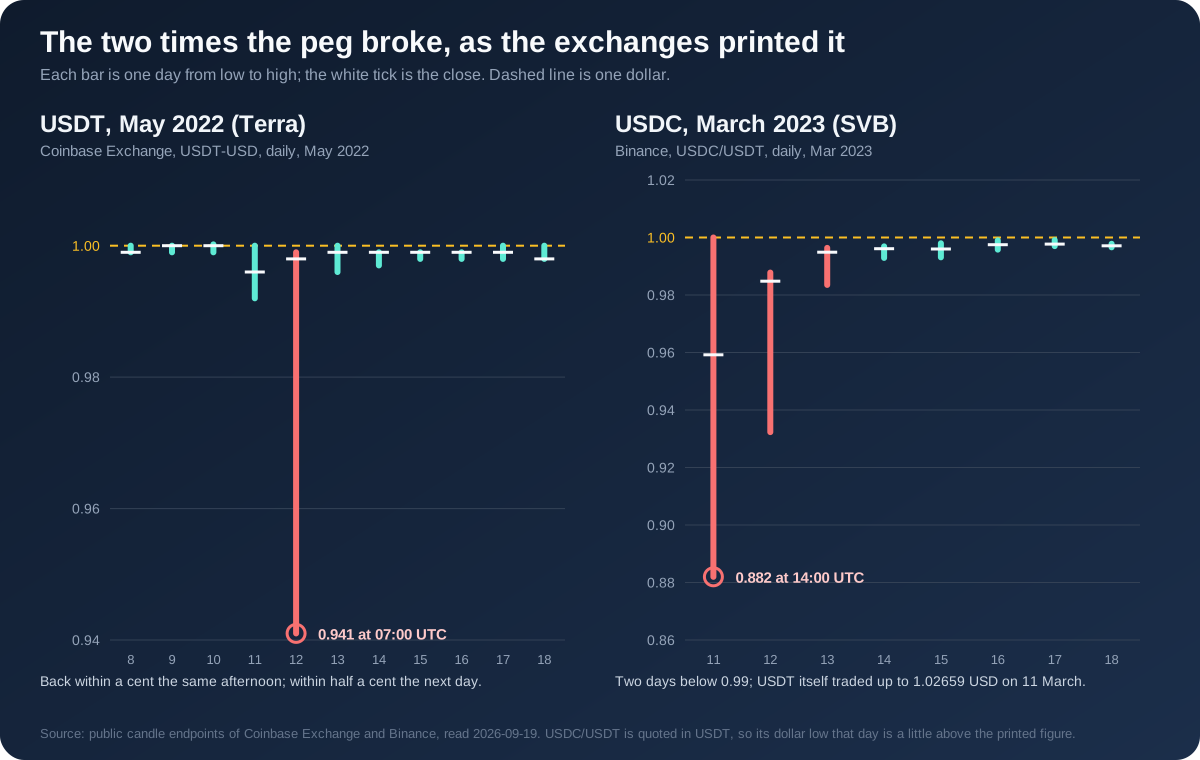
USDT, May 2022. Terra's UST collapsed in the second week of May, and traders who could not tell one stablecoin from another sold the largest one. On Coinbase's USDT-USD market the daily low was 0.992 on 11 May and 0.941 at 07:00 UTC on 12 May; the same day closed at 0.998 and the next day's low was 0.996. Tether processed several billion dollars of redemptions that week. The loop worked exactly as drawn above: redemption stayed open, the supply shrank, and the discount closed inside a day.
USDC, March 2023. On Binance's USDC/USDT market USDC printed 0.882 at 14:00 UTC on Saturday 11 March, closed the day at 0.959, fell to 0.932 again on the Sunday and did not close above 0.995 until Thursday 16 March. Because that market is quoted in USDT, and USDT itself traded at up to 1.027 USD on Coinbase the same Saturday as money fled into it, the dollar low was a little above 0.88 and the premium on USDT was the mirror image of the discount on USDC. This is the only episode where one of the two coins was priced as the safe one against the other, and it went the way most people would not have guessed.
Neither coin has broken the peg since. Both trade within a tenth of a cent of a dollar on the day this page was written, and the daily record in the chart is the whole history of either falling more than a cent.
Which one is easier to turn back into money
Price is one question; the other is whether anyone will take the coin off your hands at that price. Our exchanger monitor reads the live quotes of a few dozen independent exchangers every hour, and on 19 September 2026 the coverage looked like this.
| Network | Exchangers quoting USDT | Exchangers quoting USDC |
|---|---|---|
| Tron (TRC-20) | 22 | not issued on Tron |
| BNB Chain (BEP-20) | 20 | not quoted |
| Ethereum (ERC-20) | 19 | 16 |
| Solana | 16 | 14 |
| TON | 16 | not quoted |
| Polygon | 15 | 12 |
| Any network | 22 | 17 |
USDT is quoted by more exchangers on every network the two coins share, and the gap is widest on the cheapest rail, Tron, where USDC is not issued at all. That is the practical meaning of the "concentrated" row in the table above: the coin is where the small-ticket cash-out market is. Which network to send on, and what each one charges, is a question of its own, covered in USDT network fees compared.
On the price itself the two coins are interchangeable. On the Wise euro rail that same hour, eleven exchangers quoted USDT on Tron with the best at 0.863 EUR and the median at 0.825, and nine quoted USDC on Ethereum with the best at 0.860 and the median at 0.823; Kraken's market price for both was 0.870. The coin moved the number by a third of a cent; the choice of exchanger moved it by four cents. That ranking of what matters, exchanger first and rail second, is what our daily record of selling USDT for euros found across five and a half weeks of quotes, and it holds for USDC too.
So which should you hold
The honest answer is that they carry different risks rather than different amounts of risk, and which one is yours depends on where you are and what you are doing.
- If you are in the EEA, USDC is the one your regulated exchange still lists; USDT is what the exchanger market runs on. Many people end up holding both for that reason.
- If you cash out in small amounts through exchangers, USDT on Tron has the most quotes and the lowest transfer cost; the price you get is the same either way.
- If you park money for weeks, the difference is what you are trusting: a Treasury-and-bank reserve reported monthly under US and EU rules, or a larger, more varied reserve with a profit cushion, attested quarterly, outside those rules. The 2023 chart shows the first kind can still lose twelve cents for an afternoon when a bank fails.
- Whichever you hold, it is a company's liability, it can be frozen, and it is not covered by any deposit insurance. Keep the amount you would keep in a wallet, not the amount you would keep in a bank.
Where you keep it matters as much as which one it is. The exchanges we score put security weighted heaviest in the crypto exchange rating, and the same coin on the same network is a different risk on an exchange that lends out customer deposits and on one that does not. For anyone starting from zero, what cryptocurrency is explains why sending a token on the wrong network loses it, which is the one stablecoin mistake that has nothing to do with the peg.
Bottom line
A stablecoin is a company's promise to pay one dollar per token, kept at one dollar not by the company but by traders who can redeem with it and arbitrage the market back. USDT is bigger, sits on more exchangers and more networks, holds a broader reserve with a cushion, and has stayed outside the European rules; USDC holds Treasuries and bank cash, reports monthly, is licensed in the EU and built to the US law's shape, and is the one that fell further on the one day its reserve looked doubtful. Both have broken a dollar exactly once, both came back, and neither is a bank account.
Related
View category
USDT Network Fees Compared: TRC-20 vs ERC-20 vs BEP-20 vs SPL
The same USDT transfer costs a fraction of a cent on one network and up to $15 on another - and it's not about which is 'better,' it's four structurally different fee mechanisms. What decides each one, and how to tell before you send.
Read article →
What Is KYC in Crypto? Verification Tiers, the Travel Rule and What "No KYC" Means
KYC is the identity check anti-money-laundering law requires before a business handles your money; on an exchange it sits between sign-up and the first withdrawal. What is checked and why, the verification tiers of the eight exchanges we rate side by side, the travel rule that now follows a withdrawal to another exchange or your own wallet, what the "no-KYC" exchangers on our monitor actually do instead, and the database your passport ends up in.
Read article →
What Is a Seed Phrase? The Words That Are Your Money
A seed phrase is not a password you can reset - it is a fixed encoding of a random number, and that number is your entire wallet. How BIP-39 actually builds one, why 12 words is not weaker than 24, and what the mechanics change about how you store it.
Read article →