
Why Crypto Exchange Accounts Get Frozen, and What Actually Helps
The four things that trigger nearly every retail account freeze, why honest buyers get caught by coins they received in good faith, and the steps that work once it has happened.
Almost nobody reads about a frozen crypto account until theirs is one. So this is written for the version of you that is already staring at a balance you cannot move, and for the version that would rather not get there.
Both need the same thing first: an honest answer to whether an exchange is even allowed to do this. It is. Every centralised exchange reserves the right in its terms, and every regulated one operates under obligations that occasionally require it. That is not a loophole they slipped past you — it is the trade you made when you chose a company to hold your coins instead of holding them yourself.
What follows is what actually triggers it, what the words on your screen mean, and which of it you can influence.
Four triggers, and only one is about you


Support will rarely tell you which one you hit. The pattern is usually recognisable anyway.
Where your coins came from. The most common cause and the least understood, so it gets its own section below.
A gap in your verification. A document expired. A name stopped matching after a marriage. You moved countries and the exchange's licence does not cover the new one. This is the best case: it is paperwork, and paperwork resolves.
Behaviour that changed suddenly. An account that sat still for a year and then moved everything at once, from a new device, over a VPN, at 04:00. Nothing there is against the rules. It is also indistinguishable from someone who has just stolen your password — and the system has to assume the worse reading until a human decides otherwise.
A dispute against you. On peer-to-peer trades, a counterparty who claims they never received payment, or who reversed a bank transfer after you released the crypto. Whoever has records wins this one. Usually that means screenshots with visible timestamps and a bank statement, not a memory of what happened.
The one that catches honest people
Coins carry their history. Not a label, not a flag written into them — but a public, permanent record of every address they passed through, which anyone can read, and which exchanges pay firms to score.

So the sequence that catches people is this. You buy USDT from a seller with a long trading history and good reviews. They are honest. They send you coins they received from someone else, who received them from someone else, and somewhere three or four hops back is an address that got flagged. You deposit to an exchange. The screening runs over the whole chain behind those coins, not the last hop, and your deposit lands in review.
You did nothing wrong and you are still the one holding a paused balance.
The step that actually helps takes a minute, and only works beforehand. Ask the seller which address they are sending from, and check it before you release payment. Free explorers and address-risk checkers will show you what an exchange's screening will see. If it comes back with a risk score you do not like, cancel the trade. Losing a trade costs you a few minutes; a deposit under review can cost weeks.
Two habits worth building alongside it: keep P2P records for at least a few months, and do not consolidate coins from several trades into one address before depositing — one questionable source contaminates the score for everything you merged with it.
What the words on the screen mean
Exchanges use their own vocabulary, but the states are broadly these, and the difference matters:
| What you see | What it usually means | What helps |
|---|---|---|
| Withdrawals disabled, trading works | A security hold — new device, password change, suspicious login | Wait out the stated period; do not keep retrying |
| A single deposit "under review" | That specific deposit's history got scored badly | The rest of the account is usually fine. Do not deposit more |
| Account restricted, verification requested | A KYC gap | Send exactly what is asked, once, in the format asked |
| Everything frozen, no explanation | A compliance review | The slowest kind. See below |
The last row is the one people panic about, and panicking makes it worse.
If it has already happened
In order, and none of this is glamorous:
- Stop transacting. Do not deposit more, do not open a second account, do not try a withdrawal every hour. Each attempt is another data point in a review you want to look boring.
- Open one ticket. One. Five tickets across three channels do not escalate anything; they reset the queue position and make you look frantic.
- Send what they ask for, exactly. If they want a bank statement showing a specific transfer, send that page — not your whole year, not a photograph of a screen.
- Be able to explain the money. Where it came from, in one paragraph, with documents. "I bought it on P2P from a stranger" is true and it is not an explanation. A screenshot of the trade with the order ID is.
- Write down dates. Ticket numbers, what you sent, when. If this goes on long enough to need a regulator's complaint form, that timeline is the whole case.
- Then wait, properly. Reviews take days to weeks. That is genuinely how long the process takes, not a brush-off.
What does not work: threatening legal action in a support chat, posting on social media hoping for attention, or paying anyone who promises to unfreeze an account for a fee. That last one is its own scam and it targets exactly the people reading this section.
Choosing an exchange with this in mind
Everything above is easier on an exchange that handles it well, and that is knowable before you deposit rather than after.
What to look at: whether there is a real appeal path or just a support form, whether the licence actually covers your country (an exchange operating in your region without one has no regulator you can escalate to), whether there is a history of frozen funds that stayed frozen, and how the company behaved the last time it had a bad month.
This is why security carries the heaviest weight in our own crypto exchange scoring — a quarter of the total, ahead of fees — and why some exchanges are capped or excluded outright rather than scored low. You can see how each one lands in the ranking, including which we would not recommend and the stated reason.
Two things worth reading next, if this is a decision rather than an emergency: our Binance review goes into how its P2P side actually works, since that is where most of the provenance problem starts, and we wrote about what happens to your funds when an exchange shuts down when BitMEX announced it was closing — a different failure, same underlying question about who is holding your money.
The uncomfortable summary
A frozen account is not usually a punishment, and it is almost never personal. It is a company pausing you while it satisfies an obligation, using automated scoring that cannot tell an unlucky buyer from a launderer, and staffed by people working a queue.
You can lower the odds — check addresses, keep records, verify properly, avoid sudden dramatic patterns — and you cannot get them to zero. The only version of this that removes the risk entirely is not keeping meaningful balances on an exchange between trades. That has its own costs and its own ways to lose money, which is a separate conversation and a fair one to have with yourself before the next deposit rather than during a review.
Related
View category
What Is KYC in Crypto? Verification Tiers, the Travel Rule and What "No KYC" Means
KYC is the identity check anti-money-laundering law requires before a business handles your money; on an exchange it sits between sign-up and the first withdrawal. What is checked and why, the verification tiers of the eight exchanges we rate side by side, the travel rule that now follows a withdrawal to another exchange or your own wallet, what the "no-KYC" exchangers on our monitor actually do instead, and the database your passport ends up in.
Read article →
What Is a Stablecoin? USDT vs USDC, and What Holds the Dollar Peg
A stablecoin is a company’s promise to pay one dollar per token, kept at a dollar by traders who can redeem with the issuer and arbitrage the market back. USDT and USDC compared on reserves, redemption, freezing, European and US rules and networks; the two days each broke the peg, as the exchanges printed them; and which coin the exchanger market actually takes.
Read article →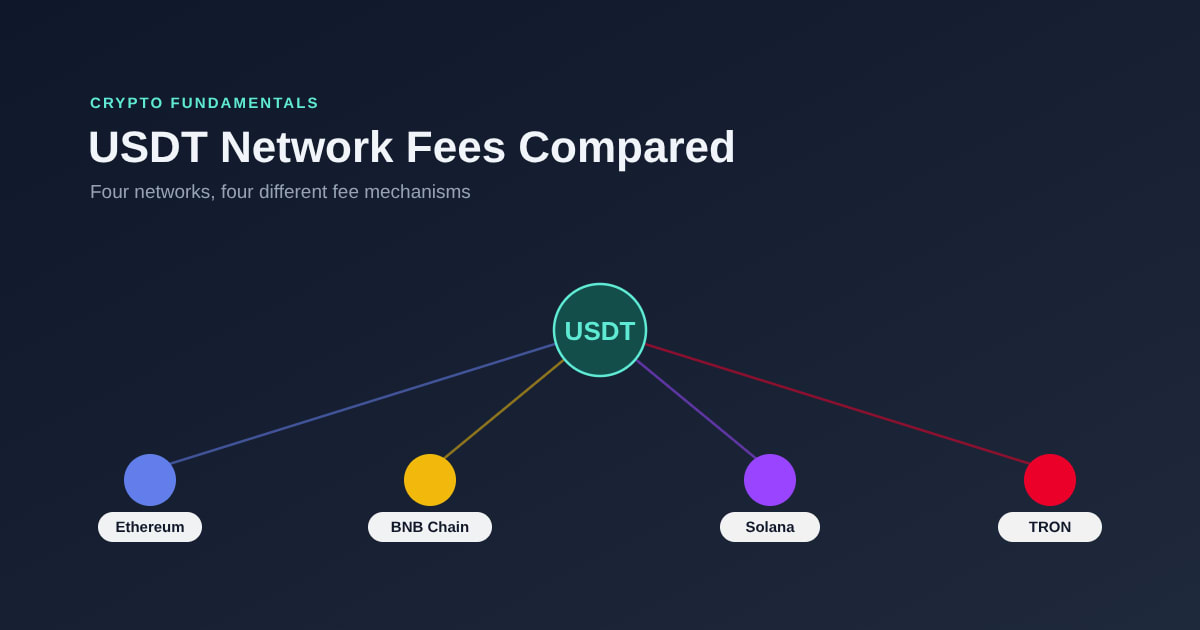
USDT Network Fees Compared: TRC-20 vs ERC-20 vs BEP-20 vs SPL
The same USDT transfer costs a fraction of a cent on one network and up to $15 on another - and it's not about which is 'better,' it's four structurally different fee mechanisms. What decides each one, and how to tell before you send.
Read article →