
Sell USDT for EUR: What Each Rail Actually Pays, Measured Daily
Wise, Revolut, SEPA, Skrill, PayPal and a bank card, read hourly for five and a half weeks and priced against what the coin was really worth in euros. The top of a bank-rail table is the market price; the middle is three and a half cents on the euro below; the exchanger you pick matters seven times more than the rail.
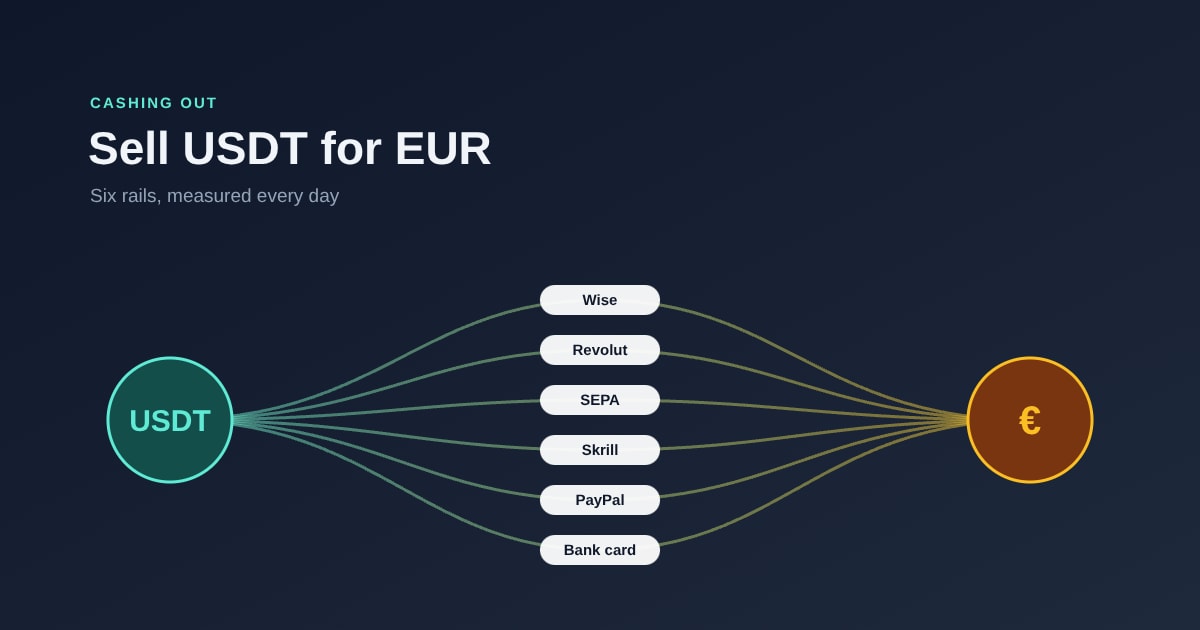
Anyone who wants to sell USDT for EUR through an exchanger meets the same table: a list of names, a rate beside each, and a best rate at the top that a comparison site sorted for you. The table answers one question - who pays the most right now - and hides the three that decide what actually lands in your account. How far does that top rate sit from what the coin is really worth in euros? Can your amount reach it at all? And does the rail you chose - a Wise balance, a Revolut account, a SEPA transfer, a Skrill or PayPal wallet, a bank card - change the price?
Our exchange monitor has been recording every euro direction with real competition once an hour since 7 August, folding each day into a record of the best, the typical and the worst quote. This piece reads that record for USDT on the TRC-20 network against six euro rails, and measures every quote against the price the coin itself fetched in euros on a regulated exchange the same day. The short version: the top of a bank-rail table is the market price, the middle of it is three and a half cents on the euro below, and which exchanger you pick matters about seven times more than which rail.
What was measured, and against what
The monitor polls the rate feeds of about forty exchangers every hour. For every direction where ten or more of them quote, it keeps a daily row: the highest effective rate seen in any reading that day (the best), the median quote at the last reading (the typical), the lowest seen (the worst), and how many exchangers were quoting. That record starts on 7 August 2026, and the window here runs to 14 September - thirty-nine days.
Three euro rails cleared the ten-quote bar every single day: a Wise euro balance, a Revolut euro account, and a Visa or Mastercard in euros. A plain SEPA bank transfer sat at eight to ten quotes and has only a partial record; Skrill and PayPal have five quotes each and no daily record at all, so for those three the numbers below come from the live table read on 15 September. Neteller (three quotes) and Payoneer (one) do not have a market worth writing about.
The reference is what the coin was actually worth in euros. USDT trades against the euro directly on Kraken, and its volume-weighted average price for each day is the benchmark for every quote here; over the window it averaged 0.8614, or about €861 for 1,000 USDT, and moved 1.42% between its lowest and highest day. Readers who think of a tether as a dollar lose nothing by doing so: over the same days the coin's euro price sat 0.02% under the ECB's dollar fixing on average. Every figure below is a distance from that market price, so it reads as a cost rather than a quote. A rate on the monitor is the effective rate an exchanger's feed publishes - what it pays after its own fee, before anything your destination charges to receive.
The best quote is the market. The typical quote is not
Over thirty-nine days, the best quote of the day on the Wise rail averaged 0.12% above the market, and on the median day sat exactly on it. Revolut's best averaged 0.15% above. The top of a bank-rail table, in other words, is the market price of the coin: an exchanger there is paying you what the coin is worth and earning on something other than the headline.
The middle of the same table is a different place. The typical quote - the median exchanger at the day's last reading - averaged 3.49% below the market on both rails, and the worst quote 8.7% below. On 1,000 USDT that is a gap of about €31 between the top of the Wise table and the middle of it, and about €76 between the top and the bottom. The best-to-worst spread on one rail on one day averaged 9.65%.

Set that beside the gap between rails. The bank rails paid 1.37% more than the card rail at the best quote, on average - and that is the largest difference between any two of the deep rails. The spread inside one rail is seven times the spread between rails. Choosing the exchanger is the decision; choosing the rail is a rounding error by comparison, at least at the top of the table.
One more thing the record shows about that top row. On 19 of the 39 days the best Wise quote sat above the market price, on nine of them by more than 1%, never by 2%. An exchanger can genuinely pay above the market when its own book is skewed - it also sells USDT for euros, at a price of its own - and a feed can also simply be wrong for an hour. Either way, a quote above the market is not a gift. It is the moment to read the rating beside the quote on the direction page, because the rate column has stopped telling you anything.
Wise and Revolut are the same market wearing two names
The same eleven exchangers quote both rails, and they quote them almost identically. Over the thirty-nine days the best quotes were 0.03% apart on average; Revolut was ahead on sixteen days, Wise on six, and on seventeen the two were within a twentieth of a percent. The widest gap in either direction was under three-quarters of a percent. The typical quotes were, on average, the same number.

So the rate is not the reason to pick one over the other. Two other things are. The first is what the destination itself allows: Wise's own help centre says it does not accept money from platforms not licensed in the UK or EU, and names account closure as a possible outcome, while Revolut takes USDT on Tron into the account directly, which gives that rail a second route that never involves an exchanger at all. Both guides lead with those facts for a reason. The second is the minimum ladder, and there the two rails part company - see below.
The card rail pays less on every single day
A card in euros is the third deep rail, and it is priced differently. Its best quote averaged 1.23% below the market, against Wise's 0.12% above; Wise's best beat the card's best on 39 days out of 39, by between 0.75% and 2.32%. On 1,000 USDT that is about €12 less at the top of the table, and the typical quote sits 2.12% further under Wise's typical - about €37 between the card's top and its middle.
That is consistent with what a card payout costs the party sending it - acquiring fees and reversal exposure that a bank transfer does not carry - though the feeds do not say why, only how much. What the card rail does offer is the lowest floor of any rail here: one exchanger takes the trade from about 32 USDT, where the Wise rail takes nothing under about 121. For a trade of a few hundred euros that difference matters more than the discount, because at that size every rail is paying 5% under the market anyway, and the card's is no worse.
SEPA: thin, and a lesson in what a "best rate" can hide
A plain SEPA transfer to any euro IBAN had eight exchangers quoting on 15 September. The top of that table is a rate 0.42% above the market that requires a minimum of 10,000 USDT - roughly €8,700 - so it exists for very few readers. The next three quotes want between about 815 and 1,180 USDT and pay from a tenth of a percent above the market to 2% under it; below that the ladder drops to about 5% under, the same as everywhere else.
The rail's daily record is the more useful lesson. It exists for eleven days only, because the direction spent the rest of the window under the ten-quote threshold, and for six of those days the recorded best was more than 10% above the market. That was one exchanger's feed, kept by the day's maximum: a daily best remembers the highest quote of any hour and never takes it back. Nobody was paid that rate. It is the clearest example on the monitor of why a best rate without a rating next to it is not information, and why the SEPA figures here come from the live table rather than the record. The live SEPA table and its guide show the rating beside every quote, and what the name-against-IBAN check that every euro-area bank runs since October 2025 means for an exchanger payout.
The practical difference of this rail is that the money arrives at your own bank under your own name, so the name on the exchanger's order has to match the account exactly, and your bank's view of a euro transfer from a crypto exchanger is a question only your bank can answer. We measured the price; we cannot measure that.
Skrill: five quotes, and a wallet with its own crypto desk
Skrill in euros had five exchangers quoting on 15 September. The best of them paid 1.67% under the market, from a minimum of about 939 USDT (roughly €800). Two more pay 3.98% under from about 300 USDT, and nothing on the rail takes a trade under about 246. At 300 USDT the best reachable quote is 6.26% under the market; at 500, just under 4%; from about 940 upward, the 1.67% headline.
Skrill is also the one destination here that runs a buy-and-sell crypto service of its own, priced inside the app. Whether your account and country let you bring an outside USDT balance into it, and what the in-app quote is on the day, are questions for Skrill; they are not in any exchanger table, including this one. What the table does say is that for a Skrill holder with a four-figure amount, the exchanger route lands about 1.7% under the market, and for a smaller one, four to six.
PayPal: the only rail that pays above the market, and why that is not good news
Five exchangers quote USDT into PayPal euros, and the top one paid 3.67% above the market on 15 September, from a minimum of 500 USDT. The second paid about 1% above from about 800. Below 500 USDT the only quote open is 14.5% under the market, which is the widest floor of any rail here; the rail's best-to-worst spread was 21%.
A price above the market is the market telling you something. A euro that arrives through PayPal is a euro the sender can dispute - PayPal's own help pages give a payer 180 days to open one - and an exchanger that pays a premium for handing you that kind of euro is telling you what it thinks PayPal euros are worth relative to bank euros. Whether your PayPal account can receive such a payment without a hold, and whether you want to hold a reversible euro for six months, are the questions that premium is asking you to answer. We take no position on them. We measured the price.
The minimum ladder: the rate you can reach is the rate you get
Every exchanger sets a minimum, and on these rails the minimums sort the table more sharply than the rates do. The chart reads the live table on 15 September by amount: for each size of trade, the best quote open to it, as a distance from the market.

Three things stand out.
Under about 500 USDT, the rail does not matter. At 300 USDT the best reachable quote is 4.6% under the market on Wise, 4.8% on SEPA, 5.1% on Revolut and the card, 6.3% on Skrill. The exchangers that pay the market price all sit behind three- and four-figure minimums, and below them every rail is served by the same handful of small-trade specialists at roughly the same discount.
The four-figure club opens at about 1,150 USDT on the bank rails - with one exception. On Wise the three quotes beneath the headline want 958, 1,156 and 1,160 USDT, and the headline itself 2,000; a trade of 1,000 USDT reaches 0.66% under the market, 1,500 reaches 0.14% under. On SEPA the shape is the same, with the top quote out of reach for almost everyone. Revolut is the exception: its headline quote opens at 500 USDT, so a trade of 500 to 950 USDT reaches the market price on Revolut and stays more than 4% short of it on Wise, whose first market-price quote opens at about 958. For ordinary amounts that is the whole difference between the two euro rails, and it is worth more than any rate gap the record found.
The card rail's discount is invisible below 1,000 USDT. At 300 USDT the card's best reachable quote is 5.1% under the market - the same as Revolut's at that size, and better than Skrill's - and the card only falls behind once a trade clears the minimums the bank rails' top quotes sit on.
Minimums move with the rates - they are set in USDT and refreshed hourly - so treat the grid as the shape of the ladder, not its rungs. The rungs are on the live table.
The network does not change the price
USDT exists on several networks, and the monitor records each separately. It makes no difference at the top of the bank-rail tables: over the window the best quote for USDT on TRC-20, ERC-20 and BEP-20 into Wise averaged 0.8624, 0.8621 and 0.8618, and on 15 September the live headline was 0.8657, 0.8653 and 0.8653; Solana and Polygon, with seven or eight quotes each, sat at the same 0.8653. The card rail is the one place the network shows: its best quote on ERC-20 and BEP-20 sat about 0.4% under the TRC-20 figure on 15 September, and further under across the window, though on fewer recorded days.
So pick the network by what your wallet holds and what the transfer costs, not by the euro rate; how USDT's fees differ by network is the piece for that, and a network mismatch is still the one mistake on this page with no undo.
Waiting for a better day does not work either
The best quote on the Wise rail moved 0.23% a day on average, on Revolut 0.24%, on the card 0.28%. The largest single-day move in the window was 1.55%, on 23 August, and the market itself moved 1.42% between its lowest and highest day. Almost everything the quotes did over five and a half weeks, the euro did first. A day's wait is a bet on the currency, not on the exchangers, and the record gives no reason to expect a better table tomorrow.
What this does not say
The daily record keeps a best, a typical and a worst, and not the name of the exchanger behind each, so who paid the most on any given day is unknown; the names here come from one live reading. A best-of-day is a maximum over hourly readings, and one hour of one feed can define it - the SEPA record shows what that looks like. The rates are effective rates as the feeds publish them; the exchanger's own page at the moment of the trade is the final word, and no rate carries the conditions that follow it - verification, a source-of-funds question, a hold on the receiving side. Three of the six rails have five to eight quotes, which is a reading, not a market. And the reference is a whole day's volume-weighted price, while a quote is read at one hour; on a day the euro moves, the two can differ by a few tenths.
Bottom line
Pick the exchanger before the rail. On one rail on one day, the top and the bottom of the table were 9.65% apart on average; the bank rails and the card rail were 1.37% apart. The top of a bank-rail table paid the market price of the coin, the middle paid three and a half cents on the euro less, and the bottom nearly nine.
Below about 500 USDT, expect 4% to 6% under the market on the bank rails, the card and Skrill, and worse on PayPal, and choose by what your amount can reach; Revolut's headline opens at 500 and Wise's at four figures, and that gap is bigger than any rate difference between the two. The card pays about 1.4% less than a bank rail on every single day, but only once a trade clears the four-figure minimums; under that it is no worse. A quote above the market - SEPA's top row, PayPal's whole top half - is the cue to read the rating, not the rate. And what USDT is worth in euros moved more over five weeks than any exchanger's quote did against it, so the day you sell matters more than the day you check.
Every figure above is our own computation from the exchange monitor's daily record (exchange_rate_history, one row per direction per day since 7 August 2026, kept only for directions with ten or more quotes) and its live table read on 15 September 2026 at 11:00 UTC, against Kraken's USDT/EUR daily volume-weighted price and the ECB's USD/EUR reference rate. Rates are effective rates as published by each exchanger's feed for USDT on the TRC-20 network, and the ladder counts only exchangers whose known reserve covers their own minimum, which is the rule the public table applies. Names are omitted on purpose: the direction pages show every quote with its rating. We will re-run the computation as the record grows.
Related
View category
What Is a Stablecoin? USDT vs USDC, and What Holds the Dollar Peg
A stablecoin is a company’s promise to pay one dollar per token, kept at a dollar by traders who can redeem with the issuer and arbitrage the market back. USDT and USDC compared on reserves, redemption, freezing, European and US rules and networks; the two days each broke the peg, as the exchanges printed them; and which coin the exchanger market actually takes.
Read article →
Bybit Master Traders After a Blow-up: What the Board Drops, and What It Keeps
We matched two complete readings of the Bybit copy-trading board twelve days apart to see what happens to a master trader who loses everything. The silent are removed; the wiped stay listed with their followers - until the ninety-day window cleans the card.
Read article →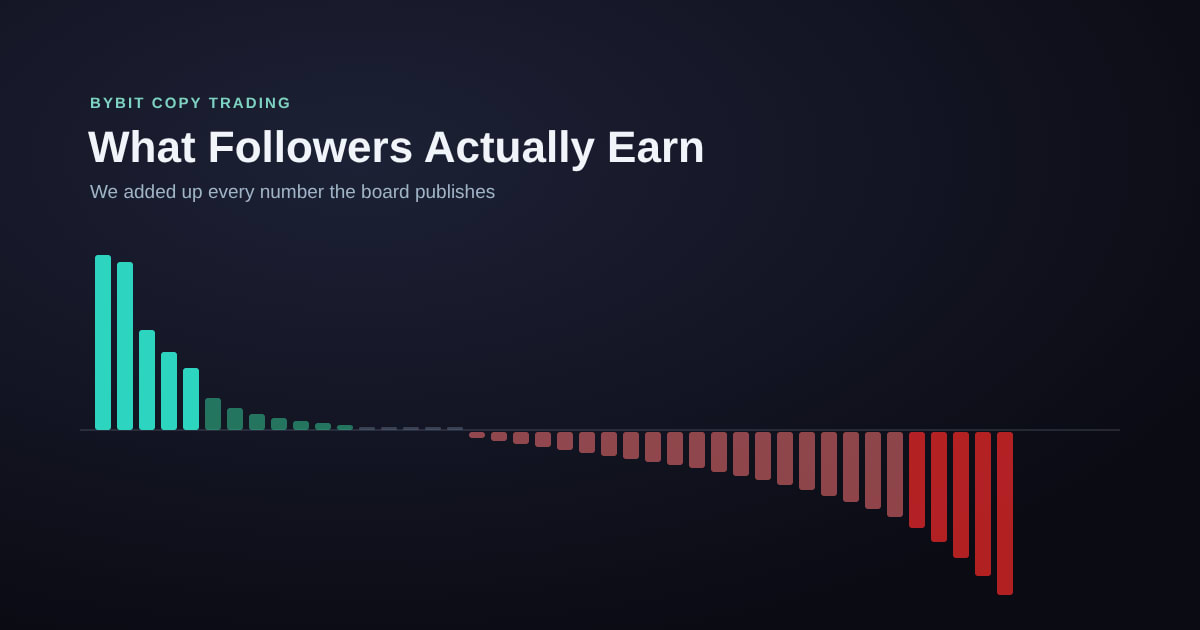
What Followers Actually Earn on Bybit Copy Trading
The board shows one card at a time and never totals them, so we did: every follower-profit figure the platform publishes, summed across every leader active enough to judge. The split, the concentration, and the number the sort button cannot show.
Read article →