
Bybit Master Traders After a Blow-up: What the Board Drops, and What It Keeps
We matched two complete readings of the Bybit copy-trading board twelve days apart to see what happens to a master trader who loses everything. The silent are removed; the wiped stay listed with their followers - until the ninety-day window cleans the card.
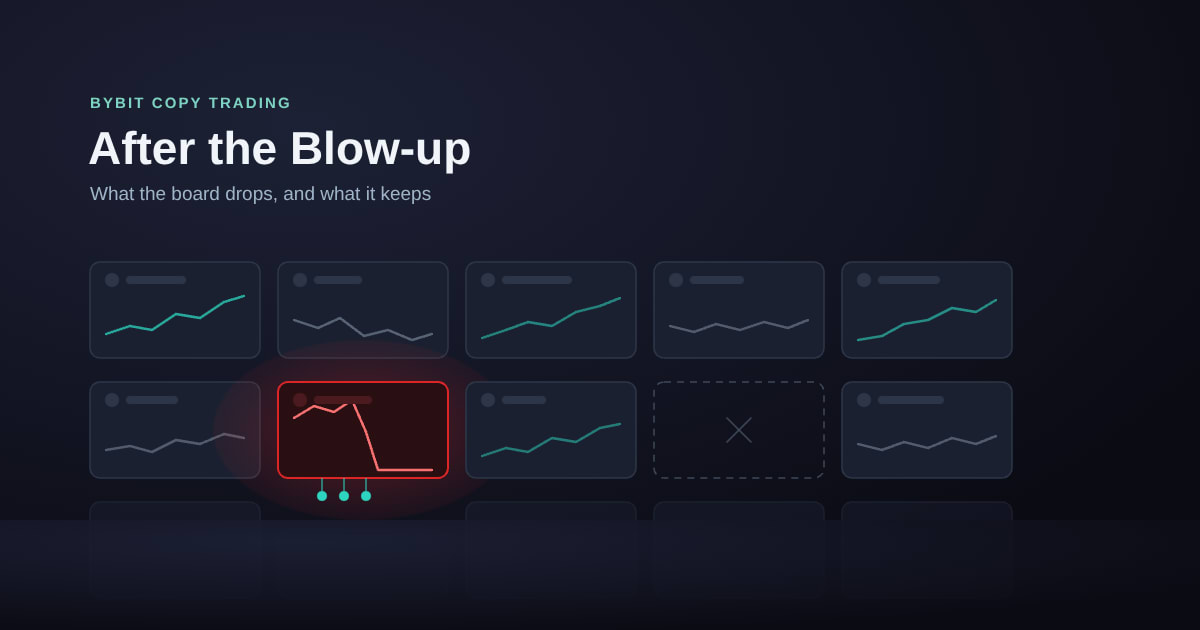
Bybit calls the people you can copy Master Traders, and on any given day its board lists about seven thousand of them. Anyone about to follow one eventually asks the uncomfortable version of the question: what happens to a Bybit master trader after a blow-up - the account that loses everything? The instinct is that they vanish, and that the board you are scrolling is a display of survivors.
We checked, because we could. Our rating of Bybit copy traders reads the whole board on a schedule and keeps every reading, so we had two complete pictures of it twelve days apart - 27 August and 8 September 2026, with 7,457 and 7,186 listed master traders - and our own readings of the followed accounts in between. Matching the two by the platform's own stable leader id answers the question directly.
The one-line answer: the board drops the silent and keeps the dead. Then the ninety-day window cleans the dead account's card, and the followers who were on it are still there when it does.
What the board removes, and what it does not
Bybit's own rules for master traders are written around activity as much as results: a tier is re-evaluated every week, no trades for fourteen days brings an automatic downgrade, and an inactive badge marks an account with no position in seven days or no trade in fourteen. The featured shelves - top return, highest profit for followers and the rest - apply activity and drawdown filters of their own before a card can appear on them. The full list applies no performance filter at all, and the published rules describe downgrades; they say nothing about removing an account for losing money.
The twelve days bear that out. Of the 7,457 master traders listed on 27 August, 692 were gone by 8 September - about one in eleven - and 421 new ones had arrived. Which ones went depended almost entirely on one thing.

- Silent accounts went. 188 cards showed no trade at all in the window - return, drawdown and follower profit all reading zero. 160 of them, 85%, were gone twelve days later.
- Wiped accounts stayed. 1,159 cards read as wiped: a return of minus 99.9% or worse, or a drawdown of 99.9% or more, as the platform reports them over its ninety-day window. 132 of them, 11%, were gone. Of the 468 whose return had reached minus 99.9% or worse, three in four were still listed on 8 September.
- Everything in between - drawdowns under 50%, between 50 and 90, between 90 and 99.9 - left the board at 5 to 7%, a background rate that looks like ordinary turnover.
So a blow-up, on its own, does not take an account off the board. Silence does, and a wiped account that keeps placing trades is not silent.
Nor does a disappearance tell you much on its own. Thirteen of the delisted accounts had ten or more followers on 27 August, and they are a mixed bag: three were wiped, two were silent, one was most of the way down, and seven looked ordinary on their last card - one of them had 556 followers and a positive return. Master traders can also simply leave, and the board does not say why a card is gone. A missing leader is a question, not a verdict.
The wiped stay on display, and their seats stay with them
Because the dead are not removed, the board carries them. On 8 September, of 7,186 listed master traders:

- 926, one in eight, read as wiped - a return of minus 99.9% or worse, or a drawdown of 99.9% or more, inside the window.
- One in five, 1,472, carried a drawdown of 90% or more; two in five, 2,856, a drawdown of at least half. More than half, 55%, showed a negative return over the window.
- Three quarters, 5,401, had nobody copying them at all.
The wiped accounts are not empty. Between them they still carried 1,463 open copy seats - a seat being one open copy relationship, which is what the card's follower count actually counts - and 82 of them had three or more followers - 1,317 seats on accounts that had, by the card's own figures, lost everything. Their follower-profit fields summed to about minus $1.02 million, a large slice of the loss side we added up across the whole board. The largest of them, Anjuta, sat at Bronze tier with 534 followers, a return of minus 80%, a 99.99% drawdown, and minus $223,902 of follower profit.
And those seats show no sign of leaving. Take the 1,027 accounts that read as wiped on 27 August and were still listed on 8 September: their seats went from 1,750 to 1,909 over the twelve days. One account, which we come to next, added 180 of those between the two board readings; take it out and the count is 1,614 to 1,593 - flat. Whether real money still sits behind a seat on a wiped account, the board cannot tell us. But no seat is being cleared.
Then the window cleans the card
The mechanism is the one that undermines every figure on a leader card: everything you are shown is a trailing ninety-day statistic. A wipe that happened ninety-one days ago is not on the card. So the wiped accounts that survive do not stay wiped on display - the loss ages out, and the card is clean again with the followers still attached.
Twelve days is enough to watch it happen. Of the 1,027 wiped-and-still-listed accounts, 179 no longer read as wiped on 8 September; 86 of those showed a drawdown under 10%, and 40 a positive return. Across the whole board, 437 cards saw their drawdown fall by thirty points or more in twelve days, against 116 that rose by that much.
One account shows the whole sequence. 2Moon is a Silver-tier master trader, 918 days on the platform, with about $338,000 under management on our latest reading. This is its card across five readings:

On 27 August the card showed a drawdown of 99.99%, a return of minus 21.5%, and follower profit of minus $239,584 - and carried the platform's own "Top Profit", "Top ROI" and "Win Streak" tags. Followers kept arriving anyway: 136, then 154, then 234 by 2 September, while the drawdown still read 99.99% and follower losses had deepened to minus $318,630. Then, between our readings of 2 and 5 September, the wipe left the window. Drawdown 61.75%, return plus 251%, follower profit plus $51,291. By our reading of 8 September: drawdown 20.08%, return plus 274%, 314 followers - 316 on the afternoon board read - and the tag now reads "Stable".
Nothing was repaid between those two readings. The minus $318,630 did not come back; it stopped being counted. The account's own page adds the detail the card leaves out - 593 closed winners and no closed losers - the pattern that holding every loser open rather than closing it leaves on a card. The one number that survives the rollover is ours: the worst drawdown in our record for 2Moon stays at 99.99%, whatever the card says this month.
The traffic runs the other way too, just more slowly. Sixty-one accounts that were alive on 27 August read as wiped on 8 September - about one in a hundred - and seven of them had three or more followers. Harley went from a return of plus 475% to minus 71%, with the drawdown from 71% to 99.99%, and was promoted from Cadet to Bronze tier in the same twelve days. Futures Traiding showed a drawdown of exactly zero and a return of plus 142% on 27 August; its followers tripled to 34 by 2 September, and by 5 September the card read minus 55%, a 99.97% drawdown and minus $6,445 of follower profit. Rebirth shows the rest of the sequence: minus 86% with an 86% drawdown on 28 August; a drawdown of zero beside a return of minus 61% on 2 September; all zeros on 5 September; gone by 8 September. Fall, clear, silence, removal.
The tiers filter what the sort does not - for a week at a time
Bybit's rank system does part of the job the board's sort does not. Master traders are rated Cadet, Bronze, Silver or Gold, and the help centre says the rating is set from three things: account balance, thirty-day cumulative profit, and the maximum drawdown over the last seven days. On the board that shows: on 8 September the six Gold and fifty Silver accounts held no wiped card at all, the 220 Bronze held nine, and the 6,910 Cadets held 917. Four in ten Cadet cards showed a drawdown of at least half; among Bronze and Silver, one in seven and one in six; among Gold, none.
The catch is the window again, only shorter. The drawdown that counts for the tier is seven days old at most, the profit thirty, and the rating is re-evaluated every Saturday, with a week's grace before a downgrade - so a tier describes the recent past rather than the account, and it moves accordingly. Our twelve days spanned two of those Saturdays, and 270 of the 6,765 accounts present on both dates changed tier; 101 of them dropped from Bronze to Cadet. DAILY TREND X2 went from Gold to Cadet with 209 followers on board, its follower cap falling from 3,000 to 100 around them; JP777 went from Gold to Silver. One account went from Cadet to Gold while its followers went from 2 to 537. A tier is a useful filter on the day you look. It is not a track record.
So how long does a Bybit master trader last?
Twelve days is a first reading, not a survival curve. What it shows for the accounts people actually follow: of the 768 master traders with at least three followers on 27 August, 700 - 91% - still had three or more on 8 September. Thirty-three were delisted, 29 slipped to one or two followers, six to none, and seven went from alive to wiped. Across the whole board, among the 285 accounts with ten or more followers on 27 August, thirteen were delisted, and the seats on them fell from 13,823 to 12,582.
We will keep reading the board and come back with a longer record. In the meantime the practical reading is simple. The drawdown on a card is a window that can close; the tier is a week; and the follower count includes seats parked on accounts that have already lost everything. Before you follow, check whether the account has a deeper fall on record than the one on display - our rating scores every leader against the worst drawdown we have ever recorded for them, not this month's - and decide how much of your money one master trader gets as if the card were clean and the history were not.
Board readings of 27 August and 8 September 2026, matched by the platform's leader id, with our own readings of 28 August, 2 September and 5 September in between; the rules quoted are from Bybit's help centre as of the same dates. The mechanisms - what is removed, what stays, what the window forgets - are properties of how the board works; the counts and the named examples are dated and will move with every window. Copy trading carries real risk, and nothing above predicts future performance.
Related
View category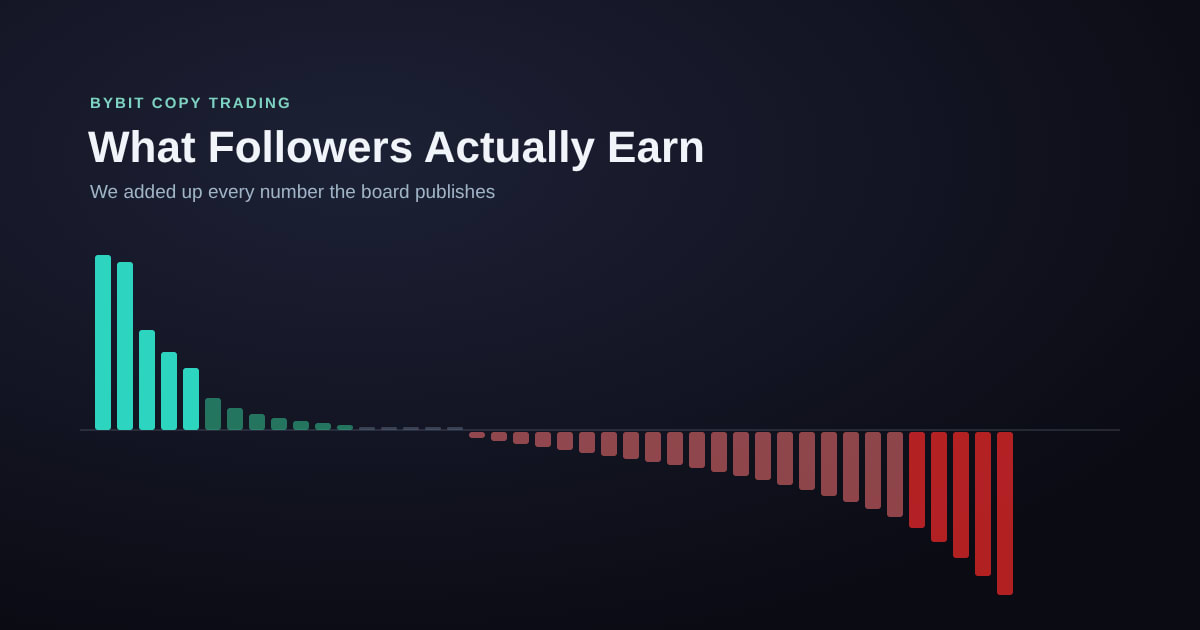
What Followers Actually Earn on Bybit Copy Trading
The board shows one card at a time and never totals them, so we did: every follower-profit figure the platform publishes, summed across every leader active enough to judge. The split, the concentration, and the number the sort button cannot show.
Read article →
DEVI Algo Trading Review: Three Bybit Accounts, One Brand
Three accounts share the DEVI name and a near-flat risk profile, and the cleanest record of the three is the one to trust least. Which of the family a copier can actually judge, and what its perfect flagship cannot prove.
Read article →
HFT. Sort of Review: The Quietest Kind of Bybit Copy Trading
A card with almost no drawdown, a win rate that looks unreal, and the arithmetic that reconciles the two. Plus the same-day twin account, and the imitators not to confuse with either.
Read article →