
What Followers Actually Earn on Bybit Copy Trading
The board shows one card at a time and never totals them, so we did: every follower-profit figure the platform publishes, summed across every leader active enough to judge. The split, the concentration, and the number the sort button cannot show.
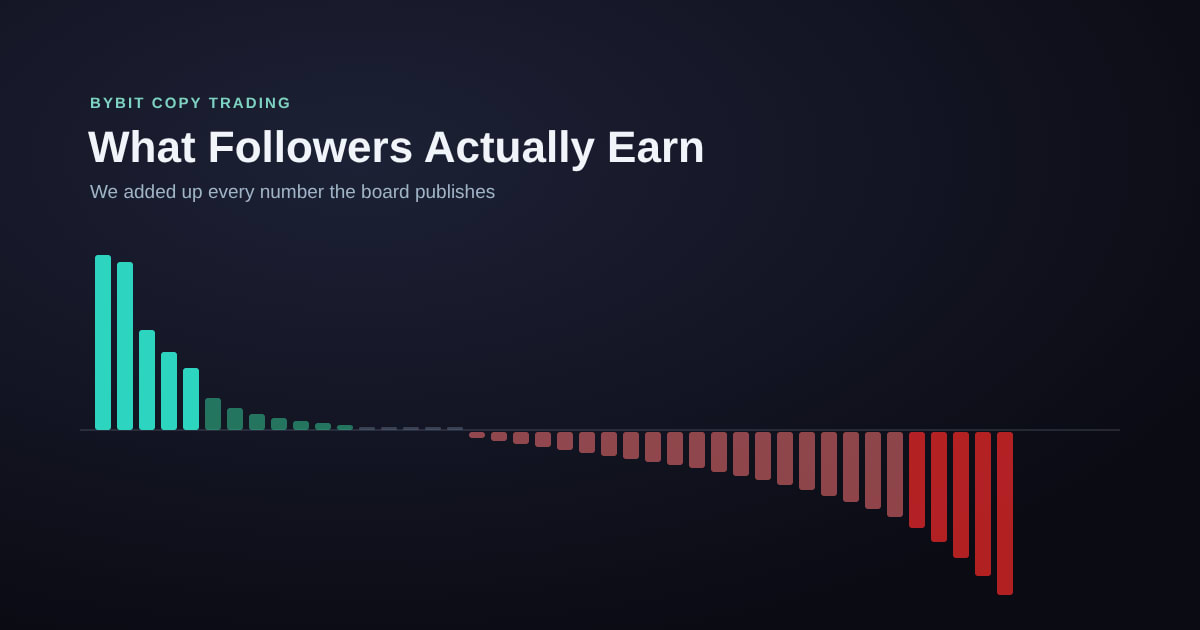
Anyone asking whether Bybit copy trading is worth it runs into the same wall: the board answers a different question. Sort it however you like - by return, by win rate, by follower count - and every view shows you individual cards. No view totals them. So we did.
Bybit publishes, for each leader, the collective profit of the people copying them. We read that figure for every leader on the board, keep our own record of the readings, and added the whole thing up. What follows is the arithmetic of the board itself - our sums, computed from the numbers the platform displays - as of our reading of 5 September 2026, over the trailing ninety days the platform reports.
The one-line result: across every leader active enough to judge, the money copying them was down about $1.46 million net.
Who we counted, exactly
The board listed roughly 7,200 leaders that week. Most are dormant or nearly unfollowed, so our rating pipeline judges the subset with at least three current copiers and sane data - 749 leaders on that reading. Everything below describes those 749 unless it says otherwise; none of the percentages extend to the board at large.
That filter, if anything, flatters the result. As a check we re-pulled the full board without the filter two days later: the thousands of small dropped accounts sum to roughly another minus $0.6 million between them, taking the board-wide total to about minus $2.2 million. And leaders who blew up badly enough to disappear from the board during the window are in nobody's total at all - more than a thousand leaders we saw in earlier readings were simply gone from this one.
The split

Nearly half of the judged leaders - 339 of 749 - showed their followers collectively under water. A third showed them in profit. The remaining fifth is an honest gap: the platform serves a literal zero in the follower-profit field for one leader in five, including visibly active accounts with dozens of copiers, and readings we have watched flip from a real negative to exactly zero between two of our runs. We count those as unmeasured, not as break-even - it is not the only field on the card that behaves this way, and we have taken the headline numbers apart one by one. Among the 599 leaders with a real reading, the median was about minus fifteen dollars - the middle of this distribution is a rounding error away from nothing.
The concentration

Here is the number we found most striking, and the reason picking matters more than participating: of all the follower profit on the judged board - every winning pool combined - the top two leaders held 52.7% - bluntz, whom we have reviewed, is one of them. The top five held 61.6%; the top ten, 69.1%. The remaining two hundred and fifty profitable leaders shared the last third between them.
The loss side is a mirror: the five worst rows carried 40.1% of all the red. The single worst pool on the board stood at minus $322,914 on our reading - not a data glitch, but a figure we have watched worsen steadily across three readings - and that one account's losses outweighed the combined lifetime earnings of most profitable leaders on the board.
These are dollar sums, so a big pool moves them more than a dozen small ones. That is precisely the point: the board's money story is written by a handful of accounts on both ends, and no sorted list of individual cards will ever show you that.
The total

All winning pools together: about +$1.15 million. All losing pools together: about -$2.61 million. Net, the judged board's followers were down about $1.46 million over the window - and as the check above showed, that is the conservative version of the number.
Two honest limits. The platform does not document whether the follower-profit figure is before or after the leader's profit share, so the winning side may overstate what copiers actually kept - we flag it rather than guess. And the follower counts are seats open today while the profit is cumulative over the window: many of the people who took the losses have already left, so nothing here supports any per-person arithmetic.
So is it worth it?
The distribution answers better than a verdict would. On this board, over this window: a third of judged leaders paid their followers, half cost them money, and the winnings pooled so tightly that missing the top handful meant missing most of the point. Copy trading on Bybit is not a lottery ticket and not a scam - it is a picking problem with brutal concentration, run through an interface whose default sort answers "who has the loudest recent return" rather than "who has actually paid the people copying them".
That second question is the one our rating is built to answer - ranked on follower outcomes and the worst drawdown we have ever recorded per leader, not the window's best face. And whatever you pick, the sizing arithmetic matters more than the pick: on a board this concentrated, the cost of being wrong is what you put in, not who you chose.
Sums computed by us from the per-leader figures Bybit publishes, read 5 September 2026 over the platform's trailing 90-day window, with a full-board check on 7 September. The concentration, the split and the mechanisms are properties of how leaderboards work; the dollar figures are dated worked examples and will drift with every window. Copy trading carries real risk, and nothing above predicts future performance.
Related
View category
DEVI Algo Trading Review: Three Bybit Accounts, One Brand
Three accounts share the DEVI name and a near-flat risk profile, and the cleanest record of the three is the one to trust least. Which of the family a copier can actually judge, and what its perfect flagship cannot prove.
Read article →
HFT. Sort of Review: The Quietest Kind of Bybit Copy Trading
A card with almost no drawdown, a win rate that looks unreal, and the arithmetic that reconciles the two. Plus the same-day twin account, and the imitators not to confuse with either.
Read article →
Bluntz Review: Bybit Copy Trading Without the Fireworks
The board scrolls past him, and his followers have been paid more than anyone else’s. What the quiet account does differently, the five days that halved his headline while his followers earned, and the look-alike not to confuse him with.
Read article →