
Trezor Safe 7 Review: What "Quantum-Ready" Actually Protects
Trezor built post-quantum cryptography into the Safe 7, and it guards the bootloader, firmware and device authentication — not your coins. Three chips from three vendors, an auditable secure element, and a data breach disclosed a week ago.
Quick verdict
The Trezor Safe 7 is the first hardware wallet to put post-quantum cryptography inside the device, and the marketing around that has already outrun what it means. This Trezor Safe 7 review starts there, and takes every claim from Trezor's own documentation rather than from anyone's summary of it.
The Safe 7 uses a post-quantum signature scheme to verify its own bootloader and firmware. It does not make your bitcoin quantum-resistant, and Trezor does not claim it does. Those are two different problems, one of which a wallet manufacturer can solve alone and one of which it cannot.
Everything else about the device is a straightforward generational step: three security chips instead of one, a bigger screen, Bluetooth, a battery. At 249 USD it is the most expensive Trezor ever sold.
What "quantum-ready" actually protects
This is the section worth reading twice, because it is where most coverage of the Safe 7 stops short.
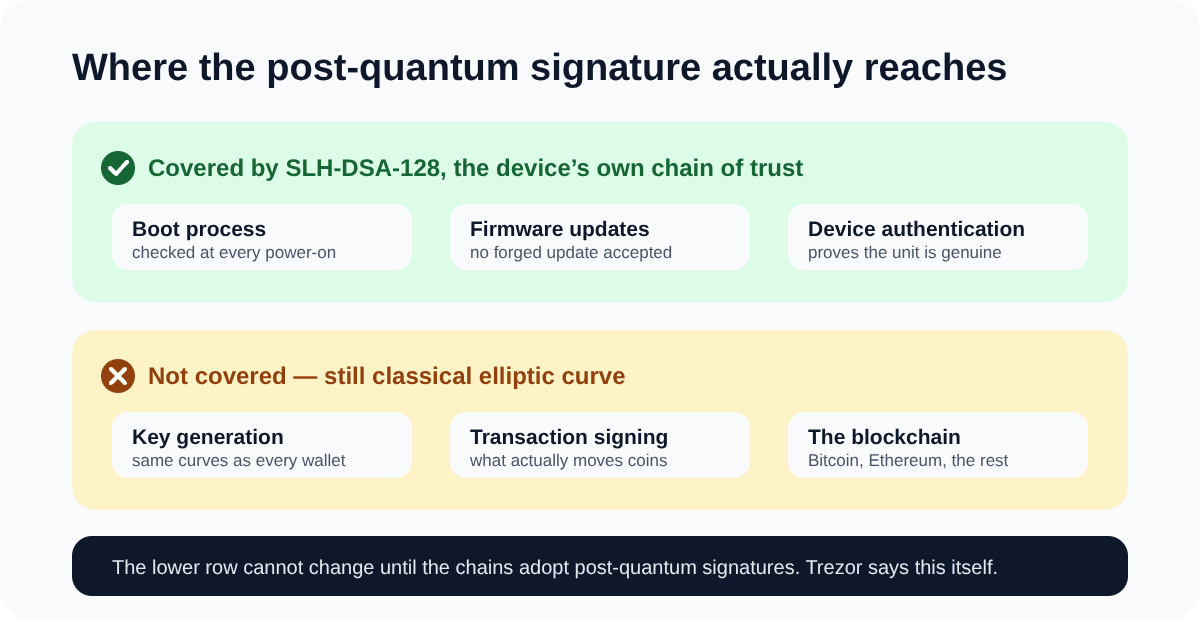
Trezor's product page states that the Safe 7 is "the first hardware wallet using post-quantum cryptography to secure firmware updates, device authentication, and the boot process." The scheme is SLH-DSA-128, standardised in 2024, and Trezor's FAQ describes it verifying "the bootloader and firmware every time the device powers on."
Read that list again: firmware updates, device authentication, boot. Your private keys are not on it.
What the Safe 7 is protecting is its own chain of trust. If classical signature schemes fall to a quantum computer, an attacker could in principle forge a firmware update and convince a wallet to install it. A device that verifies its firmware with a post-quantum signature cannot be fooled that way. That is a real problem and a real solution to it.
But the keys that sign your transactions still use the same elliptic-curve cryptography every other wallet uses, because that is what the blockchains themselves require. Bitcoin and Ethereum have not adopted post-quantum signatures. Until they do, no wallet can make your coins quantum-safe, however its firmware is signed.
Trezor says this itself, which is to its credit. Its own material notes that "upgrading blockchains is a large-scale effort that requires time and global coordination. In contrast, hardware wallets can implement PQC today," and frames the device as being able to "seamlessly update" when the chains eventually change. The spec sheet's wording is careful in the same way: designed to receive quantum-secure updates.
So if you came here searching Trezor Safe 7 quantum ready and meant it in the sense of protecting your coins from a future quantum computer, the honest answer is no, and the manufacturer is not the one telling you otherwise. What it is ready for is the update, when there is one to install.
That distinction matters commercially, because "quantum-proof wallet" is becoming a marketing phrase attached to products that do far less than this one.
Three chips from three vendors
The security architecture is the genuine hardware change, and it is unusual enough to explain properly.
Trezor's page describes keys protected by "three independent chips sourced from three different vendors":
- TROPIC01, which Trezor calls the "world's first auditable Secure Element". This is the notable one, and the reason is philosophical as much as technical.
- Optiga, an "NDA-free EAL6+ Secure Element" — a conventional certified secure element, but one whose documentation is not locked behind a non-disclosure agreement.
- STM32U5G, an ARM Cortex-M33 running at 160 MHz, doing the general-purpose work.
The point of three vendors is that a flaw or a backdoor in any one of them does not hand over the keys on its own. The point of auditable and NDA-free is Trezor's long-standing argument with the rest of the industry: a certified secure element you are not allowed to inspect asks you to trust a certificate instead of the thing itself.
Whether that argument moves you is a matter of temperament. It is the reason Trezor sits where it does in our hardware wallet rating, scoring highest on the balance between certified security and open verifiability rather than on raw feature count.
Bluetooth, and the objection to it
The Safe 7 has Bluetooth 5.0 and a USB-C port, and Bluetooth in a hardware wallet still makes people uneasy. The objection deserves a straight answer rather than reassurance.
Trezor's mitigation is that the connection carries an encrypted protocol rather than trusting the radio link, and that Bluetooth can be switched off entirely, leaving a USB-C-only device that behaves exactly like previous models. The cable is in the box.
The practical reading: if Bluetooth is the reason you would not buy this, turn it off and you have lost nothing except the convenience you did not want. If you would use it, the transport is not the layer holding your security anyway — the screen is. You still confirm every transaction on the device itself, which is the entire point of the category.
One thing not on Trezor's product page, despite people searching for it: NFC. It is not listed among the connectivity options, so do not buy this expecting it.
Screen, battery and the charging report
The display is a 2.5-inch colour panel at 520 by 380 pixels, 700 nits, behind Gorilla Glass 3. On a device whose security model rests on you reading an address off the screen and comparing it, screen quality is a security feature and not a luxury.
The battery is LiFePO₄, 3.2 V and 330 mAh, with Qi2 wireless charging. LiFePO₄ is the interesting choice: it tolerates far more charge cycles than the lithium-polymer cells in most consumer devices, which matters in a product people expect to keep for years. If the battery dies entirely, the device still works over USB-C.
Worth knowing before you order: among the 52 customer reviews on Trezor's own product page, at least one describes the battery indicator dropping sharply during wireless charging, with Trezor's support replying that off-centre placement on a charging pad can make the power-management chip misread the voltage curve. That is a single report with a vendor explanation attached, not a pattern — but it is on Trezor's own page, and it is the kind of thing worth checking on your own unit in the first week.
Backup and PIN
Backup options are 12, 20 or 24 words, plus what Trezor calls Advanced Multi-share Backup — splitting the secret into several shares where a subset can restore the wallet. That has been Trezor's differentiator for years and remains the strongest argument for the brand if you are protecting a meaningful balance: a single seed phrase on paper is a single point of failure in both directions, because it can be lost and it can be found.
PIN length goes up to 50 digits, which is more a statement than a feature.
The August data breach, and what it actually means
On 13 August 2026 Trezor disclosed that customer data had been exposed — not through its own systems, but through ShipMonk, the fulfilment provider that ships its orders. ShipMonk notified Trezor on 10 August; attackers had exploited a vulnerability in a third-party analytics platform in ShipMonk's environment.
The numbers, from Trezor's disclosure: 13,689 people affected. Of those, 11,742 had name, email address, phone number and shipping address exposed; a further 1,947 had name, city and email address. The affected orders were placed between 10 May and 8 August 2026, in the United States, the United Kingdom, Sweden, Colombia, Brazil, Italy and Portugal.
No keys were touched. No device was compromised. Wallet backups were never in that system and remain unaffected.
That is genuinely the smaller half of the problem. The larger half is what the data is: a verified list of people known to own a hardware wallet, together with where it was delivered. That is exactly the input a phishing campaign wants, and in a minority of cases a physical-risk concern.
If you ordered in that window, the practical response is not to move your funds — your funds were never exposed. It is to treat any message about your Trezor as hostile until proven otherwise. Trezor will never ask for your recovery seed, and anyone who does, however convincingly they quote your delivery address back at you, is stealing from you.
The comparison people will reach for is Ledger's 2020 breach, and the two are not equivalent. Ledger's exposed over a million customers from its own e-commerce database and has fuelled phishing for years since; we score it accordingly in our assessment of Ledger. This one is smaller, sits with a logistics partner rather than with Trezor, and was disclosed within three days. It still belongs on the record, and we have marked it on Trezor's incident history rather than leaving the score silent — a company's supply chain is part of what you buy.
Who this is for, and who should skip it
Buy the Safe 7 if you want the most auditable security architecture on the market and you are willing to pay for it, or if Multi-share Backup solves a real problem for you.
Skip it if you already own a Safe 5 and were hoping the quantum feature protects your coins — it does not, and nothing in this release changes what your keys are exposed to. Skip it too if 249 USD is a large fraction of what you are protecting; the security model of a cheaper Trezor is the same one, and a hardware wallet holding two hundred dollars is a solved problem at a lower price.
And if you are still deciding between a device and an app at all, the trade-off is laid out in our guide to the wallet types. The short version is that a hardware wallet moves your keys off any machine that browses the internet, which is a different question from whether you trust a particular exchange — and if it is exchange risk you are worried about, what actually triggers an account freeze is the more useful thing to read first.
Bottom line
The Safe 7 is a good hardware wallet with an unusually honest quantum claim underneath some unusually loud quantum marketing. The three-chip architecture is a real advance, the auditable secure element is a genuine first, and the post-quantum firmware verification is a sensible thing to build now rather than later.
What it is not is protection against a quantum computer taking your bitcoin. That fix has to happen on the blockchains, Trezor says so plainly, and any review that leaves you thinking otherwise has done you a disservice.
Prices, stock and the review count above were read on Trezor's own site on the day this was written; check the current figures before you order.
Related
View category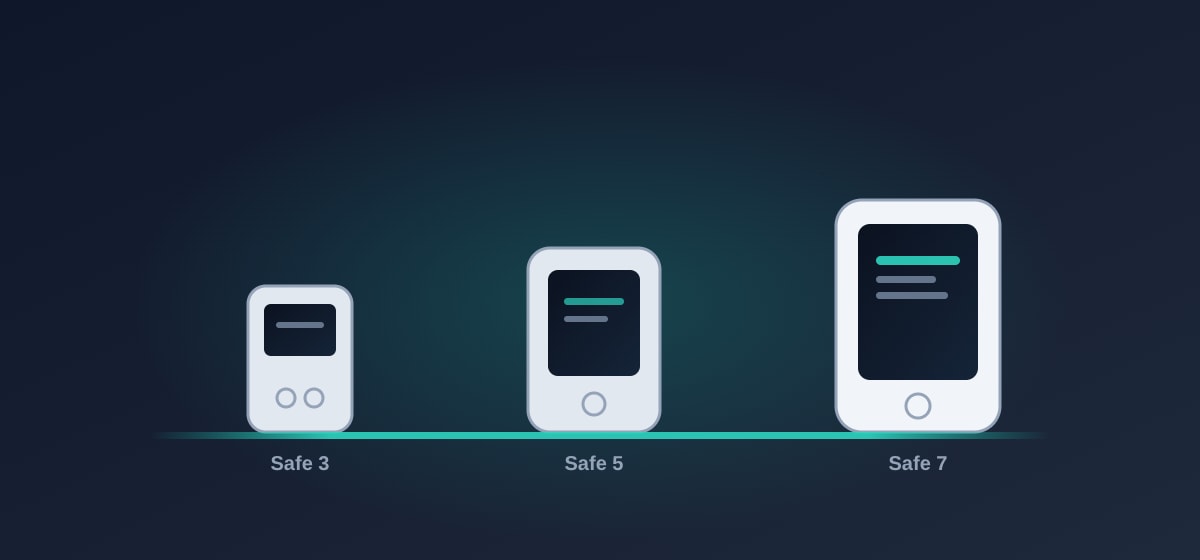
Trezor Review: Three Wallets, One Security Floor
Safe 3, Safe 5 and Safe 7 share a certified secure element, open-source firmware and Multi-share Backup. The feature that most protects you is on the 59-dollar device; the extra 190 buys screen and wireless.
Read article →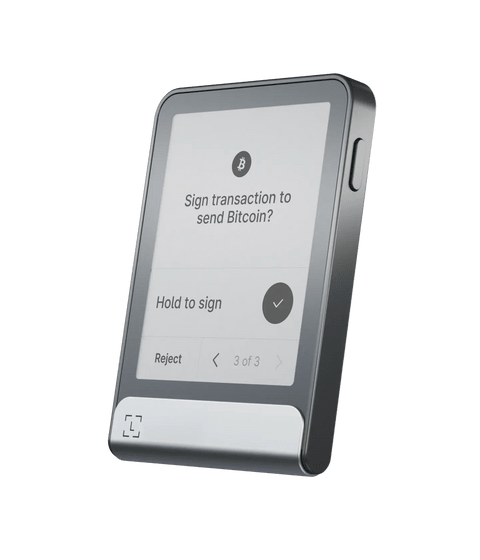
Ledger Review: Which Hardware Wallet Model Actually Fits You
A practical Ledger review covering all five current hardware wallet models, the Secure Element security core, Ledger Recover explained honestly, and the 2020 breach's lasting phishing risk.
Read article →
DEVI Algo Trading Review: Three Bybit Accounts, One Brand
Three accounts share the DEVI name and a near-flat risk profile, and the cleanest record of the three is the one to trust least. Which of the family a copier can actually judge, and what its perfect flagship cannot prove.
Read article →