
Prop Firm Drawdown Rules: Static, Trailing and the One That Closes Your Account
Three limits, and only one of them ends the account. What static and trailing maximum loss do to identical trading, why the daily limit usually watches equity rather than balance, and why the same firm often runs both.
Most people who fail a prop firm challenge do not fail on a run of bad trades. They fail because the account was closed by a rule they had read, agreed to, and misunderstood — usually the drawdown rule, and usually because they assumed it worked the way the last firm's did.
There are three separate limits, they are measured differently, and only one of them normally ends the account for good.
The three limits
Profit target. The one everybody focuses on and the one that never closes an account. Miss it and you have wasted a fee, not lost a funded account.
Daily loss limit. Usually 3–5%. Breach it and, depending on the firm, you are either out or paused until the next day. It resets on a clock, and which clock matters.
Maximum loss. The floor under the whole account. This is the one that ends things, and it is the one whose behaviour differs most between firms — because it comes in two shapes that produce completely different outcomes from identical trading.
Static: the floor that never moves
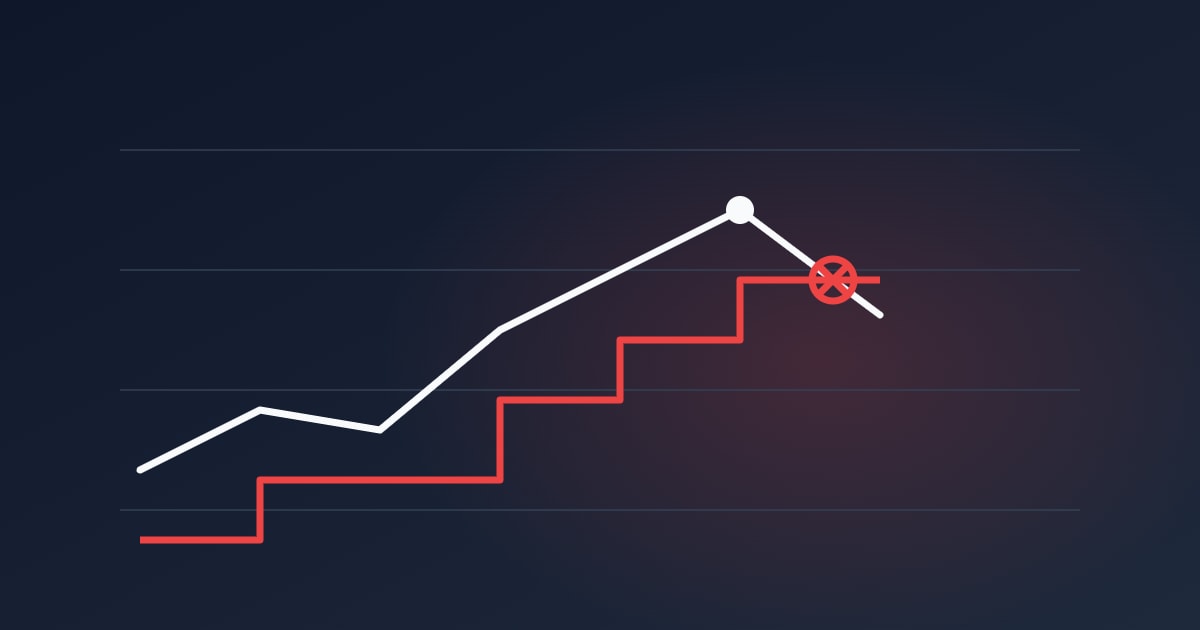
A static maximum loss is fixed the moment the account opens. Ten percent on a $100,000 account means the account dies at $90,000, and it means that on day one and on day two hundred.
The consequence is that profit buys you room. Grow the account to $110,000 and your floor is still $90,000, so you now have $20,000 of rope instead of $10,000. Every dollar you make widens the gap between you and the exit.
Trailing: the floor that follows you up
A trailing maximum loss is measured from your high-water mark rather than from your starting balance. Make a new high and the floor moves up behind it. On most firms it only ever moves up — it does not fall back when you give profit back.
That single difference changes the outcome of identical trading:

Both traders did exactly the same thing: took a $100,000 account to $110,000, then gave it all back. Under the static rule that trader is still trading, $10,000 clear of the floor. Under the trailing rule the account is closed at break-even, because the floor climbed to $100,000 behind the high and stayed there.
This is why trailing rules feel unfair to profitable traders specifically. A trader who never makes a new high is barely affected. A trader who runs the account up and then has a normal losing week is the one who gets stopped out — at a balance that would have been perfectly safe on day one.
There is a meaningful sub-distinction inside "trailing" that firms rarely put in the headline. Some trail on intraday equity, so an unrealised spike during a session ratchets the floor up permanently even if you close the trade flat. Others trail on end-of-day balance, which only ratchets on closed profit that survives to the daily close. End-of-day trailing is significantly kinder, and if a firm does not say which one it uses, assume the worse.
The daily limit is usually measured on equity, not balance
The second thing that catches people is not the size of the daily limit but its basis.
If the daily loss is measured on balance, only closed trades count and a floating loss is invisible to the rule. If it is measured on equity — which is the common case — then balance plus open profit and loss, minus swaps and commissions, is what is being watched, continuously. An open position that is deep in the red at 3pm can breach the limit without you ever clicking close.
FTMO states this explicitly, defining account equity for the rule as "Balance + Open Positions P/L ± Swaps – Commissions". Swaps matter more than people expect here: hold a position over a Wednesday rollover and the triple swap charge lands inside the equity calculation.
The reset clock is worth knowing too. FTMO recalculates at 00:00 CE(S)T, not at your local midnight and not at the broker's server time. A trader in Asia can start a session already partway into a limit that has not rolled over yet.
The same firm can use both
Here is the thing that makes "which prop firm has the best drawdown rules" the wrong question.
FTMO's 2-Step Challenge uses a static maximum loss — their own rules describe "a static limit (the Maximum Loss Limit) below which your account equity cannot drop", at 10% of initial capital, unchanged across both phases. FTMO's 1-Step product does not. There, the maximum loss "is recalculated daily at 00:00 CE(S)T" from "the highest account balance achieved at 00:00 CE(S)T of any preceding trading day", and the rules state plainly that the limit "can only increase, but never decrease".
Same firm. Same brand. Opposite rules, decided by which product you bought.
FundedNext splits the same way: its Stellar 2-Step, 1-Step and Lite accounts use a static maximum loss that locks to the initial balance, while Stellar Instant uses a 6% trailing drawdown.
The5ers makes the point most sharply of all, and not on the maximum loss — its floors are static across the board — but on the daily one. Hyper Growth and Pro Growth cut at the same 3%. On Hyper Growth that pauses trading for the rest of the session and the account survives to the next day. On Pro Growth the identical number terminates it. Same firm, same threshold, opposite consequence.
So the brand tells you very little. Read the objectives page for the specific product, and read it again if you switch plans.
What the firms in our rating actually do
| Firm | Product | Maximum loss | Daily limit |
|---|---|---|---|
| FTMO | 2-Step Challenge | Static, 10% of initial | Equity-based, resets 00:00 CE(S)T |
| FTMO | 1-Step | End-of-day trailing, 10%, rises only | Equity-based, 3% of initial |
| The5ers | High Stakes | Static, 10% of initial | 5%, from the higher of the previous day's close or balance |
| The5ers | Hyper Growth | 6% total loss | 3% — pauses the session, account survives |
| The5ers | Pro Growth | 6% total loss | 3% — terminates the account |
| FundedNext | Stellar 2-Step / 1-Step / Lite | Static, locked to initial balance | Equity-based, from start-of-day |
| FundedNext | Stellar Instant | Trailing, 6% | Equity-based |
Rules change, and a firm can revise them between the day this was written and the day you read it. Treat this as a map of the shapes to look for rather than as a substitute for the objectives page. Our prop firm ranking carries the current scores and what each one is scored on, and the individual reviews go deeper on the rest of the terms — FTMO and The5ers both have one.
The other rule that pauses a payout
Drawdown decides whether the account survives. Consistency rules decide whether the profit in it is payable, and they follow the same read-the-product pattern.
The5ers caps any single day at 50% of total profit and FundedNext at 40%. FTMO's version, the Best Day Rule, applies only to the 1-Step product and not to the 2-Step at all — and it is worth knowing that it is not a breach. Exceeding it pauses payout eligibility until further profitable days dilute the ratio back under the threshold, rather than closing the account. A rule that delays a payout and a rule that ends an account are frequently described with the same word, and they are not the same thing.
Which model to prefer
For most people, static. It is easier to reason about, it rewards profit instead of penalising it, and it means one good month does not quietly tighten the noose.
Trailing is not automatically a trap, though. It usually comes attached to a cheaper challenge, a faster route to funding, or an instant-funding product with no evaluation at all, and firms use it precisely because it caps their own exposure to a trader who spikes and fades. If you are taking that trade knowingly — small position sizes, no interest in running the account up before the first payout — a trailing floor may never bind on you at all.
What does not work is choosing a firm on the profit split, discovering the drawdown model afterwards, and finding out which kind it was during a drawdown. Position sizing is the other half of this, and it is the half you control: our guide to position sizing covers working backwards from the loss you can survive rather than forwards from the profit you want.
Bottom line
Three limits, one of which closes the account. The maximum loss is either fixed at your starting balance or it follows your high-water mark, and those two rules turn the same trading into a passed evaluation or a closed account. Check which one applies to the exact product you are buying — not to the firm — and check whether the daily limit watches your balance or your equity, because a floating loss counts against most of them.
Related
View category
WALLSTREET GOLD 2 Review: XAUUSD Copy Trading as a Staircase, Not a Spike
WALLSTREET GOLD 2 is one of the most-copied accounts in our CopyFX rating: a gold-only robot with a staircase record and a card whose drawdown figure understates its worst fall. The card never showed the account's first-year fall, and the trader's original account on the same robot has taken a fall this one has not. What the full record shows, what the fee really takes, and how to size it.
Read article →
What Is Leverage in Forex? Margin, Margin Call and Stop Out, One Chain
Leverage sets the margin, the margin sets the margin level, and the margin level is what a margin call and a stop out are measured on. One 1,000-dollar account carried through the whole chain, the levels each of the twenty brokers we rate publishes, and where negative balance protection applies.
Read article →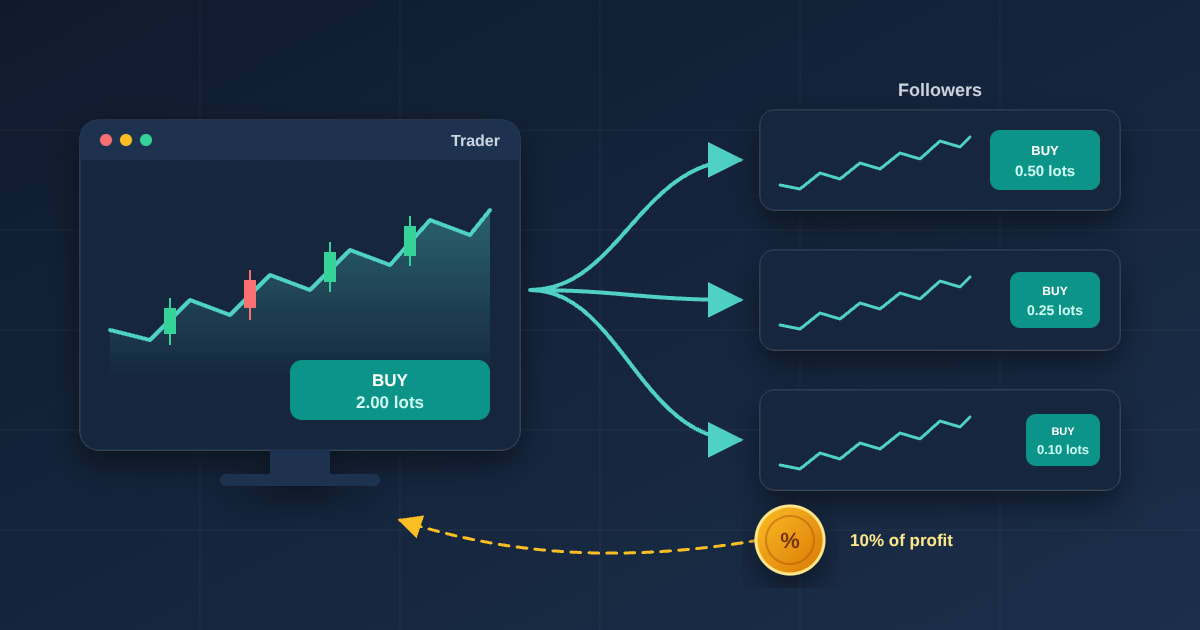
What Is Copy Trading and How It Works
Copy trading is a subscription that makes your account repeat another trader's trades, sized to your money, for a share of the profit. How a trade is copied and sized, what the fee actually charges on a forex broker and a crypto exchange, what the card shows and hides, and what our own data says the follower gets.
Read article →