
What Is Copy Trading and How It Works
Copy trading is a subscription that makes your account repeat another trader's trades, sized to your money, for a share of the profit. How a trade is copied and sized, what the fee actually charges on a forex broker and a crypto exchange, what the card shows and hides, and what our own data says the follower gets.
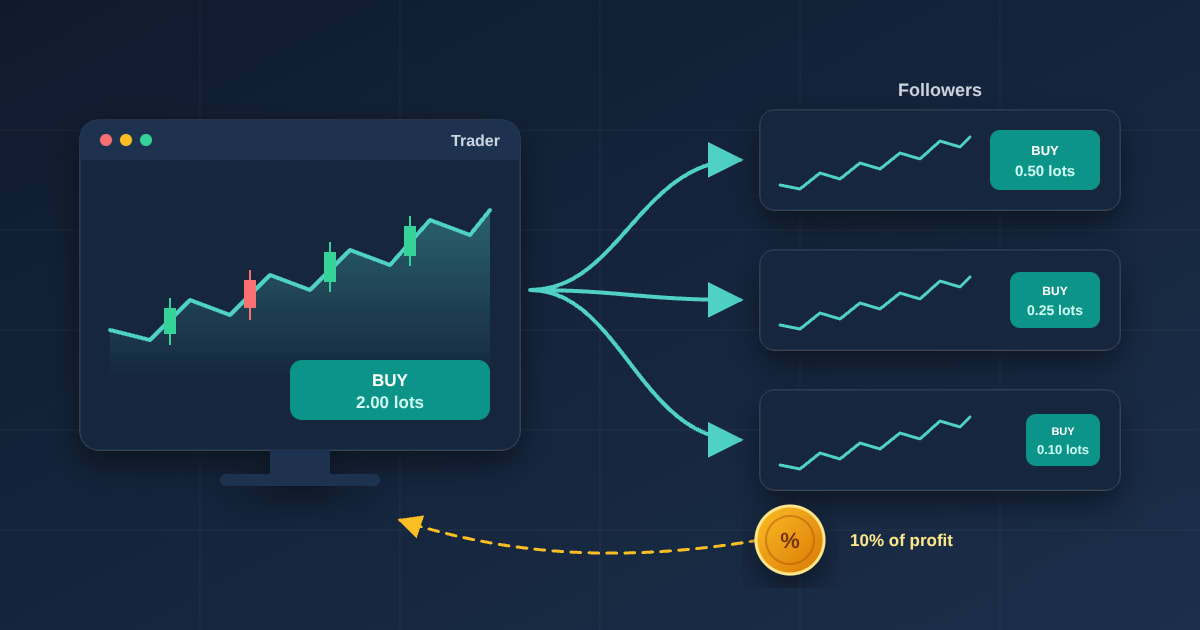
What is copy trading? A subscription that makes your trading account repeat, automatically and in a size that fits your money, every trade another person opens and closes on theirs. The trader keeps trading their own account. You keep your own account, your own balance and the right to stop at any moment. What connects the two is a rule that sizes each of their trades to your funds, and a fee that pays them a share of whatever profit their trades make you.
That is the whole idea, and it is worth holding onto, because most of what goes wrong in copy trading happens inside three phrases that do the work: "automatically", "in a size that fits" and "a share of profit". This page explains each of them on the two platforms we read every day, RoboForex's copy-trading service on the forex side and Bybit's on the crypto side, and then says what our own data shows the follower actually gets.
The three parties, and who owns what
A copy-trading arrangement has a trader, a follower and a platform. The trader (RoboForex's word; Bybit says "master trader") trades a real account of their own and publishes it: the return curve, a drawdown figure, how many people copy it, and the fee. The follower (the "investor", on RoboForex) subscribes. The platform sits between them, watches the trader's account for executed trades and reproduces each one on every subscriber's account, in the size that subscriber's settings produce.
Two things follow that beginners often get backwards. First, the money never moves. Your funds stay in your own account, in your own name, under the platform's normal withdrawal rules; on RoboForex you can withdraw at any time during an active subscription, with only the fee already earmarked for the trader held back until the next payout. A copy is not a fund you hand your money to. Second, the trader cannot touch your account. They cannot see it, place a trade on it or withdraw from it. What they can do is trade badly on theirs, and your account will follow.
That second point is the whole risk, in one line. The follower's outcome is the trader's outcome, scaled, minus the fee, plus whatever slips between the two accounts along the way. Nothing about a subscription limits the loss to what the trader's page suggested; the losing trades are copied exactly as faithfully as the winning ones. RoboForex's own help pages put it plainly: the investor chooses whom to follow and is fully responsible for the result, including any losses.
How does copy trading work, trade by trade
Copying works on executed trades, not intentions. When the trader's platform reports that a position has opened, changed or closed on their account, the copy engine reproduces that event on each subscriber's account. Pending orders sitting in the trader's terminal are not copied; only what actually executes is. Copying begins the moment the subscription becomes active: a position the trader opened yesterday is theirs alone, and you will only ever hold positions that opened after you joined. On RoboForex the copy runs inside the broker's own servers, so the delay between the trader's fill and yours is a fraction of a second; on Bybit the follower's order goes to the market as a market order, and a copy is skipped if the price has already moved further than a slippage limit, 0.5% to 1.5% by default depending on the contract.
Even so, two accounts never get exactly the same result, and both platforms say so. The follower's fill can be a tick worse than the trader's; the follower's account type can carry a different spread or commission; an instrument the trader can trade may not exist on the follower's account, in which case that trade is simply skipped; and the copied volume is rounded to the instrument's lot step, so a very small account can find some trades rounded down to nothing. The published return is the trader's, on the trader's account. Yours will rhyme with it, not equal it.
How the size is decided
The size rule is the setting that decides how much of the trader's risk you inherit, and it is the one most followers never open.

RoboForex offers three copying modes. In proportional mode the copied volume is the trader's volume scaled by the ratio of your equity to theirs, times a coefficient you set: the platform's own example is a trader with 8,000 USD opening 2 lots, and a follower with 2,000 USD and a coefficient of 1 receiving 0.5 lots. Your account then carries the same percentage risk per trade as the trader's, which is what most people assume copy trading does by default. In classic mode your equity is ignored and every trade is the trader's volume times a multiplier you choose; set 0.5 and that 2-lot trade arrives as 1 lot, on an account a quarter the size, which is four times the trader's risk. In fixed mode every trade arrives at one lot size you name, whatever the trader opened, so a cautious 0.05-lot trade and a reckless 5-lot trade land identically on your side. Cent accounts add a factor of a hundred to all of this, and what a cent account does to a copied position is a subject of its own.
Bybit's Copy Trading Classic has two modes, and the choice is locked for as long as the copy runs. Smart Copy takes the share of their balance the master put into an order and puts the same share of your investment into yours, with the master's leverage; Advanced Copy uses a fixed margin per order that you set, with leverage you choose, plus a stop-loss ratio per order, a daily position cap and a slippage limit. The minimum investment is 100 USDT unless the master requires more; on RoboForex the minimum is 100 USD or the trader's own higher figure. Both platforms let one account follow up to ten traders at once.
What is copy trading in forex
On the forex side, copy trading is usually a service the broker runs inside its own accounts, and that shapes everything about it. On RoboForex the trader's account and the follower's account are both ordinary trading accounts at the same broker, on the same platform: MT4 to MT4, MT5 to MT5 (hedge accounts only), R StocksTrader to R StocksTrader, and never across platforms. Any real account can subscribe except demo and netting accounts; the broker's own advice is to match the trader's account type, currency and leverage as closely as you can, because a different leverage changes the margin each copied trade needs, and a different account type changes the spread it pays.
What you copy is a leveraged CFD position measured in lots, so everything that applies to trading forex applies to copying it: swaps accrue on positions held overnight, a margin call closes positions on your account regardless of what the trader's account is doing, and a strategy that averages down on a grid looks smooth right up to the day it does not. Why a martingale copy-trading strategy looks safe until it isn't is the piece to read before the first subscription, because no leaderboard shows it.
Forex copy trading also has a quirk the crypto version lacks: the fee and the settlement period are set per strategy, so the same broker hosts strategies charging nothing and strategies charging half of profit, settling weekly or monthly, and the follower reads the terms on each card. Social trading, the older name from platforms that wrap copying in a feed, comments and a community, is the same mechanism with a social layer on top; the copying rules above are what matters, the feed is not.
This site covers this shape of copy trading through RoboForex, because it is the one platform whose strategies we can read one by one: our CopyFX rating re-reads every listed strategy off the platform each morning and scores it on its whole curve, not on the window the card prefers.
What is copy trading in crypto
On a crypto exchange, copy trading is a product of the exchange rather than of a broker, and on Bybit what gets copied is USDT perpetual futures: leveraged contracts on a coin's price, not the coin itself. That changes the risk more than the label suggests. A master running 20x leverage passes that leverage to a Smart Copy follower automatically; funding payments change hands at every funding interval on open positions; and liquidation is a fact of the follower's own account, decided by the follower's own margin and leverage settings, whatever the master's account is doing.
The follower's side is more configurable than on the forex platform and also more final. The copy mode cannot be changed without stopping and starting again; the investment can be raised or lowered; a trailing stop on your whole copy equity and a loss limit per master can both be set; and when you stop copying you choose between closing everything at market or holding the open positions until the master closes them, copying only their closing signals. Once every position is closed, the money goes back to your funding account.
The card on a crypto board is also a different object from the card on a forex one. Bybit publishes a card, not a curve: the ROI, the drawdown and the win rate are measured over the seven, thirty or ninety days shown, and there is no longer window, so a master who blew up four months ago and started again reads the same as one who never did. We have written how to read a Bybit leader card field by field. The one figure a crypto board publishes that a forex one does not is the followers' own pooled profit, and our Bybit copy-traders rating is scored on that rather than on the master's headline ROI, for a reason the section on the card explains.
The same shape, a leaderboard, a card, a copy mode and a profit share, exists on Binance, OKX and every other exchange that runs one, and at brokers such as XM, HFM or Vantage. The two above are the ones whose boards we read in full; the rules of thumb here carry across.
What it costs: the performance fee
Copy trading is nearly always paid for out of profit, which is the feature that makes it attractive and the one most worth understanding. On RoboForex the trader chooses a commission scheme: a performance fee of 5% to 50% of the profit their copied trades make you, or no commission at all; a flat subscription fee per period exists but is rare. On Bybit Classic the share is set by the master's rank, 10% for Cadet and Bronze, 12% for Silver, 15% for Gold, not by the master.
What separates the two is not the rate but the settlement rule, and the diagram shows why that matters more than it sounds.

RoboForex settles each strategy's fee at the end of an investment period the trader picks, one, two or four weeks, and applies a high-water mark: only profit above your previous highest cumulative result is charged. Its own example runs 100 in profit, then 150, then 140, at a 10% rate: 10, then 5 on the new 50, then nothing, because 140 is below the 150 already reached. The fee is reserved on your account as it accrues and paid to the trader on Monday at midnight server time, or within minutes if you unsubscribe. Bybit calculates the follower's net profit daily, pre-deducts the share, and settles every Monday at 03:00 UTC for the cycle that ran from Saturday to Friday; if the cycle ends in a net loss, the pre-deduction is refunded. But each cycle stands alone, so a losing week is not carried forward, and a recovery the following week is charged in full. On one path, up 100, down 50, up 50, the same 10% rate takes 10 under the watermark and 15 without it.
Two facts from our own reading of both fee books are worth carrying into any subscription. Our study of copy trading commission found no directional relationship between what a strategy charges and how it has performed, on more than five thousand RoboForex strategies and again on Bybit: a dearer trader is not a better one, so the fee is a price to pay, not a criterion to select by. And on the strategies most people copy, a 30% headline rate took a median 46.4% of the follower's whole gain over the strategy's longest exposure, not because of volatility but because profit settled out to the trader stops compounding for you.
What the card shows, and what it cannot
Every leaderboard card carries roughly the same fields: a return, a drawdown, the number of people copying, the age of the account, the fee. Two of them mean less than they look.
The drawdown on a RoboForex card is, in the platform's own glossary, the biggest drop between the account's equity and its balance: the deepest floating loss on a single occasion, not the deepest fall from a peak of the curve. We measured the difference across the strategies we rate and found the card's figure understating the fall a follower would actually have sat through by three to four times on several of them; the real fall lives in the "All" period of the yield chart, read peak to trough, and nowhere else. On Bybit the drawdown is measured inside the window shown and resets as the window moves, which is a different mechanism with the same effect.
The return is the trader's, on the trader's account, and on the forex side the follower's own result is not published at all. On Bybit it is, pooled across everyone who ever copied, and the pool's answer to is Bybit copy trading profitable disagrees with the master's card more often than intuition allows: on 12 September 2026, 249 of the 767 Bybit masters who were in profit over the previous ninety days had followers who, pooled, were in loss. Does copy trading work is the question we put to both platforms with that gap in mind, and the short answer is that the follower's odds run behind the trader's on both, by an amount that depends mostly on when you joined and how far the curve had already fallen.
The number of people copying is the most honest field on the card, and also the one that changes fastest: on RoboForex a subscription is a seat, not money, and a thousand seats can sit on a strategy whose operator has already abandoned an older account. Our count of every strategy on the CopyFX list found that on 11 September 2026 one new strategy in five registered since August belonged to an operator whose earlier account had already lost half or worse, and 36.6% of listed strategies were below zero over their whole life. A rating page can only remove the ones it can see.
Copy trading in a prop firm
The phrase turns up in a different sense inside funded-trader programmes. There, "copy trading" usually means a trade copier that mirrors your own trades from one account to another, from a personal account onto a funded one or across several challenge accounts at once, and firms treat it very differently from copying a stranger. Most permit copying between accounts you own and prohibit copying signals from anyone else's account or from a commercial service, and several cap how many accounts one copier may drive. The rules are the firm's, they are written into the agreement, and breaking them forfeits the account. Read that clause before the first copied trade; the drawdown rules those accounts live under are stricter than anything a copy-trading platform enforces on a retail account, and a copier that fires on the wrong account can breach them in a day.
Is copy trading legal, safe, or a good idea for a beginner
Copy trading is legal wherever the underlying product is. It is a retail CFD or derivatives account with automation attached, so it is available exactly where such accounts are. RoboForex does not accept clients from the EU, the EEA, the UK, the United States, Canada, Japan, Australia or Brazil, among others; Bybit has restricted its global exchange, and with it copy trading, for residents of the EEA since 1 July 2026, because its EU entity is spot-only under MiCA. Whether a platform will open an account for you at all is the first check, before any card.
Safe is the wrong word, but the risk has a specific shape. It is leveraged trading whose decisions are made by someone else, and its worst case is the trader's worst case, scaled to your account and multiplied by any size setting you got wrong. Nothing in the fee protects you: a performance fee is charged on profit, and the losses are entirely yours. What protects you is the same thing that protects any trader, the size of the position relative to the account, and in copy trading that lives in the copy mode and in how much you put into one strategy, sized against the fall the curve has already shown rather than the drawdown on the card.
For a beginner it is the easiest way to hold a trading position with no trading skill, which is both the point and the problem: the follower inherits the leverage, the instrument and the risk appetite of a person they have never met, from a card that shows the return and hides the fall. If you are going to do it anyway, how to choose a good copy trader is the test we ran on our own data, and its finding is the right expectation to start with. The checks a follower can make on the day they join barely change the odds of a profitable quarter, 59.7% against 58.5% on the RoboForex curves, but they cut the share of copies that lost half or more from 3.1% to 0.1%. Choosing well does not find the winners. It removes the disasters, and that is worth doing.
The scoring rules behind both ratings, including why the CopyFX score reads the whole curve and the Bybit score reads the followers' pool, are on the methodology page.
Related
View category
How to Choose a Good Copy Trader: Four Checks, Scored on the Day You Would Have Made Them
Every guide lists the same checks - track record, drawdown, return, followers, fee. We scored them on 748,826 entry days across every followed RoboForex strategy, classed by what the card showed that morning, and on Bybit's published follower pools. The checks barely move the odds of a winning quarter; they shrink the losing one.
Read article →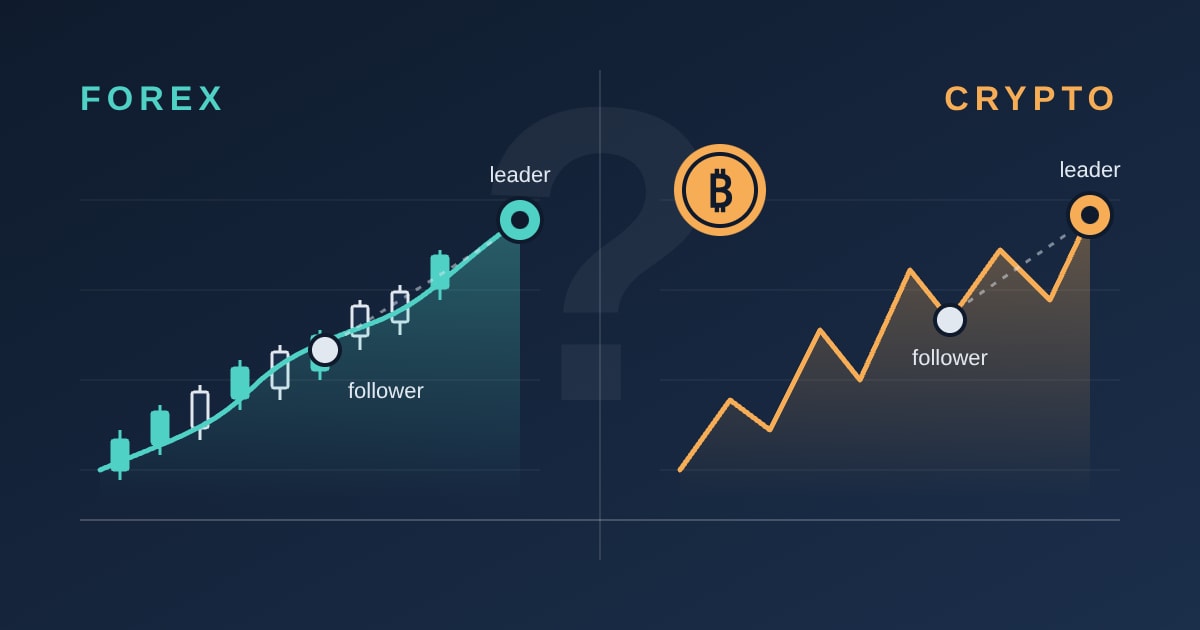
Does Copy Trading Work? The Same Question Measured on a Forex and a Crypto Platform
Broker pages answer whether copy trading works with one leader's chart. We asked the follower's version of the question on two platforms: every RoboForex copy-trading strategy with a follower, every day a copy could have started, the fee settled the way the platform settles it - and every Bybit leader with a follower, where the platform itself publishes what the copiers made.
Read article →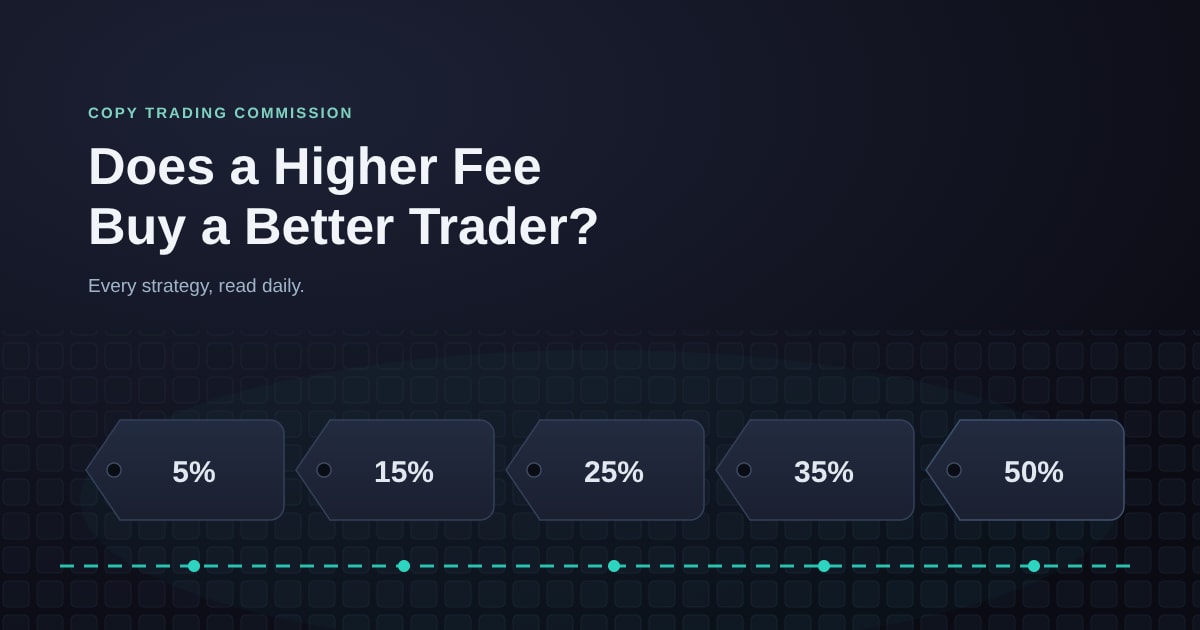
Copy Trading Commission: Does a Higher Fee Buy a Better Trader?
The fee tables explain what a copy trading commission is. None of them say whether it buys anything. We read the fee and the record of every strategy on one platform, the daily curve of the hundred most-followed, and every leader with a follower on another: what the rate predicts, what it does not, and how much more than the headline number it actually costs.
Read article →